
Parts of a Biogas Plant: A Complete Guide to System Components
An anaerobic digestion facility is an integrated network of specialized mechanical, civil, and biological sub-systems. From the moment organic waste arrives on-site until it is converted into clean renewable energy and bio-fertilizer, every component plays a critical operational role.
Understanding the individual parts of a biogas plant is essential for engineers, project developers, and facility operators seeking to maximize structural integrity, optimize biological efficiency, and ensure long-term plant safety.
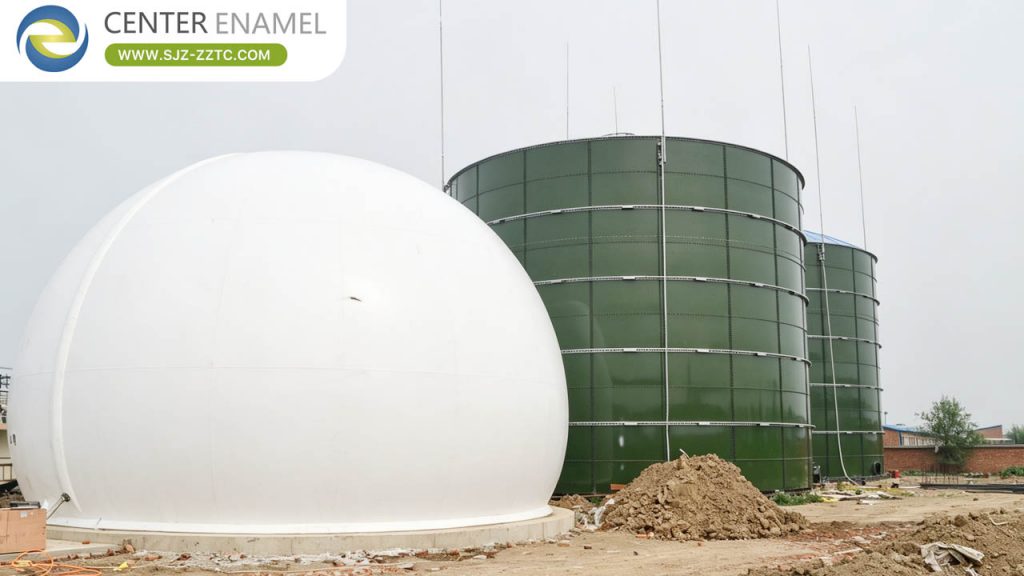
1. Feedstock Reception and Pre-Treatment Unit
The front-end of the facility manages the collection, sorting, and preparation of organic materials—such as agricultural slurry, food waste, or industrial sludge.
- Reception Pit / Mixing Tank: Collects raw biomass and blends it with water or recirculated liquid to achieve the optimal total solids (TS) concentration.
- Macerators and Shredders: Mechanical equipment designed to reduce particle size, eliminate contaminants, and increase the surface area available for bacterial breakdown.
- Inlet Pipe: Channels the homogenized slurry directly into the core reactor below the fluid level to maintain an airtight, oxygen-free seal.
2. The Anaerobic Digester (Fermenter / Bioreactor)
The digester is the centerpiece of the entire installation—a sealed, heated tank where anaerobic microorganisms break down organic matter in the absence of oxygen.
- Reactor Tank Body: Built using reinforced concrete or advanced bolted Glass-Fused-to-Steel (GFS) panels engineered to resist corrosive organic acids.
- Internal Agitation / Mixing Systems: Submersible or vertical mixers that prevent scum crust formation, eliminate dead zones, and maintain uniform contact between bacteria and nutrients.
- Thermal Heating System: Hot-water heat exchangers that sustain optimal mesophilic (35°C to 37°C) or thermophilic (50°C to 55°C) bacterial temperatures.
3. Biogas Collection and Storage System (Gasholder)
As biological digestion takes place, the resulting gas accumulates in the upper headspace or specialized storage structures.
- Gasholder Roof / Bladder: Double-membrane roofs or independent storage bladders that buffer daily production fluctuations and maintain steady gas delivery pressure.
- Piping and Condensate Traps: Corrosion-resistant gas lines paired with automated moisture traps to remove water vapor condensing out of the raw fuel.
- Safety Equipment: Essential safety devices including flame arrestors, pressure relief valves, and vacuum breakers to protect structural integrity.
4. Gas Treatment and Upgrading Unit
Raw biogas contains trace impurities that must be stripped away before utilization:
- Desulfurization System: Biological or chemical scrubbers that remove corrosive hydrogen sulfide (H₂S) to protect downstream equipment.
- Gas Upgrading Skid (Optional): Membrane separation or pressure swing adsorption (PSA) units that remove carbon dioxide (CO₂) to produce high-purity biomethane for grid injection.
5. Combined Heat and Power (CHP) Unit
- Cogeneration Engine: A specialized gas engine that burns raw biogas to generate electricity while capturing waste heat to warm the digester tanks.
6. Digestate Storage and Outlet System
- Outlet Pipe and Separator: Channels fully processed slurry out of the reactor, often passing through a screw press or decanter centrifuge to separate solid and liquid fractions.
- Digestate Storage Tank: Covered secondary containment structures holding the pathogen-free bio-fertilizer until field application.
Comparative Data Table: Biogas Plant Components & Functions
| Plant Component | Primary Physical Structure | Core Operational Role | Material / Engineering Standard |
| Reception & Inlet | Mixing pits, pumps, shredders | Prepares and feeds homogenous organic slurry | Stainless steel & heavy-duty concrete |
| Anaerobic Digester | GFS bolted tank or concrete basin | Houses anaerobic microbes and drives digestion | Glass-Fused-to-Steel or reinforced concrete |
| Gasholder | Double membrane roof or bladder | Captures and buffers biogas storage safely | UV-resistant PVC-coated polyester |
| Gas Treatment Unit | Biological filters / scrubbers | Removes corrosive H₂S and moisture | Active carbon beds & condensate drains |
| CHP Generator | Cogeneration gas engine unit | Converts biogas into electricity and usable heat | Industrial combustion engine & alternator |
| Digestate Storage | Covered secondary tank / lagoon | Stores nutrient-rich bio-fertilizer by-products | Reinforced concrete or GFS containment |
Frequently Asked Questions (FAQ)
Q1: What is the most critical part of a biogas plant?
A: The anaerobic digester (fermenter) is the core component of the facility. It provides the strictly oxygen-free, temperature-controlled environment where specialized microorganisms break down organic waste to produce biogas.
Q2: Why are moisture traps and desulfurization systems necessary?
A: Raw biogas contains water vapor and corrosive hydrogen sulfide (H₂S). Condensation traps prevent pipeline blockages, while desulfurization systems protect downstream combined heat and power (CHP) engines from severe chemical corrosion and mechanical wear.
Q3: What happens to the material left over after biogas extraction?
A: The remaining byproduct, known as digestate, is transferred to covered secondary storage tanks. Because it is rich in bioavailable nitrogen, phosphorus, and potassium, it is utilized safely as a high-grade organic fertilizer in agriculture.