
Straw Biogas Plant: Engineering Agricultural Crop Residues into Clean Renewable Energy
Agricultural activities worldwide generate hundreds of millions of tons of crop residues—including wheat, corn, rice, and barley straw—each year. Historically, unmanaged disposal methods like open-field burning or surface rotting have contributed heavily to air pollution and fugitive greenhouse gas emissions.
Constructing a commercial straw biogas plant transforms these abundant agricultural by-products into a high-value renewable energy resource. Through advanced anaerobic digestion (AD) and robust engineering infrastructure, crop residues are converted into clean baseload power, heat, biomethane, and high-grade organic bio-fertilizer.
The Technical Challenges of Straw as a Biogas Feedstock
While straw is an enormous reservoir of organic carbon, its unique chemical and physical properties require specialized engineering and operational strategies:
- Lignocellulosic Complexity: Straw contains tough, fibrous polymers (cellulose, hemicellulose, and lignin) that are difficult for standard anaerobic microbes to hydrolyze quickly. Without proper pre-treatment, raw straw yields slow, inefficient gas production.
- High Buoyancy and Scum Formation: Because of its fibrous, lightweight structure, untreated straw naturally floats to the top of liquid digester tanks, creating a dense crust layer that clogs internal mixers and reduces active reactor volume.
- Nutrient Imbalance (High C:N Ratio): Straw is heavily carbon-rich, boasting a Carbon-to-Nitrogen ratio often exceeding 50:1. Digesting straw alone results in nitrogen starvation for the microbial community, causing the biological process to stall.
Key Engineering Systems of a Modern Straw Biogas Plant
Successful industrial straw biogas facilities rely on an integrated, multi-stage engineering workflow to overcome these natural hurdles:
- Front-End Mechanical Pre-Treatment: Raw straw is shredded, chopped (typically to 10–30 mm), or ensiled to disrupt the lignocellulosic matrix and increase the surface area exposed to bacterial enzymes.
- Co-Digestion Integration: To resolve nutrient imbalances, straw is rarely digested alone. Facilities utilize co-digestion, blending carbon-rich straw with nitrogen-buffered substrates such as livestock manure, food waste, or industrial organic wastewater to achieve the optimal C:N ratio of 20:1 to 30:1.
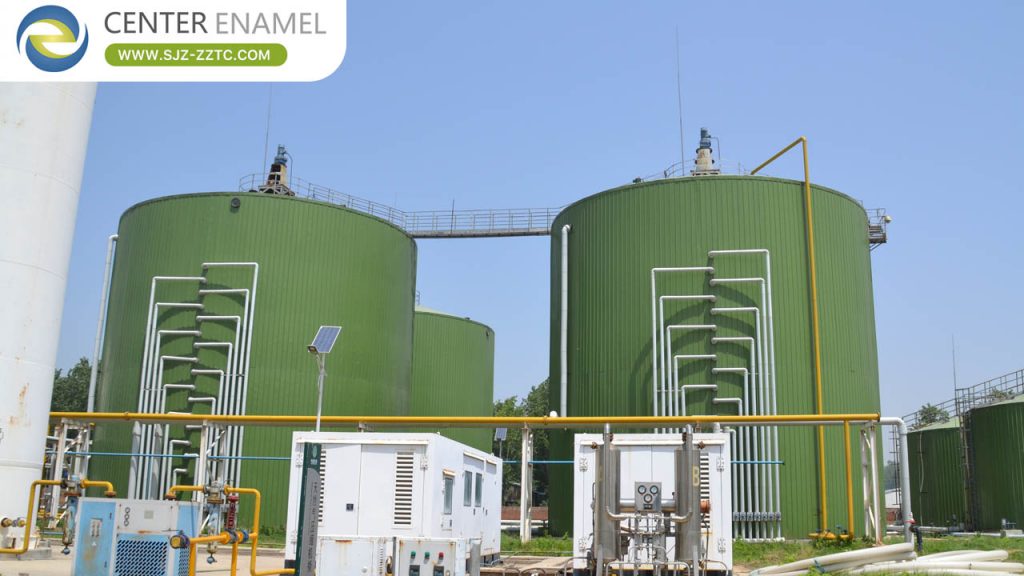
- Industrial-Grade Bioreactor Containment: High-integrity containment systems—such as Glass-Fused-to-Steel (GFS) bolted tanks or reinforced concrete structures equipped with powerful vertical mixers and double-membrane gas holders—ensure long-term, corrosion-resistant operation under rigorous biological conditions.
- Gas Purification and Upgrading: Raw biogas undergoes biological desulfurization, moisture removal, and decarbonization to isolate high-purity methane for Combined Heat and Power (CHP) generation or grid-injected biomethane (Renewable Natural Gas).
Comparative Data Table: Straw Biogas Plant Configurations
| Operational Parameter | Dry Batch Straw System | Silage Straw Wet CSTR Plant | Co-Digested Straw + Manure Plant |
| Feedstock State | High-solid stackable straw (25%–40% TS) | Ensiled, pre-softened straw slurry | Blended straw and liquid livestock manure |
| Digester Technology | Garage-type batch anaerobic reactors | Continuous Stirred-Tank Reactors (CSTR) | Advanced CSTR with solid-feeding units |
| Primary Advantage | Minimal water dilution required; handles bulky biomass | Pre-softened lignin speeds up hydrolysis | Perfectly balanced C:N ratio; maximum stability |
| Primary Challenge | Slower gas kinetics; intensive batch handling | Requires robust mixing to prevent floating crusts | Requires precise feedstock metering |
Frequently Asked Questions (FAQ)
Q1: Can a biogas plant run entirely on agricultural straw without other materials?
A: No. Straw has an excessively high Carbon-to-Nitrogen ratio (>50:1) and lacks the moisture, mineral trace elements, and nitrogen required to sustain an active anaerobic microbial community. Digesting straw as a standalone feedstock leads to nitrogen starvation and process failure; it must be co-digested with nitrogen-rich substrates like manure or food waste.
Q2: How do straw biogas plants prevent the straw from floating and forming surface crusts?
A: Facilities prevent crusting through a combination of mechanical pre-treatment (chopping straw into small 10–30 mm fragments), ensiling to pre-soften the fibers, and equipping digester tanks with heavy-duty vertical or submersible mechanical agitators that maintain continuous suspension within the liquid slurry.
Q3: What are the primary outputs generated by an industrial straw biogas plant?
A: A commercial straw biogas plant generates three primary outputs: 1) Purified biogas or biomethane used for electricity, heating, or vehicle fuel; 2) Thermal energy recovered from CHP engine cooling; and 3) Nutrient-rich organic digestate, which is processed into high-grade agricultural bio-fertilizer.