
What Makes a Reliable Dairy Wastewater Treatment Project EPC Contractor? GFS Tanks, Process Depth and Single-Chain Delivery
Dairy effluent punishes any plant designed around averages. COD can swing from 2,000 mg/L to beyond 30,000 mg/L inside a single cleaning cycle, fat clings to every pipe surface, and protein degrades into ammonia nitrogen. A dairy wastewater treatment project EPC contractor therefore has to design for the worst hour rather than the mean day, and then defend that design for decades. This article connects the industry pressures behind that brief with real effluent data, IC reactor mechanics, GFS tanks and a 2024 Nordic reference.
The Three Highs Still Define Industrial Wastewater
Industrial wastewater is still framed as three highs: high difficulty, high cost and high energy consumption. New energy, chemical and pharmaceutical streams are complex in composition, carry characteristic pollutants that conventional processes struggle to remove, and face ever stricter discharge standards; Chinese suppliers hold a clear price advantage in the mid-to-low-end equipment segment, though price rarely survives an inspection. Digitalization and low-carbon targets add further pressure on operational refinement, which is why owners increasingly prefer one accountable partner to five separate suppliers. Dairy concentrates every one of those pressures into a single, highly biodegradable but violently fluctuating stream.
Reading Dairy Effluent Before Drawing a Single Tank
Design starts with the water, not the tank. Dairy wastewater carries high COD, high oil and grease, high protein and high nitrogen and phosphorus, yet remains readily decomposable, BOD/COD typically sitting between 0.5 and 0.7, which makes it one of the most treatable food-processing streams when the load is buffered properly. The complications are physical: lactose, milk proteins and milk fats sour quickly if left standing, fat adheres and scales on equipment, protein decay raises ammonia nitrogen, pH drifts from slightly acidic toward neutral as lactic acid forms, and temperature stays moderate at 20 to 40°C. Discharge tracks CIP cycles, so flow and strength arrive in pulses.
| Parameter | Typical dairy value | Design implication |
| COD | 2,000-15,000 mg/L, CIP peaks above 30,000 | Equalization volume and anaerobic capacity |
| Oil and grease | 2,000-5,000 mg/L | Pre-separation to prevent scaling and scum |
| BOD/COD ratio | 0.5-0.7 | Strong case for anaerobic treatment |
| Ammonia nitrogen | High, from protein breakdown | Nutrient management and polishing |
| pH | Slightly acidic to neutral | Neutralization and alkalinity control |
| Temperature | 20-40°C | Mesophilic operation without major heating |
Inside the IC Reaction: Circulation Replaces Brute Force
Pretreated high-strength wastewater enters the lower main reaction zone from the bottom and mixes with the recirculated sludge-water mixture, rising fast. Anaerobic microorganisms degrade organic matter and produce large volumes of biogas, whose gas-lift action carries the mixed liquor upward to a top gas-liquid separator where the gas is collected. Degassed liquor returns by gravity through downcomers to the bottom, creating autonomous internal circulation that repeats the degradation cycle. After several passes the wastewater enters the upper polishing zone for further reaction and sludge-water separation; residual organics are consumed, sludge settles back to the reaction zone, treated effluent overflows, and aged sludge is discharged periodically. No external return pump, continuous operation.
Why GFS Tanks Hold Up Where Concrete Does Not
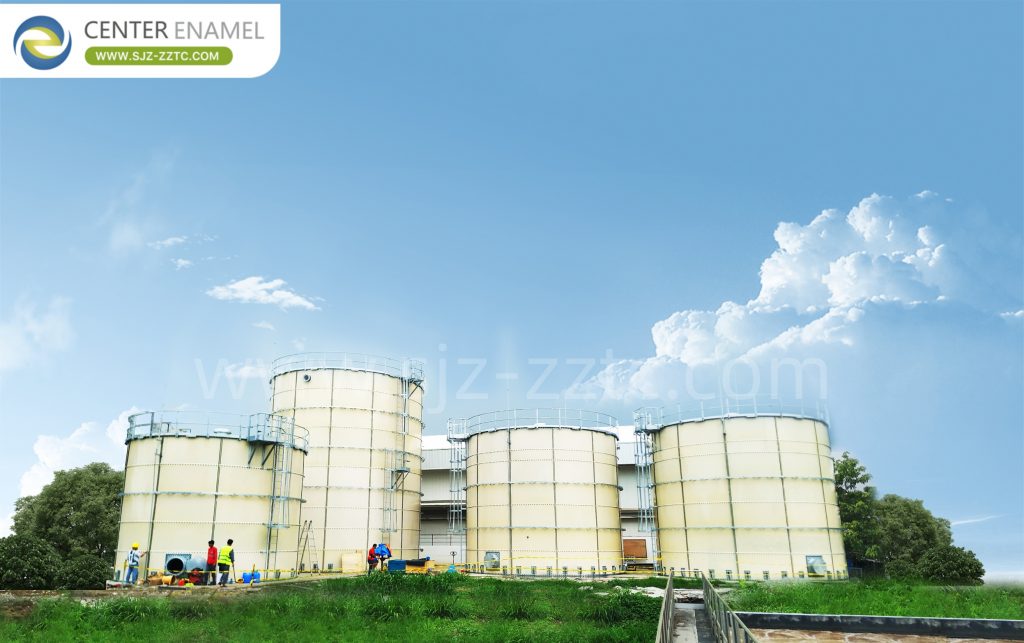
All of that biology lives inside a shell, and the shell decides maintenance cost. Concrete interiors are riddled with pores that let wastewater and acid or alkaline media penetrate into the structural layer; the result is irreversible spalling, seepage and rebar corrosion that patching cannot solve. GFS tanks are enamelled at high temperature on both the interior and exterior of every steel panel, producing a dense, non-porous finish that blocks corrosive liquid and biogas permeation, with chemical stability against acids, alkalis, salts and microbial attack. Concrete typically shows heavy corrosion and leakage after five to eight years, while GFS tank anti-corrosion life exceeds 30 years with no internal relining, eliminating the risk of contaminating groundwater and site soil and handling POME, livestock manure and high-salinity chemical wastewater without peeling or blistering.
A Nordic Case: The 2024 Sweden Biogas Plant
Cold climates test those claims quickly. In 2024 Center Enamel delivered an organic waste biogas project in Sweden using the UASB anaerobic process with GFS tanks as the main reaction equipment. Each fermentation tank measures 19.11 m in diameter and 19.2 m in height, built to resist acid, alkali and low-temperature corrosion under Nordic fermentation conditions, with the UASB retaining granular sludge and degrading organics into steady biogas. Fast assembly and 30-year corrosion protection made the configuration a fit for the cold, and the plant now combines harmless organic waste treatment with clean energy recovery.
| Project parameter | Detail |
| Location and year | Sweden, 2024 |
| Process | UASB anaerobic treatment |
| Main equipment | Center Enamel GFS tanks |
| Tank size | 19.11 m diameter, 19.2 m height |
| Design challenge | Acid, alkali and low-temperature corrosion |
| Corrosion protection | 30-year service life |
| Outcome | Harmless waste treatment plus biogas recovery |
Design Decisions That Start with the Site
A tank that ignores its site is a liability. Center Enamel's design team includes senior engineers registered in the Hebei Provincial Science and Technology Expert Database, working to European and American high-end equipment safety standards. Before drawing, the team investigates seismic zone, wind pressure, soil bearing capacity, water corrosivity and local discharge limits, then applies thickened panels, reinforced anchored bases and optimized sealing and corrosion structures as required. The same group produces integrated designs for livestock biogas, POME, municipal wastewater, hazardous waste storage and seawater desalination, covering tank structure, anti-corrosion and sealing systems, biogas piping and anaerobic process integration, and scales the package to plot area, load, treatment target and budget.
One Chain from Enamel Frit to Commissioning
Design quality means little if it fragments across suppliers. Center Enamel is the only company globally integrating proprietary enamel frit research, self-manufactured tanks and EPC general contracting, controlling the full process from solution design and equipment production through cross-border logistics, overseas construction and post-construction O&M. For a dairy wastewater treatment project, an EPC contractor that owns frit, fabrication, logistics and installation removes the coordination cost and schedule risk that appear when a designer, a fabricator and an installer each answer to a different contract.
Choosing a Dairy Wastewater Treatment Project EPC Contractor
Selection comes down to three tests. First, does the contractor read your actual cleaning cycle and effluent analysis, or recycle a generic diagram? Second, can it prove corrosion performance under your specific chemistry, with formulations and service records rather than a warranty sentence? Third, does it control fabrication, logistics, installation and commissioning itself, so accountability does not dissolve at a border? A dairy wastewater treatment project EPC contractor that passes all three shortens the path from permit to stable operation, and keeps the plant inside its cost envelope long after handover.
Frequently Asked Questions
What COD range can a dairy wastewater treatment project handle?
Typical dairy effluent runs 2,000-15,000 mg/L, with CIP peaks above 30,000 mg/L. Equalization smooths the pulses, anaerobic treatment removes most of the load and produces biogas, and aerobic polishing handles the remainder. Because BOD/COD sits at 0.5-0.7, performance is predictable once buffering is sized correctly, though ammonia nitrogen from protein breakdown usually shapes the polishing stage more than COD does.
How long do GFS tanks last in corrosive service?
Enamelled inside and outside at high temperature, they carry a design corrosion life beyond 30 years, against five to eight years before concrete shows spalling and leakage. No relining is needed, and the finish resists acids, alkalis, salts and biogas permeation. Panels arrive factory finished, so there is no field-applied lining to inspect, repair or fail.
What does an EPC contractor cover on an overseas dairy project?
Design, tank manufacturing, cross-border logistics, installation, commissioning, operator training and after-sales support, all from one contract, with site-specific seismic, wind and soil data built into the structure. The same team answers the performance question in year three, not only the handover question in week one.
Send your effluent analysis, CIP schedule and discharge limits, and we will return a sized process train, tank schedule and budget you can defend internally. Talk to Center Enamel today about a dairy plant built for the worst hour, not the average day.