
Why A²O Process Technology Still Wins in Municipal Sewage Treatment
Municipal sewage treatment capacity keeps expanding worldwide, yet capacity alone no longer decides whether a plant succeeds. Effluent limits are tighter, energy and maintenance budgets are scrutinized, and equipment has to last through decades of service. The A²O process technology handles the biological side of that equation, removing carbon, nitrogen and phosphorus in a single train, while glass-fused-to-steel tankage and disciplined installation handle the physical side.
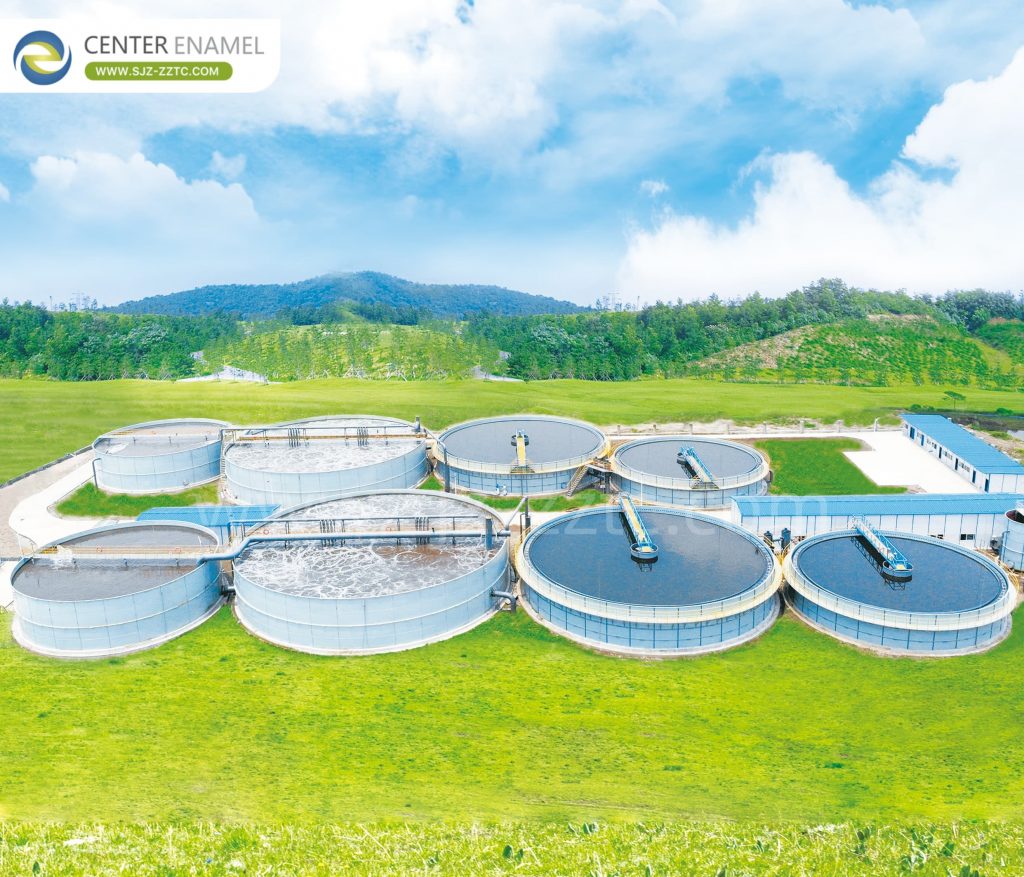
A Growing Market, Uneven Priorities
Global municipal wastewater treatment capacity continues to grow, with the Asia-Pacific region contributing the major share. China's urban wastewater treatment rate remains high, though pipeline coverage and quality enhancement still have room to improve. Developing countries concentrate on infrastructure expansion, while developed countries shift toward upgrading and equipment replacement. China's reclaimed water utilization rate is rising steadily, and rural decentralized treatment facilities are gaining penetration quickly on the back of policy support. Southeast Asia, the Middle East and Africa are major destinations for Chinese wastewater treatment equipment exports, and Chinese equipment market share keeps climbing in emerging markets. The priorities differ, but the technical target does not: every plant still has to deliver stable nutrient removal at a predictable cost. Capacity figures look impressive on paper; the real measure is effluent quality per unit of energy spent.
A²O Process Technology: Three Jobs in One Pass
In municipal sewage treatment, the A²O process technology completes organic degradation, nitrogen removal and phosphorus removal simultaneously, the three core functions that decide municipal effluent quality. Zones are clearly separated and well defined, operating principles are simple, and the technology is mature, backed by complete commissioning and O&M systems with an extremely low failure rate. No large quantities of complex chemicals are needed; microbial metabolism does the degradation work, which keeps operating costs low and avoids secondary pollution. Sludge return and nitrate recycle designs maintain stable bacterial populations, giving the process good resistance to water quality and hydraulic shocks. Effluent can stably meet China's Class IA discharge standard for municipal wastewater, capital investment is moderate, and the configuration suits large-scale municipal projects.
| Function | Mechanism | Result |
| Organics | Microbial degradation, no chemical dosing | Low operating cost |
| Nitrogen | Nitrate recycle to anoxic zone | Stable denitrification |
| Phosphorus | Release and uptake by phosphorus-accumulating organisms | Reliable P removal |
| Solids | Secondary clarifier separation | Class IA effluent |
A Load With Little Toxicity, Plenty of Risk
Stable effluent also depends on what arrives at the gate. Municipal sewage carries the lowest environmental toxicity of the five wastewater types, and its ecological risk stays controllable. Pollutants are natural organics, conventional nitrogen and phosphorus, and suspended impurities, with no synthetic toxins, heavy metals, bacteriostats or persistent pollutants, so there is no inhibition or toxicity to biochemical bacteria or aquatic organisms. Only small amounts of bacteria and viruses from human waste are present, and standard disinfection eliminates them, leaving no biosafety risk. Compliant discharge does not harm soil or aquatic ecosystems. Only long-term excessive accumulation can trigger eutrophication and black-odor conditions; there is no acute toxicity, chronic accumulation or carcinogenic, teratogenic and mutagenic risk. Because the danger is cumulative rather than immediate, compliance cannot be treated as a seasonal exercise, and that is exactly why process stability matters more than peak performance.
Where Concrete Fails, Enamel Holds
Stability depends on the vessel as much as the biology. Concrete tank interiors are riddled with pores, allowing wastewater and acid or alkaline media to penetrate and corrode the structural layer. Long-term use brings irreversible internal wall spalling, water seepage and rebar corrosion, problems that are difficult to repair and cannot be fundamentally resolved. Center Enamel's independently developed double-sided, double-layer enameling technology applies high-temperature enamel to both the interior and exterior surfaces of steel panels, producing a dense, non-porous finish that blocks corrosive liquids and biogas permeation. The enamel layer is chemically stable against acids, alkalis, salts and microbial corrosion. Concrete tanks develop extensive corrosion and leakage after five to eight years, while GFS tank anti-corrosion service life exceeds 30 years, with no frequent internal lining repairs and no route for leaked medium to contaminate the site or groundwater. Coatings carry no risk of peeling or blistering, and they adapt to aggressive duties such as palm oil mill effluent, livestock manure and high-salinity chemical wastewater, which keeps whole-life cost predictable.
The Material Science Behind the 30-Year Claim
That performance is not a coating bought off a shelf. Center Enamel independently masters more than 200 differentiated anti-corrosion enamel formulations, controls the full enamel raw material chain, and holds nearly 100 invention and utility patents. Products carry NSF, WRAS, ASME, BSCI, CE and ISO9001 certifications. Corporate credentials include National High-Tech Enterprise, National Specialized and Sophisticated Little Giant, Hebei Manufacturing Single Champion, Provincial Smart Factory and Provincial Green Factory, alongside complete environmental engineering and special equipment manufacturing qualifications. Joint materials laboratories with multiple universities keep iterating coating chemistry and large bolted tank structural design, and the resulting material barrier puts product performance on par with high-end imported European and American storage equipment.
| Item | Figure |
| Enamel formulations | 200+ differentiated |
| Patents | Nearly 100 |
| Certifications | NSF, WRAS, ASME, BSCI, CE, ISO9001 |
| GFS tank projects | 10,000+ worldwide |
Crews With Ten Thousand Projects Behind Them
Even the best panel specification fails without installation discipline. The installation team brings practical experience from more than 10,000 GFS tank projects worldwide and follows standardized construction procedures, with full control over mobilization, civil coordination, tank assembly, piping and commissioning schedules and quality. Crews are proficient in complete standardized installation for GFS tanks, dual-membrane gas storage covers, USR, CSTR and IC anaerobic reactors, and biogas desulfurization and piping systems. They work across large farms, industrial parks, remote mountainous sites and coastal high-corrosion locations, applying unified global safety standards. On large overseas projects, teams deploy as complete units for site construction, technical training and hands-on instruction of local workers, keeping control of air-tightness testing, corrosion protection and start-up.
Covers That Hold Gas, Odor and Weather
Above the tank, the aluminum geodesic dome roof closes the loop. Center Enamel's roof is stamped from high-strength aluminum alloy into a triangular grid, spherical, self-supporting structure that spans large diameters without internal support columns. Aluminum construction resists acid rain, salt spray and UV radiation, and the design complies with AWWA D108, with plate thickness, rib sections and joint connections verified by finite element stress analysis against regional wind and snow loads. Weight is only one-third to one-half of a steel roof at the same span, so it can be installed without reinforcing the tank wall. Double sealing between panels, using specialized sealant strips and mechanical interlocking, delivers both airtight gas storage and enclosed odor control, which suits biogas collection, wastewater tank odor containment and drinking water protection. The column-free interior leaves mixers and water distributors unobstructed, and aluminum does not support microbial growth, so long-term maintenance stays minimal. Specified early, a cover costs far less than retrofitting one after commissioning.
| Feature | Specification |
| Structure | Triangular grid, spherical, self-supporting |
| Standard | AWWA D108 |
| Weight | One-third to one-half of steel roof |
| Sealing | Double sealant strip, mechanical interlock |
| Installation | No tank wall reinforcement required |
What Buyers Ask Before Tender
How does A²O process technology compare with MBR on lifecycle cost?
A²O relies on microbial metabolism rather than large chemical doses and membrane replacement, so operating cost stays low and capital investment is moderate, while MBR trades higher energy and maintenance for a smaller footprint and sharper effluent. The right choice depends on land, discharge limits and operating budget.
Is municipal sewage toxic to the biomass?
No. The load is natural organics with conventional nutrients, no heavy metals or synthetic toxins, and BOD/COD above 0.45 makes degradation straightforward. The real risk is cumulative nutrient discharge, not process inhibition.
Why choose glass-fused-to-steel tanks over concrete for municipal sewage treatment projects?
The enamel surface is non-porous and chemically stable, with a service life beyond 30 years against five to eight years for concrete in corrosive service. Faster assembly and fewer lining repairs shorten schedules and cut whole-life cost.
If you are preparing a municipal sewage treatment tender, send us your design flow, influent quality and discharge standard, and our engineers will size the A²O train and tank package around your site. Ask for a comparison sheet covering process configuration, tank structure and lifecycle cost, and we will build it with your own project numbers.