
How Do GFS Tanks and the A²O Process Work Together in Modern Municipal Wastewater Treatment?
Municipal wastewater treatment is shifting toward compact, intensive plant designs that must perform reliably for decades. As global capacity expands—with the Asia-Pacific region contributing the largest share—the pressure falls on equipment that can be built quickly, installed in tight footprints, and resist the corrosive conditions inherent to sewage and sludge. Two technologies sit at the center of this shift: GFS Tanks for structural durability and the A²O Process for biological nutrient removal. Understanding how they complement each other is essential for anyone planning or upgrading a municipal facility.
Why the A²O Process Anchors Nutrient Removal
The A²O Process—anaerobic, anoxic, and oxic zones in series—remains the industry benchmark for simultaneous nitrogen and phosphorus removal. Each zone cultivates a distinct microbial community: anaerobic conditions trigger phosphorus release, anoxic conditions drive denitrification, and oxic conditions complete nitrification and excess phosphorus uptake. The result is stepwise pollutant removal that meets increasingly strict discharge standards without tertiary treatment in many cases.
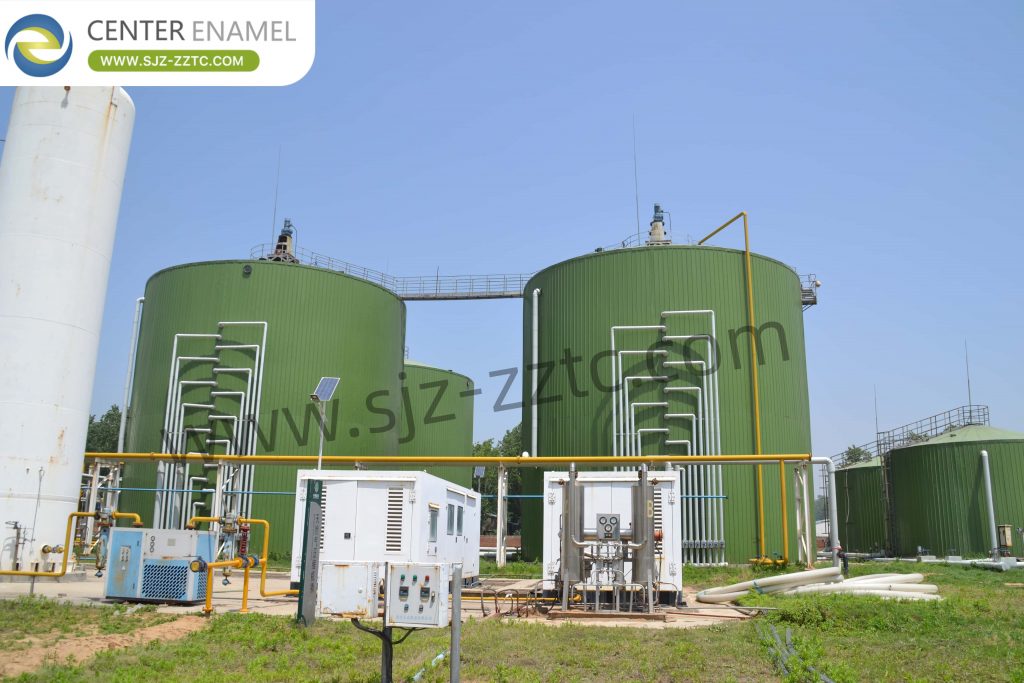
Center Enamel builds each zone using GFS Tanks in modular fashion. Anaerobic and anoxic tanks are fitted with submersible mixers to prevent sludge settling while maintaining oxygen-free conditions. Oxic tanks receive fine-bubble diffusers and blowers for continuous aeration. Coarse and fine screens, equalization tanks, and secondary clarifiers complete the pretreatment and sludge-water separation stages, while internal nitrate recycle pumps and sludge return pumps ensure bacterial circulation. Online dissolved oxygen, pH, and ammonia nitrogen monitors precisely control conditions in each zone. The complete system is mature, broadly applicable, and adaptable to flows ranging from small community plants to large urban facilities.
GFS Tanks Deliver Layout Flexibility Concrete Cannot Match
Fixed poured concrete tanks dominate traditional plant design, but they impose hard limits. Once poured, volume and shape cannot be altered. Heavy bases occupy large areas, making placement difficult on narrow or irregular plots. Their rough, uniform appearance rarely meets the aesthetic expectations of modern facilities, particularly those integrated into industrial parks or urban neighborhoods.
GFS Tanks address each of these constraints. Volume can be precisely customized from dozens of cubic meters to 50,000 cubic meters. Height and diameter combinations can be adjusted to fit constrained sites, effectively reducing land occupation. Enamel color customization achieves visual harmony with surrounding buildings and environmental facilities. When plant capacity expands, GFS tanks can be adjusted and extended in layout; concrete tanks, being monolithic, must be demolished and rebuilt. This aligns directly with the intensive construction and aesthetic operation standards of modern industrial parks.
Table 1: GFS Tanks vs. Concrete Tanks for Municipal Plants
| Criterion | GFS Tanks | Concrete Tanks |
| Volume Flexibility | Customizable, dozens to 50,000 m³ | Fixed after pouring |
| Site Adaptability | Height/diameter combinations fit irregular plots | Heavy bases, large footprint |
| Expansion | Adjustable and extendable | Demolition and rebuild required |
| Appearance | Enamel color customization available | Rough, uniform finish |
| Construction Period | Factory-prefabricated, rapid assembly | Extensive formwork and curing time |
Standardized Treatment Solutions for Large-Scale Urban Service
Beyond individual process units, municipalities need a coherent treatment train that performs consistently. Center Enamel's standardized approach follows the industry-standard sequence: pretreatment, secondary biological treatment, and advanced disinfection. Pretreatment screens and grit chambers quickly remove floating debris and grit, reducing downstream load. Secondary treatment applies mature processes—A²O Process, SBR, or oxidation ditches—for simultaneous nitrogen and phosphorus removal and organic degradation. Final UV or sodium hypochlorite disinfection eliminates pathogens for safe discharge.
The entire system is highly automated, resistant to water quality and flow fluctuations, and supported by standardized O&M procedures that sustain long-term compliance. Sludge anaerobic digestion uses GFS Tanks with simultaneous biogas recovery, converting a waste stream into a resource. This integration of liquid-stream nutrient removal and solids-stream energy recovery defines the modern municipal plant.
Global Service and Certification for International Projects
Equipment performance means little without dependable support. Center Enamel maintains regional sales centers in China and overseas local agent networks, forming a complete after-sales service loop covering all markets. The system rests on four pillars: a 24/7 rapid response mechanism, on-site domestic and overseas installation services, full-project-cycle after-sales support, and long-term warranty protection. This creates a complete chain from preliminary site survey through mid-term construction management to long-term inspection and maintenance. Service standards are uniform across domestic and international projects, coordinating personnel, materials, and on-site logistics for simultaneous projects across multiple regions—significantly reducing customer coordination costs.
For projects subject to international tendering, certifications often determine eligibility. Center Enamel holds CE, NSF, WRAS, ISO9001, BSCI, and ASME certifications, clearing barriers for EU, North American, Southeast Asian, and African projects. These credentials provide critical hard advantages for large overseas bids.
Roof Solutions Matched to Application Requirements
Not every tank requires gas-tight sealing. For atmospheric pressure storage without air-tightness requirements, FRP roof covers offer an economical general-purpose solution suitable for drinking water storage, agricultural irrigation, firewater reserve, and general production wastewater temporary storage.
FRP roofs are available in flat and dome styles, allowing selection based on tank specifications and site aesthetics. The roof is integrally molded from resin and fiberglass—lightweight, naturally water-resistant, and mildly resistant to acid and alkali corrosion. It will not rust or rot in long-term humid environments, eliminating the frequent anti-corrosion maintenance that metal roofs demand. The dome style drains excellently due to its curved structure, resisting water accumulation, dust buildup, snow load, and strong winds. The flat style facilitates maintenance walkways, level gauges, and vents on top, making inspection and operation convenient. The product is fully insulated with no risk of galvanic corrosion, will not contaminate drinking water quality, and meets environmental standards for domestic water storage. Modular design with low individual component weight allows simple on-site hoisting and assembly, offering high construction efficiency and affordable procurement and installation costs.
It is important to note the boundary: FRP roofs suit atmospheric pressure water storage tanks without biogas collection or pressurization requirements and are not recommended for anaerobic fermentation gas-producing conditions. Their typical applications include rural agricultural water storage tanks, industrial park firewater tanks, waterworks buffer tanks, and small to medium-sized domestic wastewater temporary storage facilities—making them a cost-effective general-purpose choice for conventional water storage.
Table 2: FRP Roof Cover Application Guide
| Attribute | Specification |
| Available Styles | Flat and dome |
| Material | Integrally molded resin and fiberglass |
| Corrosion Resistance | Mild acid/alkali; natural water resistance |
| Drainage Performance | Excellent (dome style) |
| Suitability | Atmospheric pressure tanks only |
| Not Recommended For | Anaerobic fermentation gas-producing conditions |
| Typical Applications | Drinking water, irrigation, firewater reserve, temporary wastewater storage |
Selecting a Supplier Who Understands Both Process and Structure
The interaction between biological process and tank structure is where projects succeed or fail. A GFS Tank supplier who understands the A²O Process can anticipate where corrosion is most aggressive, where mixing must be optimized, and how future expansion might alter hydraulic profiles. Center Enamel's in-house enamel frit development and integrated manufacturing allow coating formulations to be adjusted for specific conditions rather than relying on generic specifications. Combined with EPC contracting and anaerobic process subcontracting, this means a single entity assumes responsibility for both treatment performance and structural durability.
Frequently Asked Questions
Q: Can GFS Tanks be used for all three A²O zones?
Yes. Anaerobic and anoxic zones use submersible mixers, while oxic zones use fine-bubble diffusers. The enamel coating resists the corrosive conditions present in each zone.
Q: How long does GFS Tank installation take compared to concrete?
Factory-prefabricated panels assemble on site in a fraction of the time required for concrete formwork, curing, and finishing—often reducing construction schedules by weeks or months.
Q: Are FRP roofs suitable for biogas collection?
No. FRP roofs are designed for atmospheric pressure storage without air-tightness requirements. For biogas collection, aluminum dome covers or other gas-tight solutions should be specified.
Speak with Center Enamel's engineering team to evaluate how GFS Tanks and the A²O Process can be configured for your site's footprint, flow rate, and discharge standards.
Request a project review and receive a tailored tank layout and process recommendation for your next municipal wastewater treatment facility.