
Advanced Biogas Plant Design and High-Performance GFS Tanks by Center Enamel
Global industrial wastewater treatment policies are escalating from "compliance discharge" to mandatory "resource recovery" and "zero liquid discharge." The EU, through its Circular Economy Action Plan, requires member states to increase industrial wastewater reuse rates and extends carbon footprint accounting to the full life cycle of wastewater treatment. China continuously updates and tightens industrial water pollutant discharge standards, with increasingly stringent limits on total nitrogen, total phosphorus, and characteristic pollutants for industries such as chemicals, pharmaceuticals, and printing and dyeing. Some water-scarce regions and highly polluting industries are mandated to adopt zero or near-zero liquid discharge technologies. Germany has established a differentiated pretreatment technical standard system by industry, requiring industrial wastewater to meet specific quality requirements before discharge into municipal wastewater treatment plants, implementing strict source control.
As regulatory landscapes demand more sustainable practices, industrial facilities must upgrade their infrastructure to meet these stringent requirements. Compliance is no longer just about discharge limits; it is about adopting integrated, forward-thinking technologies. Implementing the right storage and treatment systems is essential for navigating this complex global policy environment.
GFS Tanks Bolted Assembly Construction
GFS Tanks are assembled on-site from prefabricated panels, with short construction periods and support for expansion, relocation, and reuse-advantages distinctly different from immovable concrete tanks. Concrete tank pouring requires formwork, rebar tying, pouring, and long curing periods, with a single tank construction taking months. Rain, snow, and low temperatures force work stoppages and delays. Once poured, they are permanent fixed structures that cannot be dismantled, expanded, or relocated-project relocation means complete abandonment.
GFS tank panels are all factory-prefabricated, transported to site, and directly assembled in panels with simple procedures. Construction can proceed even in low-temperature, light-rain conditions, with installation time only one-third that of concrete tanks-construction schedules are controllable. For expansion, additional steel panels can be installed to increase volume; for plant relocation, tanks can be fully disassembled with panels transported to new sites for reassembly and reuse, significantly reducing material and construction costs for new construction and reconstruction. This is ideally suited for short-term environmental projects, phased expansion projects, and relocated construction projects.
The structural flexibility provided by these storage systems serves as the foundation for sophisticated treatment workflows. With a reliable tank system in place, engineers can focus on optimizing the biochemical processes that drive energy recovery. This synergy between hardware and process is the cornerstone of modern, highly efficient industrial operations.
CSTR Process Definition
CSTR, or Continuously Stirred Tank Reactor, is a suspended-growth continuous-flow anaerobic digestion process suitable for high-solids, high-concentration organic pollutant treatment, and is the most widely used classic anaerobic treatment technology. The process relies on a mechanical stirring system to solve the technical challenges of material stratification, sludge sedimentation, and surface crusting in traditional anaerobic reactors, achieving homogeneous mixing of wastewater, anaerobic sludge, functional microorganisms, and organic substrates throughout the reactor, ensuring full contact between microorganisms and pollutants. Unlike attached-growth anaerobic processes, CSTR requires no media carriers, relying on suspended sludge bacterial communities for degradation reactions. It withstands high-suspended-solids and high-viscosity wastewater shocks, making it the mainstream process for food waste, livestock manure, and municipal sludge anaerobic digestion. The process architecture is simple, operation logic straightforward, and it is adaptable to various high-pollution organic solid-liquid mixed systems.
The efficiency of the CSTR process is heavily dependent on the specific characteristics of the influent it receives. Effectively managing complex organic wastes requires a deep understanding of the source material and its potential environmental impact. By analyzing the nature of these pollutants, project designers can tailor their systems for maximum degradation and resource recovery.
Wastewater Sources of Food Waste
Food waste wastewater originates from the resource recovery process of kitchen waste from catering services, canteens, and food processing/distribution-a typical high-concentration organic wastewater in urban solid waste resource recovery. Major sources include food waste pretreatment sorting wastewater (from bag breaking, crushing, sorting operations), oil separation wastewater (oily wastewater from three-phase oil extraction), anaerobic digestion digestate (residual liquid after food waste anaerobic digestion), and equipment/vehicle wash water. Food waste consists primarily of food residues, rich in animal/vegetable oils, starches, proteins, cellulose, salts, and seasoning residues. After pretreatment crushing and sorting, organics are solubilized forming high-concentration wastewater. Large and medium-sized cities' centralized food waste treatment facilities handle hundreds of tons daily with large continuous wastewater production; smaller facilities produce less volume but with higher concentrations-oil and salt accumulation issues are prominent.
To manage such diverse and demanding waste streams, a proven engineering partner with extensive industry experience is necessary. Center Enamel provides the expertise needed to turn these operational challenges into long-term successes. Our history of project delivery illustrates our commitment to advancing the environmental industry.
Center Enamel Development History
Center Enamel has been deeply engaged in the environmental bolted storage equipment field for over 30 years. Starting with proprietary enamel anti-corrosion material technology, the company has gradually completed the full-industry-chain upgrade from a single tank manufacturer to a comprehensive environmental EPC service provider. Throughout its 30+ year history, the company has been recognized as a National High-Tech Enterprise, National Specialized and Sophisticated "Little Giant," Manufacturing Single Champion, and Provincial Green Factory. It has successfully delivered over 30,000 environmental projects globally, establishing itself as a leading enterprise in the global GFS Tanks storage industry. The company has fully integrated the entire chain from enamel frit R&D, intelligent environmental equipment manufacturing, to EPC project contracting-every business breakthrough has been achieved through proprietary core anti-corrosion technology.
Behind every successful installation is a dedicated team of researchers and engineers working to push the boundaries of materials science. Continuous innovation ensures that our equipment remains at the forefront of the industry, meeting the most rigorous performance standards. This internal technical strength is what allows us to support clients globally.
Center Enamel R&D Team
Center Enamel has built a full-chain professional team covering R&D, design, marketing, installation, and after-sales. The R&D team is led by national-level materials technology experts, specializing in enamel frit and tank anti-corrosion core technologies. External senior environmental engineering and mechanical structure engineers are retained to strengthen R&D capabilities, focusing on anti-corrosion coating formulations, specialty corrosion-resistant tanks, and anaerobic supporting integrated equipment-continuously breaking through industry technological barriers.
The team operates through proprietary laboratories with external university research collaboration-conducting year-round new material and new process durability pilot testing and long-term corrosion simulation testing. Specialized enamel formulations are iteratively developed for extreme conditions such as high-salinity wastewater, strong acid/alkali POME, and high-organic livestock manure-providing core technical support for the company's annual new invention and utility patents-building a proprietary material technology barrier.
The final component of a successful system is the enclosure that protects the delicate anaerobic process from the elements. A specialized roof solution completes the structural assembly, ensuring the integrity of gas recovery and odor control. This attention to detail defines the difference between a standard setup and a professional Biogas Plant Design.
Glass-Fused-to-Steel Roof Cover Solution
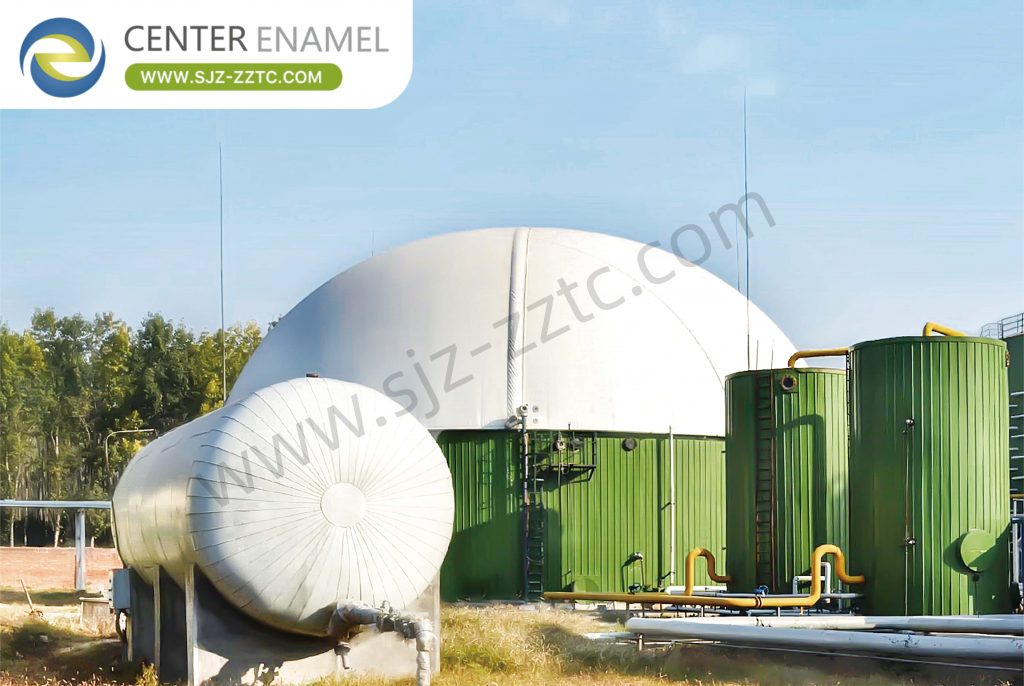
Glass-Fused-to-Steel Roof is a specialized tank cover solution designed for high air-tightness applications, primarily suited for CSTR anaerobic fermentation tanks and other biogas reactor tanks, serving as a core supporting component in organic waste anaerobic treatment projects. The roof is manufactured with the same material system as glass-fused-to-steel assembled tanks, with steel substrate and high-temperature fused glass coating integrated into one unit. The roof panel joints are equipped with specialized sealant strips and fasteners, achieving high-level overall air-tightness that completely seals biogas generated from anaerobic reactions inside the tank, preventing methane and odorous gas leakage while enabling biogas recovery and on-site odor control.
The product resists long-term corrosion from fermentation liquid and acid/alkaline biogas slurry, and will not be corroded or delaminate due to microorganisms or sulfides in the anaerobic environment. Its service life is synchronized with the glass-fused-to-steel tank, significantly reducing maintenance frequency. The structure employs steel truss supports for the glass-coated panels, providing stable load-bearing capacity. It can accommodate various process openings for mixers, biogas collection, monitoring, and manways, offering high integration. Modular components enable rapid on-site assembly, suitable for large-volume anaerobic fermentation tanks. It is widely used in livestock manure treatment, food waste anaerobic digestion, straw biogas, and municipal sludge disposal projects, and is the mainstream reliable roof selection for anaerobic fermentation tanks.
FAQs
1.Why is GFS Tanks technology essential for modern Biogas Plant Design?
GFS tanks provide exceptional corrosion resistance, modular flexibility for expansion, and rapid assembly. Their durable glass-fused-to-steel coating ensures a long service life, making them the superior choice over concrete for complex anaerobic digestion projects that require high gas tightness and structural integrity.
2.How does Center Enamel’s R&D approach benefit my project?
Center Enamel leverages over 30 years of proprietary enamel technology and national-level expertise to create custom formulations for extreme waste conditions. Our R&D ensures that our tanks and components, like specialized roof covers, can withstand harsh chemical environments, resulting in lower maintenance and higher operational stability.
3.What makes the CSTR process suitable for food waste treatment?
The CSTR process features mechanical stirring that ensures homogeneous mixing, preventing stratification and crusting in high-solids waste like food scraps. It is highly adaptable, handles hydraulic shocks effectively, and offers a straightforward, efficient architecture that simultaneously treats wastewater and recovers biogas energy for industrial use.