
Leading Cow Dung Biogas Project Solutions in Tanzania with GFS Tanks and Double Membrane Roof Technology
Tanzania's livestock sector is a vital pillar of the national economy, contributing 7.4% of GDP and supporting approximately one-third of the country's households . With Africa's second-largest cattle population, the sector faces a pressing environmental challenge: the management of millions of tons of cow dung generated daily. Studies across regions like Morogoro and Kilimanjaro reveal that traditional manure management practices—ranging from open heaping to direct field application—often lead to significant environmental contamination and greenhouse gas emissions .
A single cow can emit over 80 kilograms of methane annually, with enteric fermentation accounting for 88% of livestock emissions and manure management contributing the rest . As Tanzania pursues climate-smart agricultural strategies, converting cow dung into biogas through professional Biogas Project solutions has become an essential pathway for reducing emissions, generating renewable energy, and producing high-quality organic fertilizer .
The Comprehensive Biogas Production Process
Transforming raw cow dung into usable energy involves a sophisticated multi-stage process. It begins with pre-treatment, where the manure passes through a mechanical bar screen to remove large impurities that could damage downstream equipment. A homogenization tank then mixes the waste into a uniform slurry and removes heavy particles like sand. This prepared substrate is fed into the core of the Biogas Project system: the anaerobic digester.
Within this sealed, oxygen-free environment, microorganisms break down the organic matter through four key biological stages—hydrolysis, acidogenesis, acetogenesis, and methanogenesis. This process releases biogas, typically composed of 55%–70% methane, which is captured and stored. The remaining digestate undergoes solid-liquid separation; the fibrous portion becomes a valuable organic fertilizer, while the liquid fraction can be stored and applied to farmland, creating a closed-loop agricultural system.
The Core Technology: CSTR Process
The heart of an efficient cow dung biogas plant is the Continuous Stirred-Tank Reactor (CSTR). This high-performance anaerobic treatment technology is specifically designed to process organic wastewater with high suspended solids, a defining characteristic of livestock manure. The CSTR is a sealed tank equipped with a mechanical stirring device that ensures fermentation raw materials and microorganisms are in a state of complete, uniform mixing .
Through continuous or semi-continuous feeding at a constant temperature, the CSTR effectively degrades organic matter, maximizing biogas yield. Studies on anaerobic codigestion in CSTR reactors have demonstrated their effectiveness in enhancing biogas production and ensuring process stability . Research conducted in Tanzania has confirmed that cow dung is a suitable feedstock for biogas production, with optimal conditions achieving significant methane yields . As the core unit that achieves both waste reduction and renewable energy generation, the CSTR is indispensable for any modern Biogas Project.
Center Enamel: Your Expert Partner in Biogas Solutions
Center Enamel is a global leader in providing cutting-edge solutions for water, wastewater, and biogas projects. As the largest manufacturer of Glass-Fused-to-Steel (GFS) tanks in Asia, we bring over 36 years of international expertise to every project. Our capabilities are backed by an impressive 150,000㎡ R&D and production base, over 200 patented technologies, and a dedicated team of more than 500 employees. We offer comprehensive EPC (Engineering, Procurement, and Construction) services, process packages, and high-quality equipment supply. Our products are rigorously tested and certified to meet international standards, including CE/EN1090, ISO9001, NSF61, WARS, and EN28765. This commitment to quality gives our clients in Tanzania and over 100 other countries complete peace of mind, ensuring reliable and sustainable Biogas Project solutions tailored to local conditions.
Engineered for Biogas: GFS Tanks and Double Membrane Roofs
For any successful Biogas Project, the choice of storage and containment systems is critical. Center Enamel offers two primary solutions that are perfectly suited for the demanding environment of anaerobic digestion.
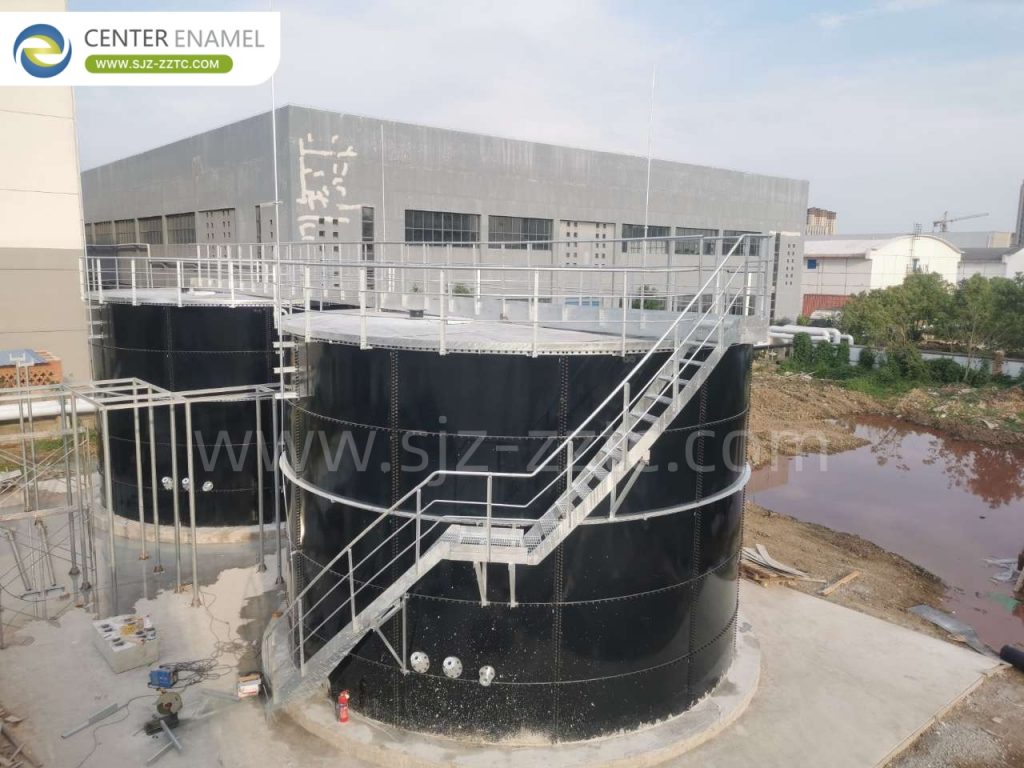
First, our GFS Tanks are the premier storage solution in the market. They are manufactured using a specialized process where steel sheets are coated with glass enamel and fired at high temperatures exceeding 820°C, creating an inert, inorganic bond that combines the strength and flexibility of steel with outstanding corrosion resistance. This is crucial in a biogas environment, where tanks are constantly exposed to corrosive gases, organic acids, and abrasive materials. With pH resistance ranging from 1 to 14, GFS Tanks resist acid, corrosion, and UV aging, ensuring a service life of over 30 years with minimal maintenance. Their modular bolted design allows for rapid on-site assembly, making them ideal for Tanzania's diverse and often remote locations.
Second, the Double Membrane Roof is the preferred gas storage solution for biogas applications. This innovative design is both cost-effective and space-efficient, significantly reducing overall project costs and eliminating the need for separate gas holder foundations. During operation, the outer membrane remains inflated for structural integrity, while the inner membrane dynamically expands and contracts to store the biogas produced. This provides a flexible and reliable gas storage system directly integrated into the digester, ensuring airtightness and safe biogas collection.
A Comprehensive Suite of Roof Solutions
Recognizing that different projects have diverse requirements, Center Enamel provides a variety of top cover solutions for storage tanks. For demanding environments, we offer an Aluminum Geodesic Dome Roof for its advanced corrosion resistance and expansive clear span capability. Our Glass-Fused-to-Steel Roof provides excellent air-tightness for pressurized structures and odor control. For ultimate corrosion resistance and longevity, we offer Stainless Steel Roofs, which are a viable solution for harsh environments. Additional options include FRP Roofs for applications where air-tightness is not required, as well as Aluminum Alloy Trough Deck Roofs, which are economical and weather-resistant options suitable for Tanzania's varied climate conditions.
Complete Biogas Project Equipment Supply
Beyond tanks and roofs, Center Enamel is a one-stop-shop for all essential biogas equipment. We supply critical components, including:
Gas Holder: For storing purified biogas.
Black Membrane: Used for various containment applications.
Solid-liquid Separator: For separating digestate into liquid and solid fertilizer components.
Torch System: A safety system for flaring excess gas.
Lifting Pump: For moving slurry and digestate through the system.
Dehydration and Desulfurization Tank: For cleaning and purifying raw biogas, ensuring optimal combustion and equipment protection.
Efficient & Reliable Installation of GFS Tanks
Center Enamel's GFS Tanks are engineered for fast and efficient on-site assembly, a critical advantage for Tanzania's often-remote agricultural regions. Our tanks are constructed from modular, bolted steel panels, which offer numerous advantages:
Short Construction Times: Prefabricated panels significantly speed up the installation process, reducing project timelines and minimizing disruption to farm operations.
Superior Corrosion Resistance: The glass-fused-to-steel coating ensures a long service life of over 30 years with minimal maintenance, making it ideal for Tanzania's diverse climates.
Ease of Transport and Relocation: The modular design allows for easy shipping, dismantling, and relocation if farm layouts change.
Zero On-site Welding: All components are factory-prefabricated and assembled with high-strength bolts, avoiding welding failures and ensuring anti-corrosion integrity.
Cost-Effective Installation: The lightweight structure reduces foundation costs, and the bolted assembly eliminates the need for heavy lifting equipment, reducing overall project costs.
One-Stop Solutions for Tanzania's Biogas Future
Center Enamel is a complete solutions provider for the Tanzanian market, offering tailored approaches for every phase of a Biogas Project.
We offer:
Expert Design and Consultation: Our engineers design systems specifically suited to Tanzania's local climate, breeding scale, and environmental conditions, supporting the country's climate-smart livestock goals .
High-Quality Equipment Manufacturing: We produce all key components, including GFS Tanks, Double Membrane Roofs, and other process equipment, to the highest international standards.
Comprehensive EPC Service: We manage the entire project, from design and engineering to procurement, construction, and commissioning, ensuring a seamless and efficient delivery.
Process Package and Equipment Supply: We offer specialized process packages and individual equipment supply, allowing clients to customize their biogas plant according to their specific needs.
Conclusion
Tanzania's livestock sector has a powerful opportunity to transform its environmental challenges into valuable assets. By adopting a comprehensive Biogas Project system powered by our advanced GFS Tanks and Double Membrane Roof technologies, the country can efficiently convert cow dung into renewable energy and organic fertilizer. This directly addresses the urgent need to mitigate methane emissions—projected to increase by 50% by 2030 if no action is taken—while promoting sustainable agricultural development .
Center Enamel, with its decades of expertise, global certifications, and commitment to quality, stands ready to be the strategic partner for Tanzania's sustainable energy future, helping farms reduce their environmental footprint while creating new revenue streams and energy independence.
Frequently Asked Questions (FAQ)
1. What is the biogas production potential of cow dung in Tanzania?
Research has shown that cow dung is a highly suitable feedstock for biogas production. Studies indicate that approximately 0.49 m³ of biogas can be produced per kilogram of COD from dairy wastewater under optimal conditions of 35°C and pH 7.0 . Given Tanzania's vast cattle population, the potential for biogas generation is substantial.
2. How does the CSTR process benefit Tanzanian dairy farmers?
The CSTR process provides a stable and efficient method for converting cow dung into biogas. Its mechanical stirring system ensures uniform mixing and prevents scum accumulation, making it highly effective for processing high-solids manure. This results in consistent biogas production, on-farm energy generation, and the production of digestate that can be used as organic fertilizer, reducing reliance on chemical inputs .
3. Can biogas solutions help Tanzania reduce livestock greenhouse gas emissions?
Yes. Converting cow dung into biogas through anaerobic digestion captures methane that would otherwise be released into the atmosphere. The World Bank has highlighted that mitigating methane emissions from Tanzania's livestock sector is crucial for climate action, and biogas technology offers a proven pathway to achieve this while also providing clean energy and improving livelihoods .