
Advanced Solutions for Biogas Power Plant and Livestock Wastewater Treatment Using GFS Tanks
Global livestock inventories such as swine remain stable. The US has developed technical models represented by integrated crop-livestock systems with on-field application and Comprehensive Nutrient Management Plans; Denmark, the Netherlands, and others have developed centralized biogas projects with digestate application systems. China's large-scale farms still have considerable room for improvement in supporting biogas project coverage, and digestate resource utilization rates lag behind advanced European levels. Greenhouse gas emissions from livestock account for a significant proportion of total global anthropogenic emissions, making manure management a critical battleground for agricultural carbon reduction. Latin American countries started later in manure management but are accelerating relevant infrastructure development.
As global agricultural practices evolve, the transition toward sustainable energy and waste management has become a priority. Establishing a reliable Biogas Power Plant is now a fundamental strategy for converting agricultural waste into renewable energy. This shift not only addresses environmental concerns but also provides significant economic advantages for modern livestock operations.
GFS Tanks Adaptable to Complex Operating Conditions Across All Industries
Center Enamel has independently developed over 200 specialized enamel frit formulations and supporting patents, capable of customizing anti-corrosion enamel based on customer storage media, with adaptability comprehensively superior to concrete tanks. Concrete tanks use a single material, only suitable for neutral clean water storage. When storing corrosive materials such as livestock manure, palm oil mill effluent, chemical wastewater, food waste digestate, high-salinity wastewater, etc., additional anti-corrosion linings must be applied. These linings are prone to failure, preventing long-term stable operation and cannot adapt to alternating high/low concentration storage conditions.
GFS tanks can be specifically formulated with specialized enamels resistant to strong acids, strong alkalis, high organic content, and high salinity. A single tank can switch between multiple wastewater and fermentation feedstock storage requirements. They are universally applicable across biogas anaerobic digestion, municipal wastewater, livestock farming, food processing, and industrial water treatment scenarios, eliminating the need to rebuild tanks for media changes, perfectly meeting the needs of diversified, multi-condition environmental protection projects.
To support the demanding requirements of high-efficiency energy systems, the choice of containment technology is critical. GFS Tanks offer the durability and corrosion resistance necessary to withstand the harsh conditions found in professional fermentation and waste storage. Their adaptability ensures that they remain the gold standard for long-term project stability.
UASB Reaction Process
After pretreatment through screens and equalization tanks to remove impurities and balance water quality and flow, wastewater is uniformly fed into the reactor through the bottom distribution system. The wastewater rises at a constant rate through the high-concentration granular sludge bed at the bottom, where anaerobic microorganisms rapidly degrade most organic matter, converting it into biogas, clean water, and a small amount of sludge. Gentle hydraulic mixing maintains sludge suspension, expanding microbial contact area. Remaining pollutants continue to degrade in the mid-section suspended sludge layer, with the mixed liquor finally entering the top three-phase separator for gas, solid, and liquid separation. Biogas is collected upward for utilization, sludge settles back to the reaction zone, treated effluent overflows from the top, and aged sludge is periodically discharged-fully automated continuous operation.
Integrating this advanced reaction technology is essential for effectively handling the high pollutant loads generated by large-scale farming. Implementing a robust Livestock Wastewater Treatment system enables facilities to maximize pollutant removal while optimizing biogas yields. This synergy between process technology and structural integrity is the hallmark of modern waste management engineering.
Livestock Wastewater Key Water Quality Characteristics
Typical high-concentration organic wastewater with "four highs"-high COD, high ammonia nitrogen, high total phosphorus, and high suspended solids-very high pollution load. Livestock wastewater COD can exceed 8,000 mg/L, with high turbidity and suspended solids. Nitrogen and phosphorus levels far exceed discharge standards, being the primary cause of eutrophication. Wastewater is rich in manure, feed residues, and metabolic waste, readily turning black and odorous. Water quality fluctuates significantly with production cycles, seasons, and washing frequency. Aquaculture wastewater has lower pollutant concentrations but significant nitrogen/phosphorus accumulation issues, causing algal blooms and water quality deterioration with long-term discharge.
Accurately characterizing the input stream is the prerequisite for designing any high-performance treatment facility. By deeply understanding these water quality markers, engineers can ensure that the entire plant operates within safety parameters. This precision is what allows for the successful design and implementation of durable, long-term environmental infrastructure.
Indonesia Palm Oil Biogas Project
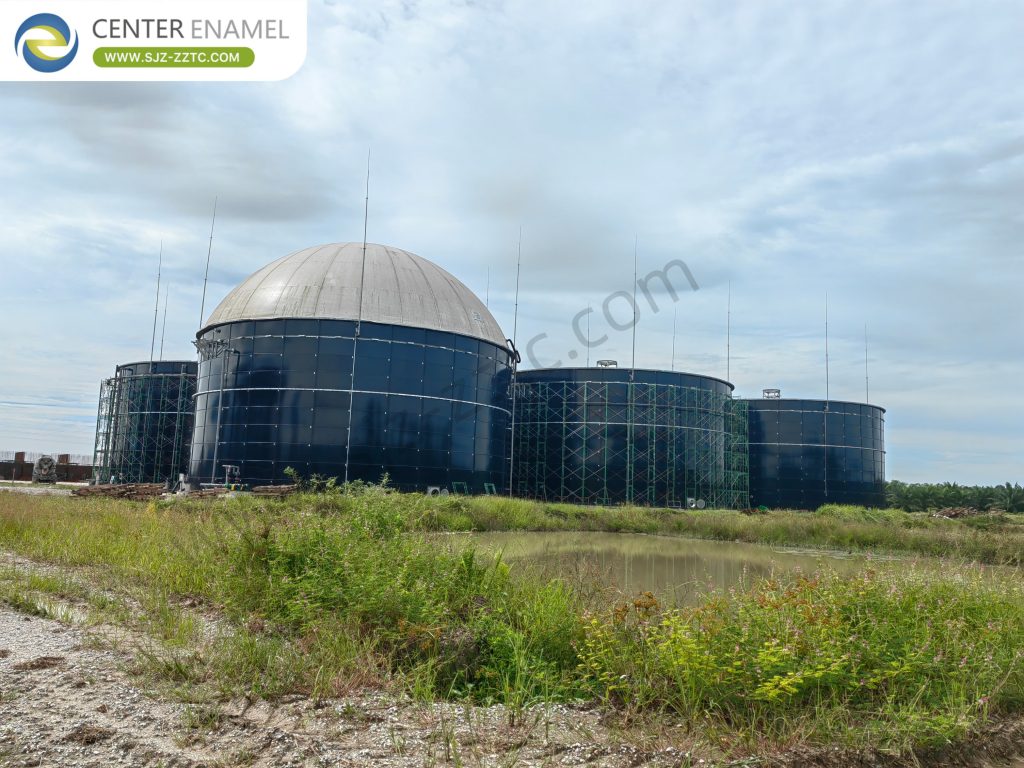
Specifically designed for high-concentration palm oil wastewater treatment with 3 GFS fermentation tanks, each 19.86 m diameter × 8.4 m height. Installation began November 2009 with only 7 construction personnel, completing all tank assembly in 40 days-highly efficient and time-saving. Tanks are fitted with dual-membrane gas storage covers for POME anaerobic digestion-degrading organics and recovering biogas energy while eliminating palm industry pollution. This is an early benchmark POME biogas treatment project in Southeast Asia.
Proven real-world performance provides the confidence needed for new investors to adopt innovative environmental solutions. The success of such benchmarks illustrates how custom designs can overcome localized challenges to produce superior energy output. Such historical successes reinforce the reliability of integrated equipment and professional delivery chains.
Center Enamel Design Team
The design team includes senior engineers registered in the Hebei Provincial Science and Technology Expert Database, with design standards aligned with strict European/American high-end equipment safety standards. The team can provide complete integrated design for differentiated overseas projects in livestock biogas, POME, municipal wastewater, hazardous waste storage, seawater desalination, etc.-covering tank structure, anti-corrosion/sealing systems, biogas piping, and anaerobic process integration.
Pre-design thoroughly investigates local seismic zone, wind pressure, soil bearing capacity, water quality corrosivity, and local environmental discharge standards-applying thickened panels, reinforced anchored bases, and optimized sealing/corrosion structures as needed. Complete customized equipment solutions can be tailored to customer plant area, wastewater load, treatment targets, and budget-balancing safety, economics, and local adaptation-providing compliant, stable, and highly adaptable equipment structural design support for global environmental projects.
Expertise in design ensures that every detail, from structural load-bearing to chemical resistance, meets the highest international standards. A well-coordinated design process is the backbone of delivering projects that are both safe and highly efficient. When teams work in harmony with the local environment, the result is a resilient piece of engineering that serves the client for decades.
Full-Industry-Chain Integrated Delivery Capability
Center Enamel is the only company globally integrating proprietary enamel frit R&D, self-manufactured tanks, and EPC general contracting-full-process self-control from solution design, equipment production, cross-border logistics, overseas construction, to post-construction O&M-significantly reducing client coordination and time costs.
Frequently Asked Questions (FAQ)
How do GFS Tanks benefit a Biogas Power Plant?
GFS tanks provide exceptional corrosion resistance against acidic fermentation and high-salinity manure. Their modular design allows for rapid assembly, while the specialized enamel coating ensures a long service life and minimal maintenance, making them the most cost-effective and reliable containment solution for sustainable biogas energy production.
Why is specialized equipment necessary for Livestock Wastewater Treatment?
Livestock wastewater contains high organic loads, ammonia, and phosphorus, which are highly corrosive. Specialized GFS tanks and advanced anaerobic processes are essential to prevent structural failure, ensure efficient pollutant degradation, and protect the surrounding environment from contamination while enabling effective resource recovery and regulatory compliance.
What does Center Enamel’s full-industry-chain capability offer clients?
Center Enamel integrates R&D, manufacturing, and EPC contracting under one roof. This allows us to provide end-to-end solutions, eliminating communication gaps between suppliers and contractors, reducing project delivery times, and ensuring that high-quality, customized equipment is seamlessly installed and maintained for every global project.