
Advanced UASB Process Solutions for Textile Wastewater Treatment Projects
The textile industry faces mounting environmental pressures to treat complex, high-organic wastewater streams effectively while recovering valuable resources. Modern textile wastewater treatment projects demand robust infrastructure capable of handling extreme chemical conditions while delivering reliable performance over decades of operation. This challenge has driven the adoption of advanced anaerobic digestion technologies, particularly the Upflow Anaerobic Sludge Blanket (UASB) process, as a cornerstone solution for high-strength industrial effluent management.
Market and Industry Landscape for Textile Wastewater Treatment
The competitive landscape shows divergence, with leading companies building integrated service capabilities through technical integration and capital operations, and industry concentration gradually increasing. Chinese companies continue to consolidate their advantages in mid-tier equipment exports, while international giants target high-end customers and complex industrial wastewater markets. Local players occupy the mid-to-low-end and industrial park centralized treatment markets with service responsiveness and cost advantages. In the anaerobic process segment, UASB, EGSB, and IC anaerobic reactors, with advantages of high loading rates, small footprints, and stable operation, are widely used in high-concentration organic wastewater pretreatment in food processing, pharmaceutical fermentation, alcohol brewing, chemical, and textile industries. These reactors use steel tank shells, and their corrosion resistance and gas-tightness directly determine long-term operational stability. The application value of glass-fused-to-steel tanks in such scenarios is increasingly prominent, particularly for textile wastewater treatment projects where aggressive chemical environments are the norm.
The escalating demand for energy recovery from industrial wastewater further reinforces the value proposition of the UASB process. By converting organic pollutants into methane-rich biogas, textile manufacturers can offset significant operational costs while meeting stringent environmental discharge standards. This dual benefit of pollution control and energy generation positions the UASB process as a transformative technology for the textile sector.
GFS Tanks Corrosion Resistance Far Superior to Traditional Concrete Tanks
Center Enamel's independently developed double-sided double-layer enameling technology is the industry's leading coating anti-corrosion technology, with corrosion resistance completely surpassing concrete tanks. Concrete tank interiors are riddled with pores, allowing wastewater and acid/alkaline media to easily penetrate and corrode the structural layer. Long-term use leads to irreversible problems such as internal wall spalling, water seepage, and rebar corrosion, which are difficult to repair and cannot be fundamentally resolved. These limitations are particularly pronounced in textile wastewater treatment projects, where aggressive dyeing chemicals and high salinity accelerate concrete degradation.
GFS tanks feature high-temperature enameling on both the interior and exterior surfaces of steel panels, with a dense, non-porous enamel finish that completely blocks corrosive liquids and biogas permeation. The enamel layer has extremely strong chemical stability, resisting acids, alkalis, salts, and microbial corrosion. Concrete tanks will develop extensive corrosion and leakage after 5-8 years of use, while GFS tank anti-corrosion service life can exceed 30 years, with no need for frequent internal lining repairs throughout the service life. This significantly reduces long-term anti-corrosion maintenance investment and fundamentally eliminates environmental risks of medium leakage contaminating sites and groundwater. Compared to traditional concrete and FRP tanks, GFS tank coatings have no risk of peeling or blistering, and are adaptable to highly corrosive conditions such as palm oil mill effluent, livestock manure, and chemical high-salinity wastewater, with outstanding long-term comprehensive cost advantages.
This superior chemical resistance is achieved through a fusion process where glass enamel is bonded to steel at temperatures exceeding 800°C, creating an inert, impervious surface that withstands the full pH range of 1-14. For textile wastewater characterized by high alkalinity from mercerizing processes and acidic conditions from dyeing operations, this robust containment infrastructure is essential for maintaining process integrity.
The UASB Reaction Process for Textile Wastewater Treatment
After pretreatment through screens and equalization tanks to remove impurities and balance water quality and flow, wastewater is uniformly fed into the reactor through the bottom distribution system. The wastewater rises at a constant rate through the high-concentration granular sludge bed at the bottom, where anaerobic microorganisms rapidly degrade most organic matter, converting it into biogas, clean water, and a small amount of sludge. Gentle hydraulic mixing maintains sludge suspension, expanding microbial contact area. Remaining pollutants continue to degrade in the mid-section suspended sludge layer, with the mixed liquor finally entering the top three-phase separator for gas, solid, and liquid separation. Biogas is collected upward for utilization, sludge settles back to the reaction zone, treated effluent overflows from the top, and aged sludge is periodically discharged-fully automated continuous operation.
The UASB process offers distinct advantages for textile wastewater treatment projects, including low capital costs, effective decolorization, minimal excess sludge production, and low energy requirements compared to chemical treatment processes. Research has demonstrated that UASB reactors can achieve 50-65% COD removal efficiency, with further treatment steps enhancing overall performance. When combined with biofilter and aerobic processes, the integrated system achieves remarkable pollutant removal rates, with studies showing COD removal exceeding 97% in UASB-electro-membrane bioreactor configurations. The UASB process also contributes significantly to color removal, with anaerobic bacteria effectively breaking down azo bonds that cause persistent coloration in textile effluent.
Key Water Quality Characteristics of Textile Wastewater
High color, high alkalinity, high COD, high suspended solids, and large water quality fluctuations-these represent the most prominent color pollution category in industrial wastewater. COD typically ranges from 1,000-10,000 mg/L, with desizing and scouring wastewater exceeding 10,000 mg/L. Color levels are extremely high, with dyeing wastewater color reaching hundreds to thousands of dilution multiples, containing various dyes (reactive, disperse, acid) with deep, difficult-to-decolorize colors. High pH levels are common, with mercerizing and scouring wastewater pH exceeding 12 (strongly alkaline). Discharge temperatures are elevated, with dyeing process effluent reaching 50-70°C. BOD/COD ratios approximately 0.25-0.4 indicate moderate to poor biodegradability, with dyes and sizing agents being recalcitrant organics. The wastewater also contains surfactants, sizing agents (PVA, starch), fiber impurities, dye auxiliaries, and inorganic salts (sodium sulfate, sodium chloride). Water quality varies dramatically with dye type and process changes, exhibiting distinct intermittent discharge characteristics.
These challenging characteristics demand robust treatment solutions capable of handling extreme variability while maintaining consistent performance. The UASB process, when housed in corrosion-resistant GFS tanks, provides the necessary flexibility and durability to manage these demanding conditions effectively.
Indonesia Palm Oil Biogas Upgrade Project: A Proven Model for Textile Applications
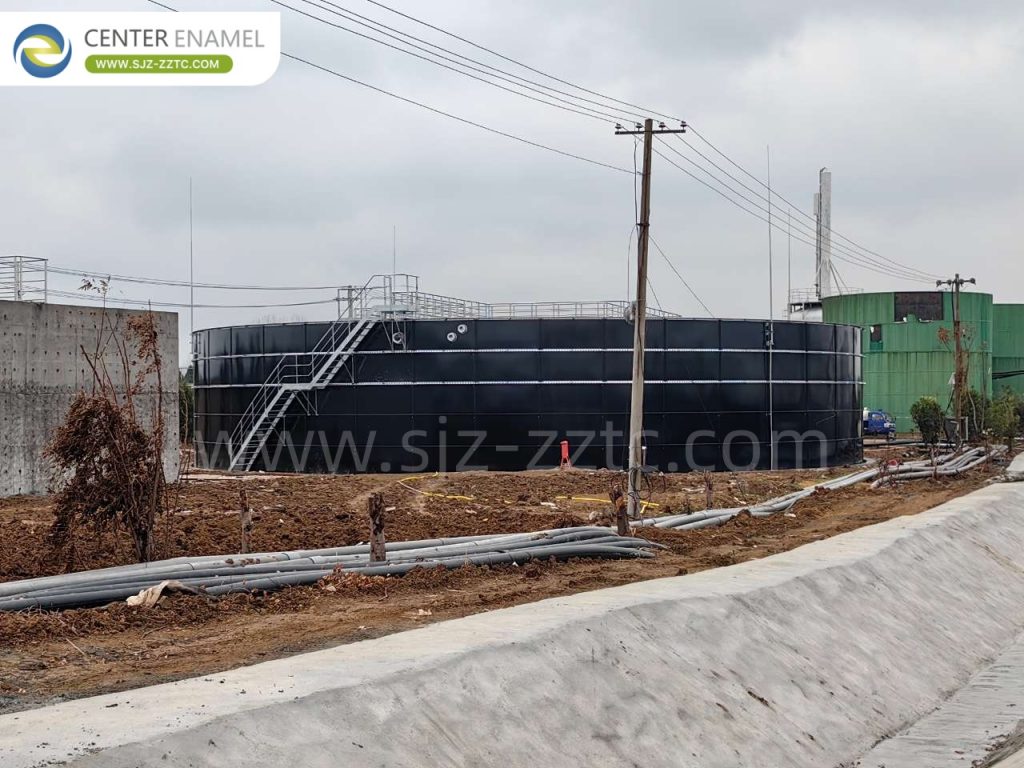
Commissioned in 2013 as the core anaerobic digestion reactor for the POME treatment station, with 3 GFS tanks in two sizes: 17.58 m dia. × 8.4 m height and 16.82 m dia. × 7.2 m height. The tanks serve as the core anaerobic reaction equipment specifically for high-organic palm oil production wastewater, where anaerobic digestion degrades pollutants and recovers biogas. Tanks are adapted to local palm industry wastewater needs. GFS tank assembly is convenient with corrosion resistance for Southeast Asia's hot humid high-corrosion environment-a mature biomass energy environmental benchmark project.
The success of this project demonstrates the transferability of GFS anaerobic digestion technology to textile wastewater treatment projects, where similar challenges of high organic loading, aggressive chemical environments, and tropical operating conditions prevail. The project exemplifies how durable infrastructure can deliver reliable performance over extended operational periods while recovering valuable biogas energy from waste streams.
Center Enamel's Smart Manufacturing Base Scale
Center Enamel's core intelligent manufacturing base is located in Hebei Province, China, covering a total area of over 150,000 m², with Phase I mature manufacturing facility and Phase II high-end environmental equipment industrial park-dual-base synergy ensures stable production capacity. The base includes dedicated R&D office buildings, proprietary material laboratories, and finished product testing centers, with full-process quality control systems meeting ISO, NSF, CE, and other international standards. The facility operates to green manufacturing standards, certified as a Provincial Green Factory-balancing efficient production with energy conservation and emission reduction. The company has 6 marketing service centers across China, establishing a nationwide production-sales network ensuring stable global order delivery. The base is adjacent to expressway networks and major logistics hubs, with complete container shipping capabilities-supporting simultaneous large-scale tank projects globally. The base employs over 500 staff, with multiple parallel automated production lines-facility scale and production capacity firmly placing it among the global top tier of GFS tank equipment manufacturers.
This manufacturing capacity ensures consistent quality and timely delivery for textile wastewater treatment projects worldwide, with the capability to produce tanks meeting stringent international standards including AWWA D103 and OSHA requirements.
Over a Decade of Global Installation Experience
Unmatched global practical experience among domestic peers-over a decade covering multiple regions and all industry sectors. In 2009, Center Enamel completed the first overseas GFS tank installation-sending a team to Niger, Africa for drinking water storage tank installation. In 2015, it broke industry ground with China's first GFS tank export and installation to the US-passing strict US acceptance standards. All installed projects have operated stably for many years, covering livestock biogas, POME, municipal wastewater, and drinking water storage applications. Construction has covered Southeast Asia, Africa, the Americas, and other regions-accumulating specialized solutions for complex sites including mountainous terrain, coastal salt spray, tropical high temperatures, and high-standard European and American facility conditions-maturely addressing global special construction requirements.
This extensive experience in diverse environmental conditions and industry applications provides valuable insights for textile wastewater treatment projects, where site-specific challenges require tailored solutions and proven execution capabilities.
Frequently Asked Questions
1. Why is the UASB process preferred for textile wastewater treatment?
The UASB process offers significant advantages including low capital costs, effective COD and color removal, minimal sludge production, and biogas energy recovery. Studies show COD removal efficiencies of 50-65% with further treatment achieving over 97% removal. The process handles high organic loads while producing renewable energy, making it economically and environmentally attractive for textile facilities.
2. What makes GFS tanks superior to concrete tanks for anaerobic digestion?
GFS tanks feature a non-porous glass enamel coating fused to steel at 860°C, providing complete corrosion resistance across pH 1-14. Unlike concrete tanks that develop extensive corrosion and leakage within 5-8 years, GFS tanks maintain integrity for over 30 years with no internal lining repairs required, significantly reducing long-term maintenance costs.
3. Can the UASB-GFS system handle the variable nature of textile effluent?
Yes. The UASB process, housed in robust GFS tanks, is designed to accommodate significant fluctuations in COD, pH, temperature, and salinity typical of textile wastewater. The technology has been proven in full-scale operations across multiple industries and regions, with mature solutions for challenging conditions including high temperatures, corrosive environments, and variable loading rates.