
Agricultural Waste Treatment: Crop Residue And Manure To Biogas
Agricultural waste treatment is the management of farm-generated organic residues - crop straw, harvest leftovers, and animal manure - so they are stabilised and converted to biogas rather than burned or left to emit methane. The practical route characterises the material by total solids and C:N, co-digests complementary streams at a C:N near 20-30:1, and runs them in a CSTR or USR at 35-38 C; the design is driven by the residue mix and the cold-climate duty, not by a single recipe.
What Counts As Agricultural Waste
Agricultural waste spans two very different fractions. Crop residue - straw, husk, stalks - is lignocellulosic, carbon-rich, and slow to break down. Animal manure is nitrogen-rich and faster. On a mixed farm both appear together, and the art is combining them so the blend digests steadily instead of stalling on too much fibre or too much ammonia.
| Residue | C:N tendency | Digestibility |
| Crop straw | Very high C | Slow, lignocellulosic |
| Animal manure | Low N-rich | Fast, ammonia risk |
| Mixed farm waste | Balanced by blend | Steady with co-digestion |
Co-Digestion Balances The Blend
Co-digestion is the core technique: pairing a carbon-heavy residue with a nitrogen-heavy manure moves the feed toward a C:N near 20-30:1, the band where methanogens stay active. It also dilutes inhibitors and smooths the volatile-solids load. The limit is real - over-load with straw and the hydraulic retention time stretches; over-load with manure and ammonia inhibition creeps in above roughly 1,500-2,000 mg/L free ammonia.
Reactor Choice For Mixed Farm Waste
A CSTR with mechanical mixing handles the heterogeneous, high-solids blend common on farms and tolerates feed swings. A USR (Upflow Solids Reactor) suits solid-rich feed with less mixing energy. In cold regions the reactor needs insulation and possibly waste-heat recovery so the 35-38 C mesophilic set-point holds through winter, because a dropped temperature directly cuts gas output.
| Reactor | Best feed | Note |
| CSTR | Mixed, high solids | Mechanical mixing, insulated for cold |
| USR | Solid-rich | Lower mixing energy |
| Covered lagoon | Very dilute, warm | Low capital, slow |
Project Case Study: Zhaqi Biogas Project In Inner Mongolia
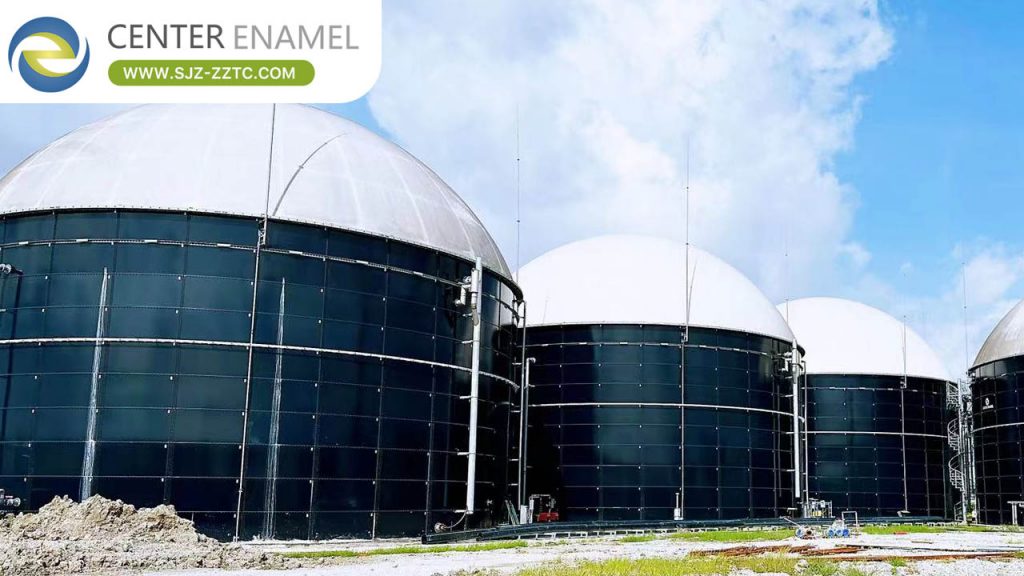
Project / Application: Farm animal manure plus agricultural waste (grass straw), Xing'an, Inner Mongolia. Industry: Agriculture / biogas. Process: Medium-temperature CSTR anaerobic fermentation. Key Requirements: Stable winter operation on a manure-and-straw blend.
| Field | Value | Source / Evidence |
| Handling Capacity | 900 m3/D (manure + agri waste) | Company project reference |
| Reactor Type | 4 CSTR 25.98 x 8.4 m | Company project reference |
| Daily Biogas Output | 20,000 m3/day | Company project reference |
| Feedstock | Animal manure + grass straw | Company project reference |
| Design | Cold-climate medium-temp | Company project reference |
About Company
Shijiazhuang Zhengzhong Technology Co., Ltd (Center Enamel) is a comprehensive high-tech enterprise specializing in wastewater engineering, process section contracting, and equipment manufacturing. The company delivers biogas and wastewater projects through three main lines - EPC (turnkey) contracting, equipment supply, and process packages - covering livestock and municipal wastewater, biomass energy, industrial wastewater, and food waste. Its reactor portfolio spans CSTR, USR, UBF, UASB, IC, and EGSB, backed by in-house Glass-Fused-to-Steel tank manufacturing (enamel firing at 820-930 C) and certifications including ISO 9001, NSF/ANSI 61, and CE-EN 1090. With 35+ years of operation, a 150,000 m2 manufacturing base, and projects in 100+ countries, Center Enamel provides the single-responsibility engineering behind the Zhaqi Inner Mongolia biogas project that ran four CSTR reactors on a manure-and-straw blend at 900 m3/day, built for cold-climate stability - a scoped agricultural-waste solution.
Comparison: Agricultural Versus Pure-Manure Waste
| Element | Crop-residue-rich | Manure-rich |
| Limiting factor | Slow fibre | Ammonia |
| Co-digest partner | Manure | Straw / crop residue |
| Target C:N | 20-30:1 | 20-30:1 |
| Reactor duty | Insulated CSTR | Insulated CSTR |
Agricultural waste treatment is the C:N-balanced co-digestion of crop residue and manure in an insulated anaerobic reactor - scoped from the residue blend and the climate, not from a generic farm package.
Frequently Asked Questions
Q1: What counts as agricultural waste? A1: Crop straw and harvest residues plus animal manure from farming operations.
Q2: How is crop residue digested? A2: Slowly, so it is co-digested with manure to balance C:N near 20-30:1.
Q3: What C:N ratio is targeted? A3: Roughly 20-30:1 for stable methanogen activity.
Q4: Which reactor fits mixed farm waste? A4: A CSTR with mixing and insulation; USR for very solid-rich feed.
Q5: Does cold weather hurt output? A5: Yes - below the 35-38 C set-point gas drops, so insulation or waste-heat recovery is needed.
Q6: What is the ammonia limit? A6: Above ~1,500-2,000 mg/L free ammonia, inhibition can stall digestion.
Q7: Is agricultural waste better than landfilling? A7: AD recovers energy and stabilises residue instead of emitting methane untreated.
Q8: Who scopes the blend? A8: An engineer sets the feed ratio from solids, C:N, and retention time.
Suggested CTA
Send your residue mix, volumes, and winter low temperature to an engineer, or request a scoped agricultural waste treatment outline.