
Anaerobic Digester Design for Biogas Projects: Types, Sizing, and Performance
The anaerobic digester is the heart of any biogas project—the sealed biological reactor where microorganisms convert organic matter into methane-rich biogas. Anaerobic digester design for biogas projects directly determines methane yield, operational stability, capital cost, and ultimately the financial viability of the entire energy system. Selecting the wrong digester type for a given feedstock is the single most common cause of underperformance in commercial biogas facilities.
Digesters must balance competing biological and engineering requirements: maintaining stable temperature, ensuring uniform feedstock distribution, preventing scum and grit accumulation, managing volatile fatty acid (VFA) buildup, and providing sufficient hydraulic retention time (HRT) for complete methanogenesis. Each digester technology makes different trade-offs among these parameters.
This technical guide provides a comprehensive framework for anaerobic digester design in biogas projects—comparing the three primary digester types (CSTR, plug-flow, covered lagoon), presenting sizing formulas, operational parameters, and performance benchmarks to support informed technology selection and project planning.
Understanding Anaerobic Digester Technology: Three Primary Types
Anaerobic digesters for biogas projects fall into three principal categories distinguished by their mixing mechanism, solids handling capability, and operating temperature regime. The choice depends on feedstock characteristics (solids content, grit, fibrous material), climate, and project scale. Mesophilic operation (35-38 degrees C) is the industry standard for stability, while thermophilic operation (50-55 degrees C) offers faster kinetics and pathogen destruction but demands more energy for heating.
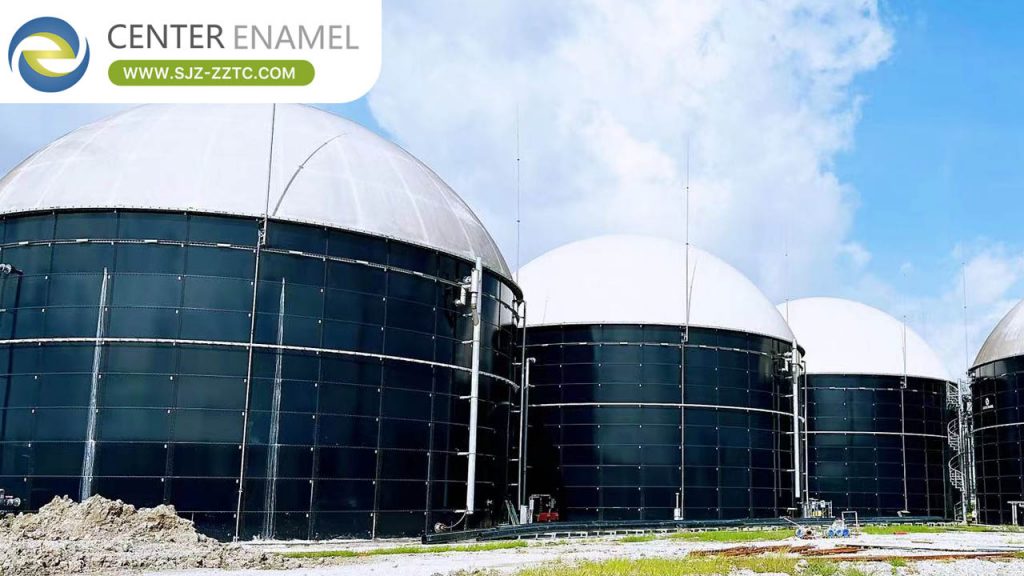
Complete-Mix (CSTR) Digesters use mechanical or gas mixing to maintain a homogeneous slurry within a vertical steel or concrete tank. They handle feedstocks with 3-10% total solids, making them ideal for food waste, manure slurries, and co-digestion blends. Typical HRT is 15-30 days; organic loading rates range from 2-5 kg VS/m3/day. CSTRs offer excellent process control but require higher CAPEX ($200-400 per cubic meter).
Plug-Flow Digesters are horizontal cylindrical or rectangular tanks where feedstock enters at one end and digestate exits at the other, with minimal longitudinal mixing. They excel at high-solids (8-15% TS) fibrous feedstocks like dairy and beef manure. HRT is typically 15-25 days. Plug-flow digesters have lower CAPEX ($150-250 per cubic meter) and simpler maintenance requirements.
Covered Lagoon Digesters are large, in-ground earthen basins fitted with flexible geomembrane covers. They suit very large-volume, low-solids (0.5-3% TS) waste streams like dairy flush manure. HRT extends 30-60+ days. They offer the lowest CAPEX ($30-80 per cubic meter) but only perform effectively in warm climates (mean temperature above 15 degrees C) without supplemental heating.
Comparative Data Table: Anaerobic Digester Performance
| Parameter | CSTR | Plug-Flow | Covered Lagoon |
| Feedstock TS Range | 3-10% | 8-15% | 0.5-3% |
| Operating Temperature | 35-38 degrees C (meso) | 35-38 degrees C (meso) | Ambient (warm climates) |
| HRT (days) | 15-30 | 15-25 | 30-60+ |
| OLR (kg VS/m3/day) | 2-5 | 2-4 | 0.5-1.5 |
| Methane Yield (m3/kg VS) | 0.30-0.45 | 0.25-0.40 | 0.20-0.35 |
| CAPEX ($/m3 volume) | $200-400 | $150-250 | $30-80 |
| Mixing System | Mechanical/gas | Self-driven | None |
| Best Suited For | Food waste, co-digestion | Dairy/beef manure | Large-volume dilute waste |
Digester Sizing: Engineering Formulas and Design Criteria
Sizing an anaerobic digester requires calculating the active volume needed to achieve target methane output while maintaining stable biological conditions. The fundamental sizing formula is:
Active Volume (m3) = Daily Feedstock Volume (m3/day) x HRT (days) / Utilization Factor (0.80-0.85)
For example, a project processing 50 t/day of food waste slurry (8% TS, density approximately 1,000 kg/m3) at 25 days HRT and 0.82 utilization factor requires: (50 m3/day x 25 days) / 0.82 = approximately 1,524 m3 of active digester volume. A safety margin of 15-20% is recommended for grit accumulation and foam events, bringing total volume to approximately 1,800 m3.
Additional design criteria include: heat exchanger capacity sized to maintain mesophilic temperature with 10 degrees C safety margin against winter conditions; feed pump redundancy (N+1); gas storage buffer equivalent to 6-12 hours of production; and digester mixing power of 5-10 W/m3 for CSTR configurations.
Frequently Asked Questions (FAQ)
Q1: What is the difference between mesophilic and thermophilic anaerobic digestion?
A: Mesophilic digestion operates at 35-38 degrees C and is the industry standard due to its stability, lower energy requirements, and resilience to temperature fluctuations. Thermophilic digestion operates at 50-55 degrees C, offering faster reaction kinetics (shorter HRT), higher methane yields (5-15% increase), and superior pathogen destruction. However, thermophilic systems require 50-80% more heating energy and are more sensitive to process upsets.
Q2: How do I choose between CSTR and plug-flow digester technology?
A: Choose CSTR for feedstocks below 10% solids, particularly food waste, slurries, and co-digestion blends that benefit from thorough mixing. Choose plug-flow for fibrous, high-solids (8-15% TS) feedstocks like dairy manure, where self-driven flow reduces mechanical complexity and operating costs. Covered lagoons are only viable for very dilute, large-volume waste in warm climates without freezing conditions.
Q3: What causes digester failure and how can it be prevented?
A: The most common digester failure modes are VFA accumulation (caused by overloading or temperature drop), ammonia toxicity (from high-protein feedstocks), and hydrogen sulfide inhibition. Prevention requires: maintaining OLR below the digester's rated capacity, continuous temperature monitoring with alarm systems, daily VFA/alkalinity ratio monitoring (target below 0.4), and hydrogen sulfide scrubbing when feedstocks contain sulfur-rich proteins.