
Anaerobic Digestion Explained: Process Stages, Benefits, and System Design
Anaerobic digestion is the biological process at the heart of the modern organic waste-to-energy industry. In sealed, oxygen-free digesters, microorganisms break down manure, food waste, crop residues, and wastewater sludge to produce biogas and a nutrient-rich residue called digestate. The technology is proven at every scale, from on-farm units to centralised industrial plants.
Operators who treat anaerobic digestion as a black box often pay the price: slow gas production, foaming, acidification, and costly shutdowns. Understanding the process scientifically is not an academic exercise - it is the difference between a plant that runs reliably for twenty years and one that struggles from commissioning onward.
This guide explains the four biological stages of anaerobic digestion, the design parameters that govern performance, and the full range of benefits a well-engineered system delivers to farms, municipalities, and industrial facilities.
Understanding the Four Stages of Anaerobic Digestion
The rate-limiting step is usually hydrolysis for solid feedstocks and methanogenesis for easily degradable substrates. System design must therefore balance organic loading with the slow growth of methanogenic archaea.
- Hydrolysis: complex polymers (carbohydrates, proteins, lipids) are broken into soluble sugars, amino acids, and fatty acids by hydrolytic bacteria.
- Acidogenesis: these soluble compounds are fermented into volatile fatty acids, alcohols, hydrogen, and carbon dioxide.
- Acetogenesis: volatile fatty acids are converted into acetic acid, hydrogen, and carbon dioxide - the direct substrates for methanogens.
- Methanogenesis: archaea convert acetic acid and hydrogen/carbon dioxide into methane and carbon dioxide, the two main components of biogas.
Key Design Parameters for Anaerobic Digestion Systems
Four parameters dominate the performance and stability of any anaerobic digestion system: temperature, retention time, organic loading rate, and carbon-to-nitrogen ratio. Together they determine digester size, gas yield, and operational risk.
- Temperature regime: mesophilic digestion at 35-40°C is the most stable and common; thermophilic digestion at 50-55°C delivers faster conversion and better pathogen kill but demands more energy and closer control.
- Hydraulic retention time (HRT): typically 20 to 40 days at mesophilic temperatures; shorter HRTs risk washing out slow-growing methanogens.
- Organic loading rate (OLR): commonly 2 to 5 kg VS/m³/day for wet digestion; exceeding the design OLR causes acidification.
- Carbon-to-nitrogen ratio: the ideal range is 20:1 to 30:1; manure alone is nitrogen-rich, so carbon-rich co-substrates such as crop residues are often blended in.
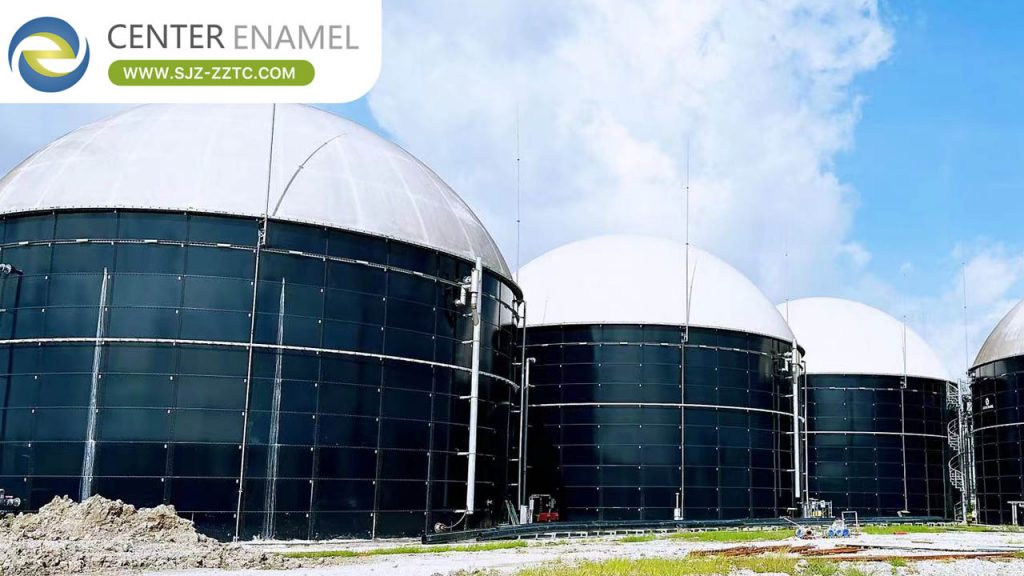
- Digester tank design: glass-fused-to-steel (GFS) and stainless steel tanks offer the corrosion resistance and gas-tightness required for decades of service.
Comparative Data Table: Operating Regimes
For most commercial biogas projects, mesophilic operation is the conservative, bankable choice, while thermophilic operation suits sites with stringent hygiene requirements or limited footprint.
| Parameter | Mesophilic | Thermophilic | Operational Impact |
| Temperature | 35-40°C | 50-55°C | Thermophilic faster, higher energy demand |
| Hydraulic Retention Time | 20-40 days | 12-25 days | Thermophilic allows smaller digester volume |
| Pathogen Reduction | Moderate | High (>90%) | Thermophilic suits food-waste pasteurisation |
| Process Stability | High | Lower (sensitive to shocks) | Mesophilic easier to operate for mixed feedstocks |
| Biogas Yield | Baseline | 5-15% higher | Must be weighed against extra heating cost |
Benefits Beyond Biogas Production
When designed and operated correctly, anaerobic digestion is one of the few technologies that simultaneously solves a waste problem, produces renewable energy, and returns nutrients to the soil - the definition of a circular-economy asset.
- Waste stabilisation: organic matter is reduced in volume and odour potential by 40 to 60 percent.
- Pathogen reduction: controlled digestion and optional pasteurisation make digestate safe for agricultural use.
- Nutrient recycling: nitrogen, phosphorus, and potassium are conserved and returned to soil as bio-fertilizer.
- Methane avoidance: capturing biogas prevents fugitive methane, a greenhouse gas roughly 28 times more potent than CO₂.
- Circular value: combined gas and digestate revenues typically improve project payback by two to three years.
Frequently Asked Questions (FAQ)
Q1: How long does anaerobic digestion take?
A: The complete process typically takes 20 to 40 days at mesophilic temperatures. Retention time depends on feedstock type, temperature, and digester design: thermophilic systems can complete digestion in 12 to 25 days, while some high-solids batch systems run for 30 to 60 days.
Q2: What can go wrong in an anaerobic digester?
A: The most common failures are acidification from overfeeding, ammonia inhibition from nitrogen-rich substrates, foaming from fats and proteins, and temperature shock. These are avoided by monitoring pH, volatile fatty acids, and gas composition, and by maintaining a balanced carbon-to-nitrogen ratio.
Q3: What is the difference between anaerobic and aerobic digestion?
A: Anaerobic digestion operates without oxygen and produces biogas (methane and carbon dioxide) plus digestate; aerobic composting operates with oxygen and produces heat, carbon dioxide, and compost. Anaerobic digestion captures the energy value of the waste and is the preferred route for wet, high-moisture feedstocks such as manure and food waste.