
Anaerobic Digestion Explained: Stages, Yield, And System Design
Anaerobic digestion is a four-stage microbial process that breaks organic matter into biogas without oxygen. Yield tracks the volatile solids fed, not the total volume: mature cattle manure typically returns 0.20-0.30 m3 of biogas per kg of volatile solids at 55-65% methane, with mesophilic digestion at 35-38 C and a retention time set by the feedstock.
What Anaerobic Digestion Is
Anaerobic digestion is the biological stabilisation of organic waste by microbes in the absence of oxygen. Unlike aerobic treatment, it produces a usable fuel (biogas) and far less sludge, which is why it sits at the centre of organic-waste energy recovery.
The Four Microbial Stages
Hydrolysis breaks complex solids into soluble sugars and amino acids; acidogenesis turns those into volatile fatty acids; acetogenesis converts them into acetate and hydrogen; and methanogenesis closes the chain into methane and carbon dioxide. If one stage is starved of the right conditions, the whole digester backs up.
| Stage | Microbes Act On | Produces |
| Hydrolysis | Complex solids | Soluble organics |
| Acidogenesis | Soluble organics | Volatile fatty acids |
| Acetogenesis | Fatty acids | Acetate and hydrogen |
| Methanogenesis | Acetate and hydrogen | Methane and CO2 |
Yield And The Levers That Move It
Gas yield is governed by volatile solids, temperature, and retention time. Co-digesting manure with energy crops or food waste shifts the carbon-to-nitrogen ratio toward 20-30:1 and lifts yield, but only when the extra feed is reliably available. Loading rate and retention time must be matched to the digester volume.
System Design Basics
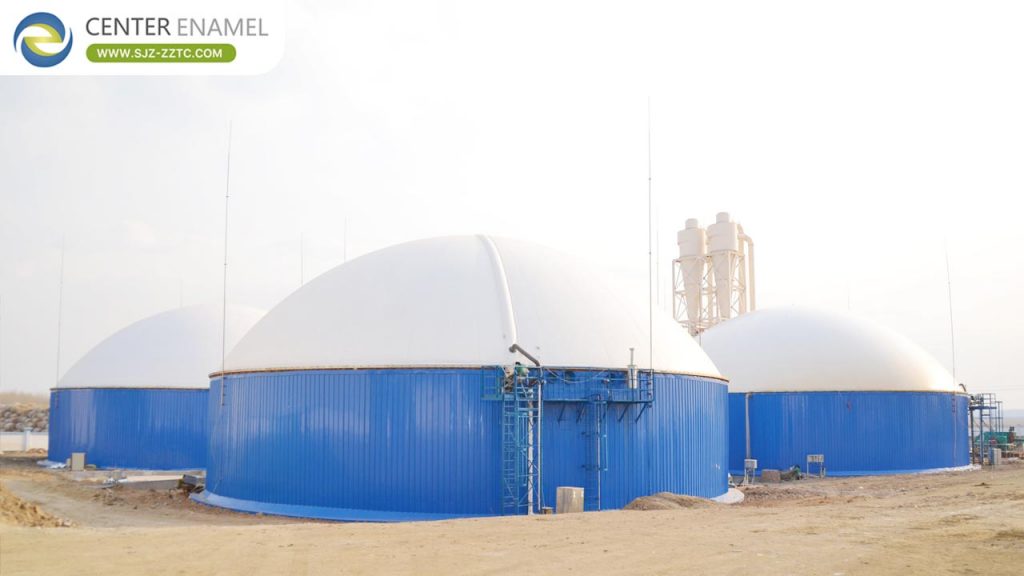
A CSTR suits uniform slurries, a UASB suits low-solid warm effluents with granular sludge, and a USR holds coarse high-solid feed. The sealed digester is usually a Glass-Fused-to-Steel tank, chosen for corrosion resistance and fast, factory-controlled assembly.
Project Case Study: Malaysia Biogas Project
Project / Application: Large-scale biogas from agro-industrial wastewater, Malaysia. Industry: Food and agro-industrial. Tank Type: Glass-Fused-to-Steel (GFS). Key Requirements: High-rate digestion of high-strength effluent with reliable daily gas output.
| Field | Value | Source / Evidence |
| Tank Type | GFS (Glass-Fused-to-Steel) | Company project reference |
| Tank Quantity | 5 Nos. | Company project reference |
| Dimensions Per Tank | O24.46 x 12 m | Company project reference |
| Volume Per Tank | 5,400 m3 | Calculated from supplied diameter and height |
| Total Effective Volume | 27,000 m3 (5 tanks) | Company project reference |
| Daily Biogas Production | 22,000 m3 total | Company project reference |
| Digestibility | approx 80% | Company project reference |
| Gas Yield Rate | 0.45 m3 / kg COD removed | Company project reference |
| Parameter | Inlet | Effluent |
| COD | greater than or equal to 60,000 mg/L | greater than or equal to 12,000 mg/L |
| BOD | less than or equal to 25,000 mg/L | less than or equal to 5,000 mg/L |
About The Supplier
Shijiazhuang Zhengzhong Technology Co., Ltd (Center Enamel) manufactures Glass-Fused-to-Steel tanks rated for anaerobic digestion, with enamel firing at 820-930 C and certifications including ISO 9001, NSF/ANSI 61, and CE-EN 1090. The bolted design supports rapid deployment for high-rate biogas projects.
Comparison: Digester Types
| Type | Best Feed | Note |
| CSTR | Uniform slurry | Heated and mixed |
| UASB | Low-solid warm effluent | Builds granular sludge |
| USR | High-solid coarse feed | Holds solids without fine mixing |
Anaerobic digestion is a biological system first and a tank second. Get the four stages, the volatile-solids balance, and the retention time right, then let a sealed GFS digester make the biogas recovery practical.
Frequently Asked Questions
Q1: What is anaerobic digestion? A1: A four-stage, oxygen-free microbial process that turns organics into biogas and stabilised residue.
Q2: What are the four stages? A2: Hydrolysis, acidogenesis, acetogenesis, and methanogenesis.
Q3: How much biogas per kg of solids? A3: Mature cattle manure typically yields 0.20-0.30 m3 per kg of volatile solids at 55-65% methane.
Q4: What temperature does AD need? A4: Mesophilic digestion typically runs at 35-38 C; thermophilic is higher but less robust.
Q5: What is the C:N ratio for? A5: A balanced 20-30:1 keeps microbes fed without ammonia inhibition.
Q6: Which digester suits manure? A6: A CSTR for slurry; USR or UASB for higher solids or liquid fractions.
Q7: How much tankage is needed? A7: It scales with daily feed and retention time; one project used five 5,400 m3 GFS tanks for 22,000 m3/day biogas.
Q8: Is AD better than aerobic? A8: For high-strength organics it produces fuel and less sludge, but needs sealed, heated tanks.
Share your feedstock composition and daily volume with an engineer, or request a digester type and tankage recommendation.