
Advanced GFS Tanks and Anaerobic Digestion for Reliable Beverage Wastewater Treatment Projects
The core challenges of industrial wastewater treatment center on the "three highs"-high difficulty, high cost, and high energy consumption. Wastewater from new energy, chemical, and pharmaceutical industries is complex in composition with numerous characteristic pollutants, and traditional treatment processes are difficult to remove effectively. Chinese companies have significant price advantages in the mid-to-low-end equipment segment. The industry also faces continuous technological upgrade pressure from increasingly stringent emission standards, as well as new requirements for digitalization and low-carbon transformation on operational refinement management capabilities.
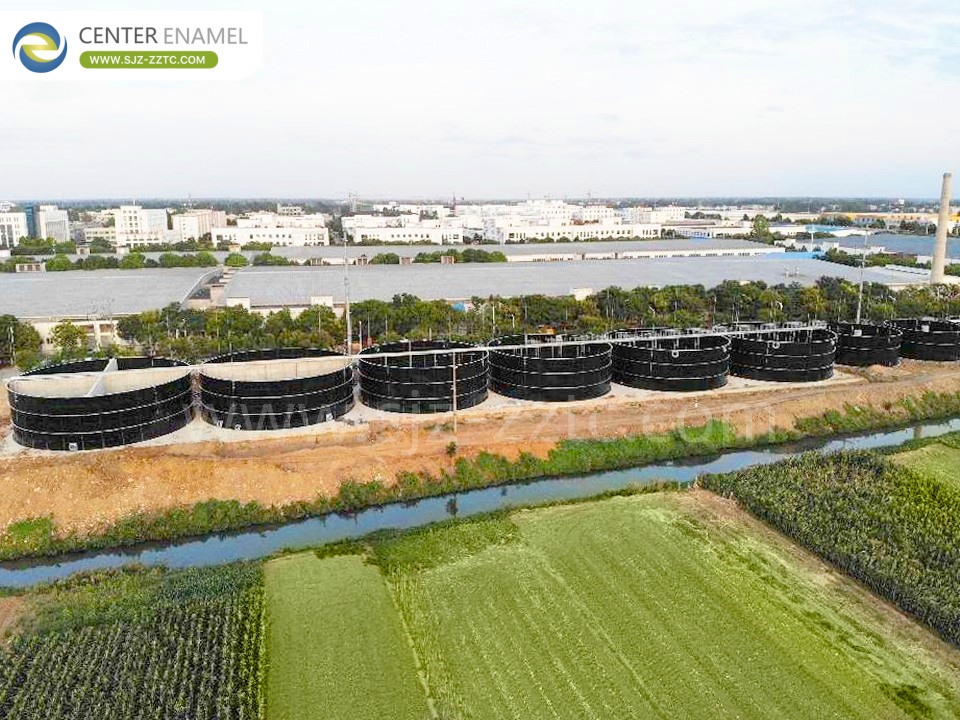
Addressing these systemic challenges requires not only innovative process design but also fundamental upgrades in critical infrastructure, particularly in tank containment systems that must withstand aggressive media over decades of service. This is precisely where the exceptional durability of modern storage solutions becomes a decisive factor for long-term operational success.
GFS Tanks Corrosion Resistance Far Superior to Traditional Concrete Tanks
Center Enamel's independently developed double-sided double-layer enameling technology is the industry's leading coating anti-corrosion technology, with corrosion resistance completely surpassing concrete tanks. Concrete tank interiors are riddled with pores, allowing wastewater and acid/alkaline media to easily penetrate and corrode the structural layer. Long-term use leads to irreversible problems such as internal wall spalling, water seepage, and rebar corrosion, which are difficult to repair and cannot be fundamentally resolved.
GFS tanks feature high-temperature enameling on both the interior and exterior surfaces of steel panels, with a dense, non-porous enamel finish that completely blocks corrosive liquids and biogas permeation. The enamel layer has extremely strong chemical stability, resisting acids, alkalis, salts, and microbial corrosion. Concrete tanks will develop extensive corrosion and leakage after 5-8 years of use, while GFS tank anti-corrosion service life can exceed 30 years, with no need for frequent internal lining repairs throughout the service life, significantly reducing long-term anti-corrosion maintenance investment and fundamentally eliminating environmental risks of medium leakage contaminating sites and groundwater. Compared to traditional concrete and FRP tanks, GFS tank coatings have no risk of peeling or blistering, and are adaptable to highly corrosive conditions such as palm oil mill effluent, livestock manure, and chemical high-salinity wastewater, with outstanding long-term comprehensive cost advantages.
This proven corrosion resistance makes GFS Tanks the preferred containment solution for high-strength organic effluents, particularly when combined with robust biological treatment stages. Their ability to maintain structural integrity under aggressive conditions ensures that subsequent treatment processes, such as Anaerobic Digestion, can operate at peak efficiency without the risk of containment failure.
UASB Process Advantages in Anaerobic Digestion
No mechanical mixing equipment is required, with sludge suspension achieved through hydraulic action, resulting in very low overall energy consumption. High-concentration anaerobic granular sludge can be cultivated, with high sludge concentration, strong activity, excellent settleability, low sludge washout, and low sludge yield, significantly reducing sludge disposal costs. The integrated design combines reaction, sedimentation, and separation simultaneously, with small footprint and moderate capital investment. Simple structure with low failure rates and convenient maintenance. High volumetric loading rate with excellent organic pollutant degradation efficiency and good shock load resistance. Stable biogas production with high resource recovery value. The process is mature and widely adopted, with well-established construction, commissioning, and O&M systems, suitable for large-scale industrial wastewater treatment.
When these process advantages are coupled with Center Enamel's GFS Tanks as reactor vessels, the resulting Anaerobic Digestion system achieves superior treatment performance with minimized operational interruptions. This synergy is particularly valuable for the food and beverage sector, where consistent high-rate digestion of sugar-laden waste streams is essential for meeting discharge limits while recovering energy.
Beverage Wastewater Environmental Toxicity of Pollutants
Beverage wastewater pollutants are entirely natural food components (sugars, fruit juice, tea)-no synthetic toxic chemicals-extremely low chemical toxicity and good environmental safety. Core pollutants are high-concentration soluble sugars-non-toxic to aquatic organisms, but direct discharge leads to rapid aerobic decomposition, severely depleting dissolved oxygen and causing fish suffocation-a classic oxygen-demanding pollution problem. Fruit juice organic acids lower receiving water pH, affecting aquatic life. Tea polyphenols affect water color and taste at trace levels. High sugar content promotes rapid microbial growth, mold, and decomposition/odor. Long-term discharge causes organic pollution, algal blooms, and eutrophication. Overall pollution is primarily oxygen-demanding organic pollution-no heavy metals or persistent organic accumulation risks-pollutants are rapidly naturally degradable with short environmental recovery periods.
Understanding this specific pollutant profile is critical for designing an effective Beverage Wastewater Treatment Project. The high organic strength and biodegradability of these waste streams make them ideal candidates for Anaerobic Digestion technologies housed in durable GFS Tanks, which can efficiently convert pollutants into biogas while preventing corrosion from organic acids.
Project Showcase: Ghana Municipal Domestic Wastewater Treatment
Completed installation in 2021, treating 1,800 m³/day of municipal wastewater using UBF anaerobic + A²/O nitrogen/phosphorus removal mature processes. Equipped with multiple Center Enamel GFS tanks including 1 UBF anaerobic reactor, 1 secondary clarifier, and 2 internal/external double-layer A²/O biological tanks. Influent has high COD, BOD, suspended solids, and nitrogen/phosphorus concentrations-after full treatment, effluent parameters are significantly reduced with pH stable at 6.5-9.0, fully meeting local environmental discharge standards. Corrosion-resistant, conveniently assembled GFS tanks efficiently solve urban domestic wastewater pollution while balancing treatment effectiveness and O&M economics-a mature municipal wastewater case in Africa. This project demonstrates how standardized GFS Tank solutions, combined with proven anaerobic processes, can deliver reliable performance across diverse geographical and regulatory contexts.
Installation and Construction Team Expertise
The installation team has practical experience from over 10,000 GFS tank projects globally, strictly following standardized construction procedures-full control over project mobilization, civil coordination, tank assembly, piping, and commissioning schedules and quality.
The team is proficient in complete standardized installation processes for GFS tanks, dual-membrane gas storage covers, USR/CSTR/IC anaerobic reactors, and biogas desulfurization/piping systems-adaptable to large-scale farms, industrial parks, remote mountainous sites, coastal high-corrosion sites, and other complex locations-strictly implementing unified global safety construction standards. For large overseas cross-border projects, the team can be deployed as complete units for on-site construction, technical training, and local worker practical instruction-full control over construction details, air-tightness testing, and corrosion protection-ensuring timely and stable commissioning of global environmental projects through standardized delivery capability. This deep installation expertise ensures that every GFS Tank and Anaerobic Digestion system performs according to design specifications from day one, protecting client investments.
Center Enamel's Extensive Global Benchmark Project Cases
Center Enamel's project portfolio covers over 100 countries across Southeast Asia, Africa, Europe, and the Americas-30,000+ mature projects-accumulating complete industry solutions across palm oil, livestock, municipal, brewing, and food waste biogas-rapidly matching customized solutions for different regional climates, water quality, and regulations. This vast repository of real-world applications provides invaluable reference data for designing optimized treatment trains, from pretreatment through Anaerobic Digestion in GFS Tanks to final polishing steps, ensuring that every new Beverage Wastewater Treatment Project benefits from proven engineering best practices.
Frequently Asked Questions
Q1: Why are GFS Tanks ideal for high-strength industrial wastewater treatment?
GFS Tanks offer superior corrosion resistance with a dense enamel coating that withstands acidic, alkaline, and saline conditions for over 30 years-far exceeding concrete tanks which typically leak within 5-8 years-significantly reducing maintenance costs and environmental risks.
Q2: How does Anaerobic Digestion benefit Beverage Wastewater Treatment Projects?
Anaerobic Digestion efficiently degrades high-sugar organic loads in beverage wastewater, achieving over 80% COD removal while producing methane-rich biogas for energy recovery. The UASB process requires no mechanical mixing, features low energy consumption, and generates minimal sludge.
Q3: What global project support does Center Enamel provide for wastewater treatment?
Center Enamel offers complete EPC services and installation teams with experience from over 10,000 GFS tank projects globally. They provide standardized construction, on-site training, and long-term after-sales support across 100+ countries, ensuring reliable project delivery.