
Why Anaerobic Digestion Now Leads Industrial Wastewater Treatment
The rules changed faster than most plants did. Discharge compliance, once the whole objective, is now the entry ticket. Regulators want reuse, recovered energy and a documented carbon story, and they want all three without compromising uptime. That shift explains why Anaerobic Digestion has moved from an optional pretreatment step to the load-bearing wall of modern Industrial Wastewater Treatment, and why the partner delivering it matters as much as the process itself.
From Discharge Limits to Resource Recovery
Europe set the direction with its Circular Economy Action Plan, which pushes member states toward higher industrial water reuse rates and extends carbon accounting across the full life cycle of treatment. China keeps tightening discharge standards, with steadily lower ceilings on total nitrogen, total phosphorus and industry-specific pollutants in chemicals, pharmaceuticals, and printing and dyeing. Water-scarce regions and heavily polluting sectors are being pushed toward zero or near-zero liquid discharge. Germany took a different route, building sector-by-sector pretreatment standards so that industrial effluent must reach defined quality before it enters a municipal plant.
Read together, these regimes point the same way: a plant that only removes pollutants is now a cost centre with a compliance risk attached. One that recovers energy, cuts sludge and documents its footprint is an asset. Anaerobic Digestion is what makes that transition physically possible, and an experienced China Industrial Wastewater Treatment Project EPC Contractor is what makes it commercially deliverable.
What Anaerobic Digestion Actually Delivers
At its core the process is simple: microorganisms consume organic matter in the absence of oxygen and produce biogas, a renewable fuel, while converting most of the load into gas rather than into waste sludge. For food and beverage, chemical and pharmaceutical streams, that means two returns at once, COD removal high enough to protect downstream stages, and energy that offsets operating cost.
The gains come from integration, not from a reactor alone. A GFS tank fitted with a gas-lift internal circulation system and upper and lower three-phase separators handles circulation and sludge separation without external return pumps. Precision bottom distribution and pressure-regulated feed devices keep influent uniform. Lift pumps, equalization and flow metering hold the feed steady. At the top, integrated collection, desulfurization, dehydration and storage convert biogas into usable energy, while online monitoring tracks temperature, pH, COD and levels in real time.
Building the Treatment Train Around the Effluent
No single reactor carries a plant to compliance. For high-sugar, readily biodegradable effluent, the reliable configuration runs pretreatment, anaerobic digestion, aerobic polishing and final treatment, each stage sized to what the previous one leaves behind.
Pretreatment screens out pulp, tea residue and other solids before they reach a pump. Equalization absorbs the swing between concentrated cleaning-in-place (CIP) pulses and dilute filling water, with alkali dosing to correct acidic streams. The anaerobic stage, typically UASB or an IC reactor, then removes the bulk of the sugar load and captures the energy in biogas. Aerobic A/O or SBR stages finish residual organics and handle nitrogen and phosphorus, and sedimentation, filtration and disinfection close the loop.
| Treatment Stage | Primary Function | Design Consideration |
| Pretreatment | Remove pulp, tea residue and solids | Prevents clogging in pumps and lines |
| Equalization and pH control | Absorb CIP peaks, neutralize acidic streams | Sized on peaks, not averages |
| Anaerobic digestion | Degrade high-strength sugars, produce biogas | UASB or IC reactor in GFS tanks |
| Aerobic polishing | Residual COD, nitrogen and phosphorus | A/O or SBR configuration |
| Final treatment | Sedimentation, filtration, disinfection | Meets local discharge or reuse limits |
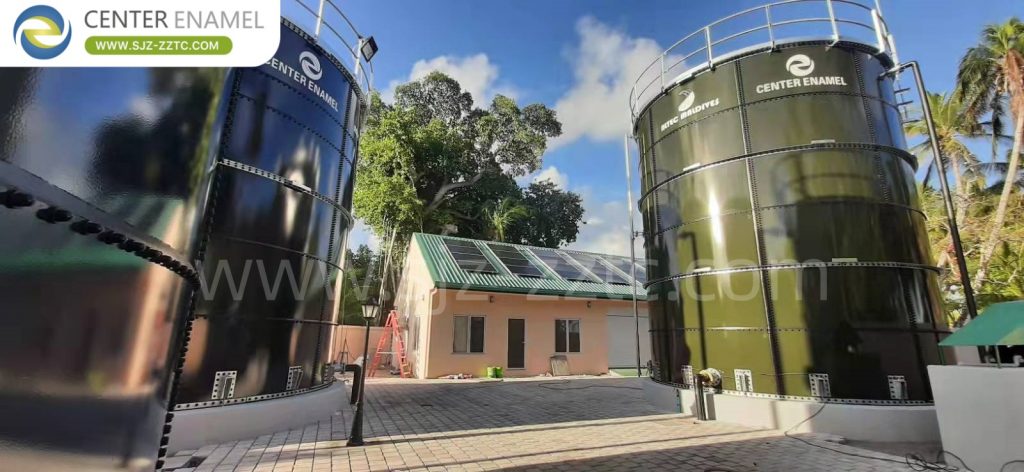
For the digesters, Center Enamel specifies GFS tanks built to resist organic acid and sugar fermentation corrosion. The train stays simple and highly automated, which suits the intermittent, seasonal discharge pattern typical of beverage plants.
Equipment That Has to Survive the Chemistry
Process design fails when the steel behind it fails. Center Enamel works from a product matrix rather than a catalogue: core storage, covers, specialty vessels and engineering services, with in-house enamel frit development, manufacturing and GFS application under one roof.
GFS tanks use double-sided hot-rolled, double-layer enamel corrosion protection, holding up against strong acids, alkalis, high salinity and microbial attack, and assembling modularly on site. Fusion bonded epoxy tanks, produced on China's first intelligent standardized line, serve drinking water, firewater and neutral media. Aluminum dome covers use a proprietary self-supporting alloy structure that meets international waterproof and load-bearing standards for sealing and biogas capture. The range is completed by carbon steel, stainless steel and composting tanks plus non-standard pressure vessels, and by environmental EPC contracting and anaerobic section subcontracting across food waste, leachate, municipal wastewater, livestock biogas, petrochemical, metallurgical and desalination work.
| Product Category | Key Offering | Where It Fits |
| Core storage | GFS tanks, double-sided enamel | Corrosive wastewater, biogas, chemical duty |
| Potable and fire water | Fusion bonded epoxy tanks | Drinking water, firewater, neutral media |
| Sealing and gas capture | Aluminum dome covers | Biogas collection, odour and weather sealing |
| Other vessels | Carbon steel, stainless steel, composting tanks | Supporting and non-standard duty |
| Engineering | Environmental EPC and anaerobic subcontracting | Single-point process and build responsibility |
Proof from Delivered Projects
Specifications read well on paper; operating history reads better. Center Enamel's reference list spans more than a decade of overseas work, including Nordic fermentation duty and the first Chinese GFS tank installed in the United States.
| Project | Year | Scope | Why It Matters |
| Niger | 2009 | First overseas drinking water tank | Established overseas installation capability |
| United States | 2015 | First Chinese GFS tank exported and installed | Passed strict US acceptance standards |
| Sweden | 2024 | UASB digestion, Ø 19.11 m × 19.2 m GFS fermenter | Cold-climate biogas recovery, European demonstration project |
Service and Credentials That Clear Tenders
Complex international projects fail on logistics more often than on biology. Regional sales centres in China and local agent networks support a service loop built on four commitments: round-the-clock response, on-site installation at home and abroad, support across the full project cycle, and long-term warranty cover. That chain runs from the first site survey through construction management to inspection and maintenance, and it removes coordination cost from the client side.
The commercial team behind it includes environmental specialists and multilingual trade staff working in English, French, Spanish and Arabic, with working knowledge of discharge rules, biogas subsidy schemes and carbon trading mechanisms in major markets. Certifications including CE, NSF, WRAS, ISO 9001, BSCI and ASME clear tendering barriers in the EU, North America, Southeast Asia and Africa.
Why a China EPC Partner Makes Commercial Sense
Chinese manufacturers have consolidated a durable position in mid-tier equipment exports by pairing proven designs with competitive fabrication economics. Integrating enamel R&D, intelligent manufacturing and EPC contracting under one entity shortens the path from specification to handover, and keeps cost, safety and local adaptation in a single balance. What a client gains is not a cheaper reactor but a narrower gap between what was designed and what gets built.
Frequently Asked Questions
How does anaerobic digestion support zero liquid discharge targets?
It removes the bulk of the organic load before aerobic stages, so aeration energy and waste sludge both drop. Lower energy demand and smaller sludge volumes make the downstream membrane and evaporation steps behind zero liquid discharge more affordable to run, and the biogas offsets part of the plant's own power draw. The trade-off is equalization upstream, so CIP peaks reach the reactor already smoothed.
Are GFS tanks suitable for anaerobic digesters?
Yes. The double-sided enamel coating resists the organic acids and sulphides formed during digestion, and the vitrified surface will not corrode or blister the way painted steel can. Tanks are gas-tight, assemble quickly from modular panels, and are typically specified for a service life beyond 30 years. Coating thickness and frit quality are what separate a 30-year shell from a ten-year one.
Can Center Enamel deliver projects outside China?
Yes. More than a decade of overseas installation, regional sales centres and local agents support worldwide delivery, with 24/7 response and on-site installation. CE, NSF and ASME certification allow equipment to enter EU, North American, Southeast Asian and African tenders without re-testing. Local agents also handle customs, installation crews and spare-part logistics.
Send us your effluent data, discharge limits and site conditions, and our engineers will return a process configuration with indicative capex and operating cost.
Talk to Center Enamel about your Industrial Wastewater Treatment project, and we will help you match Anaerobic Digestion capacity to your real load profile before you commit to a design.