
Anaerobic Digestion of Pig Manure: A Comprehensive Guide to Biogas Production
In the modern agricultural landscape, the concept of "waste" is being fundamentally redefined. For centuries, the management of livestock excrement—specifically pig manure—was viewed as a significant logistical burden and a potential environmental hazard. Today, however, as the world moves toward a circular economy and aggressive decarbonization, pig manure has emerged as a high-value strategic asset. Through the systematic application of Anaerobic Digestion of Pig Manure, this biological residue is being transformed into a reliable stream of renewable energy and premium organic fertilizer.
Shijiazhuang Zhengzhong Technology Co., Ltd, operating under the world-renowned brand Center Enamel, has established itself as a global pioneer in this field. With over thirty years of engineering excellence and a project footprint spanning more than one hundred countries, we provide the integrated engineering, procurement, and construction (EPC) services required to turn complex manure management challenges into profitable Biogas Production opportunities. This guide explores the technical, environmental, and economic foundations of this transformative technology.
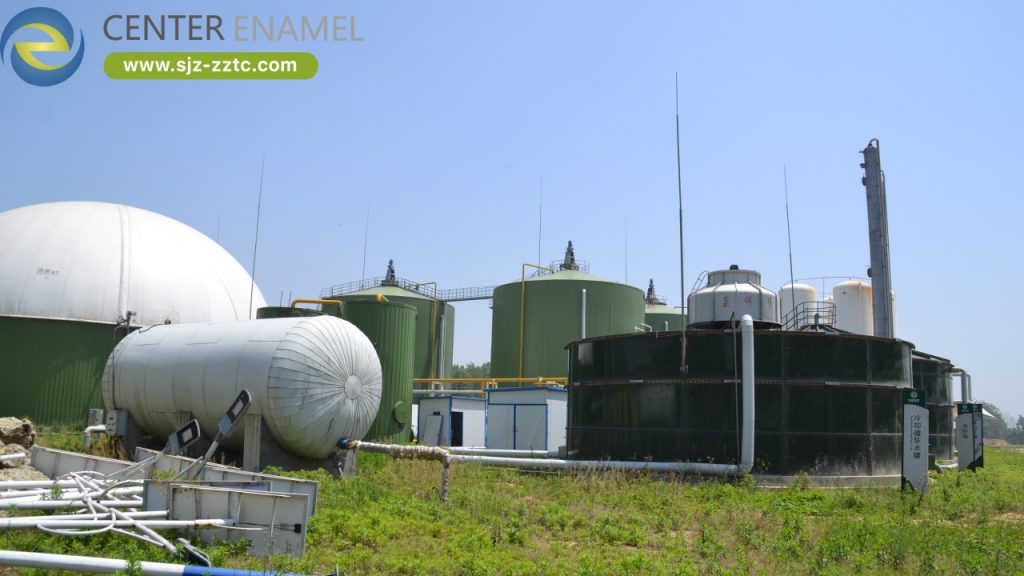
The Biological Science of Biogas Production
The process of Anaerobic Digestion of Pig Manure is a natural biological phenomenon that occurs in the absence of oxygen. When managed within a professionally engineered environment, this process becomes a highly efficient "biological factory" for energy recovery.
1. The Four Stages of Digestion
The conversion of pig manure into biogas is not a single reaction but a complex, four-stage biological sequence:
Hydrolysis: Large organic polymers (proteins, fats, and carbohydrates) are broken down into smaller, soluble monomers like amino acids and sugars.
Acidogenesis: These monomers are further degraded by acidogenic bacteria into volatile fatty acids, ammonia, and carbon dioxide.
Acetogenesis: The volatile fatty acids are converted into acetic acid, hydrogen, and carbon dioxide.
Methanogenesis: In the final and most critical stage, specialized methanogenic microorganisms convert these intermediates into methane and carbon dioxide—the primary components of biogas.
2. Optimizing the Environment for Methanogens
Methanogens are the most sensitive organisms in the digester. To ensure consistent Biogas Production, the internal environment must be strictly controlled. This includes maintaining a stable pH (typically between 6.5 and 8.0) and a constant temperature. Most industrial systems operate in the mesophilic range (near 35 to 40 degrees Celsius), as this provides a balance between high gas yields and process stability.
Strategic Advantages of Anaerobic Digestion of Pig Manure
Implementing an advanced digestion system provides a multi-layered return on investment that extends far beyond simple waste disposal.
1. Renewable Energy Independence
The primary output of the system is biogas, a versatile fuel that can be used to generate electricity and heat through Combined Heat and Power (CHP) units. For large-scale swine operations, this energy can cover all on-farm needs, reducing reliance on expensive utility grids. Furthermore, excess energy can often be sold back to the grid, creating a significant new revenue stream.
2. Environmental Stewardship and Decarbonization
Pig manure is a source of methane, a greenhouse gas significantly more potent than carbon dioxide. By capturing this methane within our sealed GFS tanks, we prevent its release into the atmosphere. This process directly supports global climate goals and helps farms comply with increasingly strict environmental regulations regarding air and water quality.
3. Odor Control and Pathogen Reduction
The Anaerobic Digestion of Pig Manure significantly reduces the volatile compounds responsible for the strong odors associated with swine farms. Additionally, the high-temperature environment within the digester destroys more than 90 percent of disease-causing pathogens, creating a healthier environment for both the livestock and the local community.
Engineering Excellence: The Center Enamel Solution
A successful biogas project requires containment infrastructure that can withstand the uniquely corrosive nature of pig manure. At Center Enamel, our core strength lies in our proprietary Glass-Fused-to-Steel (GFS) technology.
1. Glass-Fused-to-Steel (GFS) Tanks
Our GFS tanks are the gold standard for Anaerobic Digestion. By fusing a specialized glass enamel to steel at temperatures exceeding 800 degrees, we create a material that is both structurally robust and chemically inert.
Superior Corrosion Resistance: Pig manure produces hydrogen sulfide and organic acids that can quickly degrade concrete or standard steel. Our GFS tanks are impervious to these substances, ensuring a service life of several decades.
Modular Assembly: Our bolted design allows for rapid on-site construction regardless of weather conditions, significantly reducing project timelines compared to traditional methods.
2. Advanced Roofing Systems for Gas Management
For a turnkey Biogas Production facility, the choice of roofing is critical for safety and efficiency.
Double Membrane Roofs: These function as an integrated gas holder. The flexible inner membrane stores the produced biogas, while the pressurized outer membrane protects the system from external wind and snow loads.
Aluminum Dome Roofs: For the storage of treated digestate or process water, our Aluminum Dome Roofs offer a maintenance-free, clear-span solution that protects the resource from contamination while providing a professional, geodesic aesthetic.
Maximizing Efficiency through Turnkey EPC Services
Center Enamel provides more than just tanks; we deliver complete turnkey solutions. As an experienced EPC contractor, we manage every phase of the Anaerobic Digestion of Pig Manure project:
Feasibility & Design: We analyze the specific manure characteristics and energy goals of the farm to design a customized system, often utilizing the Continuous Stirred-Tank Reactor (CSTR) process for its superior mixing and stability.
Manufacturing: All GFS panels and specialized components are manufactured in our ISO-certified facilities, ensuring compliance with international standards like AWWA D103 and ISO 28765.
Installation & Commissioning: Our global teams oversee the rapid assembly and biological startup of the system, ensuring the microbial community is healthy and gas production is optimized.
Global Success Stories: Proven Results in the Field
Center Enamel’s expertise is backed by a history of successful, high-capacity installations. These real-world applications demonstrate our ability to deliver reliable infrastructure for Biogas Production across various regions.
Shandong Heze Biogas Project: This major regional energy project utilized 3 units of our high-performance GFS tanks. The facility successfully converts massive volumes of agricultural residues into a stable supply of renewable energy, showcasing the scalability of our modular technology.
Inner Mongolia Hinggan League Project: Operating in one of the most challenging climates in Asia, this project features 4 units of our advanced bolted steel tanks. The system consistently produces high-purity bio-natural gas from organic waste, proving the durability of our engineering against extreme temperature fluctuations.
Jiangsu Xuzhou Biogas Project: This industrial-scale facility utilized 4 units of our GFS containment technology. By processing concentrated organic waste streams, the project has become a benchmark for efficient nutrient recovery and carbon footprint reduction in the province.
Leading the Future of Agricultural Energy
The Anaerobic Digestion of Pig Manure is a vital technology for the future of sustainable farming. By embracing the principles of resource recovery, the swine industry can transform its environmental challenges into a robust foundation for energy independence and economic growth.
At Shijiazhuang Zhengzhong Technology Co., Ltd (Center Enamel), we are committed to providing the innovative containment solutions and engineering expertise required to make this vision a reality. Through our world-class GFS tanks, integrated Double Membrane Roofs, and maintenance-free Aluminum Dome Roofs, we are helping the global livestock industry build a cleaner, greener, and more profitable future.