
How Does Anaerobic Digestion Reshape Papermaking Wastewater Treatment?
Papermaking is one of the most water-intensive industries in the world, and its effluent is one of the hardest to tame. Between alkaline white water, fiber-rich process streams and lignin-loaded black liquor, a single mill can generate a pollutant load that conventional treatment simply cannot absorb. This is precisely where anaerobic digestion changes the economics of the entire plant-not by polishing the problem away, but by converting it into energy, recoverable material and reusable water.
The framework below connects the industry's core pain points, the engineering inside an IC anaerobic system, the standardized papermaking train, a proven overseas case, and the service model that holds it all together.
Industrial Wastewater's Toughest Challenges, Explained
Any credible solution has to start with an honest diagnosis. Industrial wastewater treatment is still defined by what the sector calls the "three highs": high difficulty, high cost, and high energy consumption. Effluents from new energy, chemical and pharmaceutical production carry complex compositions and a long list of characteristic pollutants, and traditional processes struggle to remove them reliably. Meanwhile, tightening discharge standards keep pushing plants toward further technological upgrades, while digitalization and low-carbon transformation add new demands on operational precision.
These pressures are structural rather than temporary. That is why the industry is shifting from "treat and discharge" toward "recover and reuse"-and why anaerobic digestion, which removes organic load while producing biogas, has moved from an optional add-on to a core building block of modern industrial wastewater design.
What Sits Inside an IC Anaerobic Digestion System
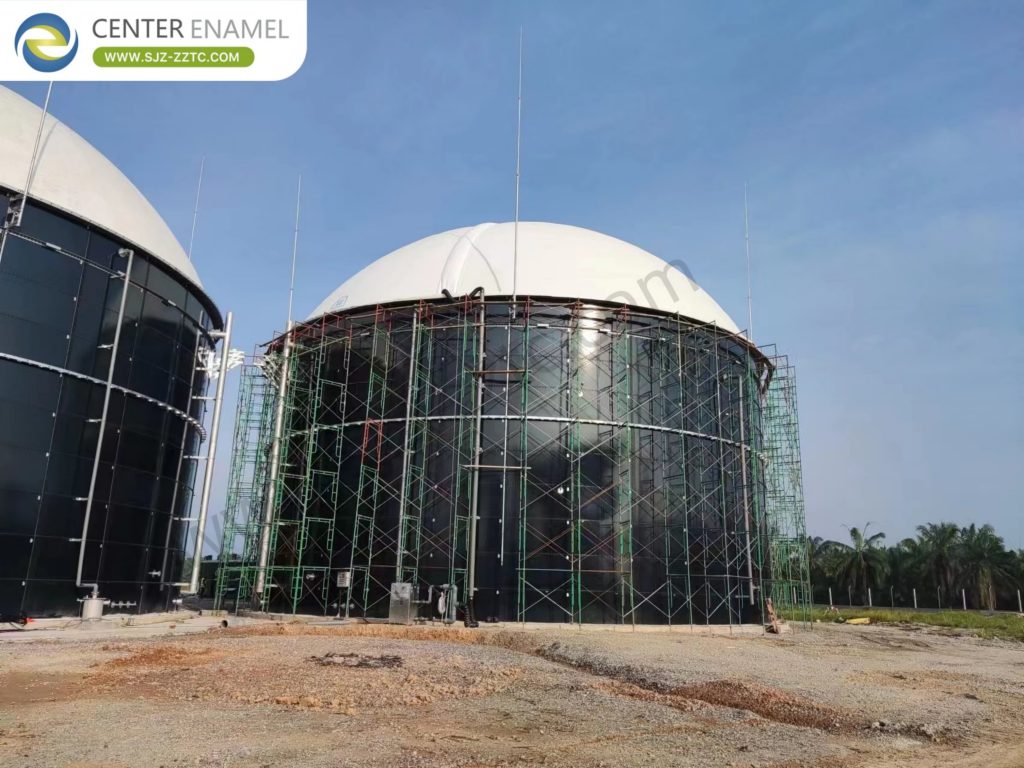
If anaerobic digestion is the engine, the internal circulation reactor is its combustion chamber. The heart of the system is a GFS tank fitted with a built-in gas-lift internal circulation loop and upper and lower three-phase separators-the components responsible for autonomous circulation and reliable sludge-water separation.
Around that core sit the supporting layers that determine whether the reactor performs steadily or intermittently. A bottom precision distribution system and a pressure-regulating feed device keep influent uniform and stable. Influent lift pumps, equalization tanks and flow meters give operators precise control over loading. At the top, high-efficiency biogas collection, desulfurization, dehydration and storage are integrated into one package, while high-precision online monitoring tracks temperature, pH, COD and liquid level in real time. Dedicated sludge discharge pipes at the bottom and mid-section handle recirculation without any external return pump.
The result is a highly integrated skid: compact in structure, free of redundant external equipment, and heavily automated-which matters enormously when a mill runs the system around the clock with a lean operations team.
Case in Focus: High-Strength Brewery Wastewater in South Africa
Before applying this logic to paper, it is worth looking at where it has already been proven. In South Africa's brewing sector, a high-concentration organic wastewater project was delivered using Center Enamel GFS tanks alongside stainless steel tanks as the core equipment set.
Table 1-South Africa brewery wastewater project configuration
| Project Aspect | Configuration | Purpose and Outcome |
| Market and effluent type | Brewing industry, high-concentration organic wastewater | Addresses a pollution challenge specific to the local brewing cluster |
| Core anaerobic digestion system | GFS tanks as the primary anaerobic stage | Suits high-COD, high-sugar, readily degradable brewery streams; delivers efficient organic pollutant destruction |
| Supporting tanks | Stainless steel tanks for wastewater transfer and chemical storage | Keeps auxiliary processes stable and contamination-free |
| Corrosion and durability strategy | Corrosion-resistant linings and stainless-steel wetted surfaces | Supports long-term service in aggressive, variable effluent |
| Installation approach | Flexible bolted assembly, shop-fabricated components | Shortens site works and simplifies logistics in remote regions |
| Operational result | Continuous treatment of production and cleaning wastewater | Long-term stable performance with a mature reference in Africa |
The lesson travels well. A brewery's sugar-rich stream and a paper mill's fiber- and lignin-rich stream differ in composition, yet both reward the same principle: take the organic load out anaerobically, recover the gas, and let aerobic stages do the finishing work.
How a China Papermaking Wastewater Treatment Project EPC Contractor Builds the Train
That principle becomes a repeatable design when a China papermaking wastewater treatment project EPC contractor standardizes the whole sequence rather than selling isolated tanks. The reference train combines white water recirculation, physicochemical pretreatment, anaerobic digestion and aerobic treatment, with one governing strategy: maximize recycling so the volume that must be discharged keeps shrinking.
White water recirculation is the water-saving backbone. Paper machine white water passes through microfiltration, dissolved air flotation and disc filters, and the recovered fiber goes straight back to repulping-cutting discharge volume by roughly 60–80%. Screens and fine screens then recover fiber and filler suspended solids for sale, while coagulation, sedimentation and DAF remove the remaining colloids and fine solids. Cooking black liquor is collected separately and routed to alkali recovery boilers, where alkali is reclaimed and lignin is burned for steam, reducing pollution at the source instead of at the end of the pipe.
Only after that does the biological core take over: IC or UASB anaerobic digestion followed by A/O aerobic treatment for dissolved organic degradation, with chemical decolorization and membrane filtration added as a final polish wherever discharge standards demand it. Because alkalinity and lignin corrosion punish ordinary materials, every tank in the chain is built on Center Enamel GFS technology.
Table 2-Standardized treatment train for papermaking effluent
| Stage | Primary Objective | Key Equipment | Contribution |
| White water recirculation | Recover fiber, cut discharge volume | Microfiltration, DAF, disc filters | Reduces discharge volume by 60–80% |
| Fiber and filler recovery | Capture suspended solids for reuse or sale | Screens and fine screens | Turns waste solids into recoverable material |
| Physicochemical pretreatment | Remove colloids and fine solids | Coagulation, sedimentation, DAF | Stabilizes downstream biology |
| Black liquor handling | Recover alkali, recover lignin energy | Separate collection plus alkali recovery boiler | Cuts pollution at source |
| Anaerobic digestion | Destroy dissolved organic load, produce biogas | IC or UASB reactors in GFS tanks | Core energy recovery stage |
| Aerobic treatment | Polish residual organics | A/O process | Meets effluent targets before final stage |
| Advanced finishing | Meet strict local standards | Chemical decolorization, membrane filtration | Compliance and reuse readiness |
Global Service, Local Response
Engineering only holds its value if the service around it holds too. Through regional sales centers in China and an overseas agent network, Center Enamel runs a complete after-sales loop across every market it serves. Four pillars carry that loop: a 24/7 rapid response mechanism, on-site installation both domestically and abroad, full-project-cycle after-sales support, and long-term warranty protection.
Together they form an unbroken chain from the preliminary site survey, through construction management, to long-term inspection and maintenance. The same system is applied to domestic and international projects alike, coordinating staffing, material supply and site interfaces when several projects run in different regions at once-which is what keeps multi-party coordination costs down and delivery timelines honest.
Experts Who Speak Your Market
Behind that system sits a team built for cross-border work: environmental industry generalists and multilingual foreign trade specialists with hands-on experience across global biogas, wastewater and biomass energy markets, and project track records in Southeast Asia, Africa, Europe and the Americas.
That depth shows up in practical ways. The team reads local discharge regulations, biogas subsidy schemes and carbon trading rules, and packages them into one-stop site surveys, solution planning and investment return analysis. Working in English, French, Spanish and Arabic, it matches a client's regional industrial resources, budget and environmental requirements before sizing anything-then customizes GFS tanks and anaerobic reactor configurations around production capacity, treatment targets and expected gas yield. Because the same people have already navigated overseas approvals, equipment import and construction execution, clients are warned about those risks early rather than after they land.
Roof Covers for Every Duty
The tank is only half the asset; the cover decides how well it ages. The FRP roof is a general-purpose, economical solution for atmospheric-pressure storage without airtightness requirements-drinking water storage, agricultural irrigation, firewater reserve and general production wastewater holding.
It comes in flat and dome styles, chosen according to tank specification and site aesthetics. Each roof is integrally molded from resin and fiberglass, so it is lightweight, naturally water-resistant and mildly resistant to acid and alkali attack. In permanently humid environments it will not rust or rot, which removes a recurring maintenance burden. The dome profile drains exceptionally well, resisting water accumulation, dust buildup, snow load and strong winds, while the flat profile gives maintenance walkways, level gauges and vents a stable platform for easy inspection. Fully insulated and free of galvanic corrosion risk, the roof will not compromise drinking water quality and meets environmental standards for potable storage. Low component weight keeps on-site hoisting and assembly simple, shortening construction and holding procurement costs down.
One boundary is worth stating plainly: this roof serves atmospheric water storage only. Where biogas collection or pressurization is required-that is, anaerobic fermentation conditions-a different cover specification should be engineered. Within its scope, it remains the cost-effective choice for rural agricultural tanks, industrial park firewater tanks, waterworks buffer tanks and small-to-medium domestic wastewater holding.
Why Partner With Center Enamel
Every thread above converges on one delivery proposition: a single contractor accountable for tanks, process design, equipment integration and after-sales continuity. That portfolio now spans more than 10,000 total projects, including over 2,000 wastewater and 1,000 biogas references built on the same GFS platform described here.
For a mill weighing its options, that track record converts a technical question into a commercial one: which partner can carry the project from effluent survey to stable operation without handing risk back to the owner? Center Enamel answers it with standardized trains, corrosion-proven tanks and a service network that follows the equipment wherever it is installed.
Frequently Asked Questions
Can anaerobic digestion handle lignin-heavy papermaking wastewater?
Lignin resists biological breakdown, so the train treats it upstream instead: black liquor is separated and routed to alkali recovery, where lignin is burned for steam. The anaerobic stage then focuses on dissolved organic load, which keeps reactor performance predictable and biogas output stable.
Why recirculate white water before treating it?
Because the cheapest liter of wastewater is the one never discharged. Recovering fiber through microfiltration, DAF and disc filters returns usable material to repulping and cuts discharge volume by 60–80%, shrinking every downstream tank and the operating cost attached to it.
Do GFS tanks suit alkaline, corrosive papermaking streams?
Yes-that is the reason for specifying them. Glass-fused-to-steel surfaces resist high alkalinity and lignin corrosion far better than uncoated alternatives, and bolted assembly allows large-diameter reactors to be erected quickly even on constrained sites.
Ready to size a train for your mill? Send us your effluent analysis and production profile, and our engineers will return a process configuration with gas yield and payback figures attached.
Talk to a Center Enamel project specialist today-one conversation is usually enough to tell whether anaerobic digestion fits your plant.