
What Makes Anaerobic Digestion and GFS Tanks the Backbone of a Durable Industrial Wastewater Treatment Project?
The competitive landscape of industrial wastewater treatment shows clear divergence. Leading companies are building integrated service capabilities through technical integration and capital operations, and industry concentration is gradually increasing. Chinese companies continue to consolidate their advantages in mid-tier equipment exports. International giants target high-end customers and complex industrial wastewater markets, while local players occupy the mid- to low-end and industrial park centralized treatment markets with service responsiveness and cost advantages.
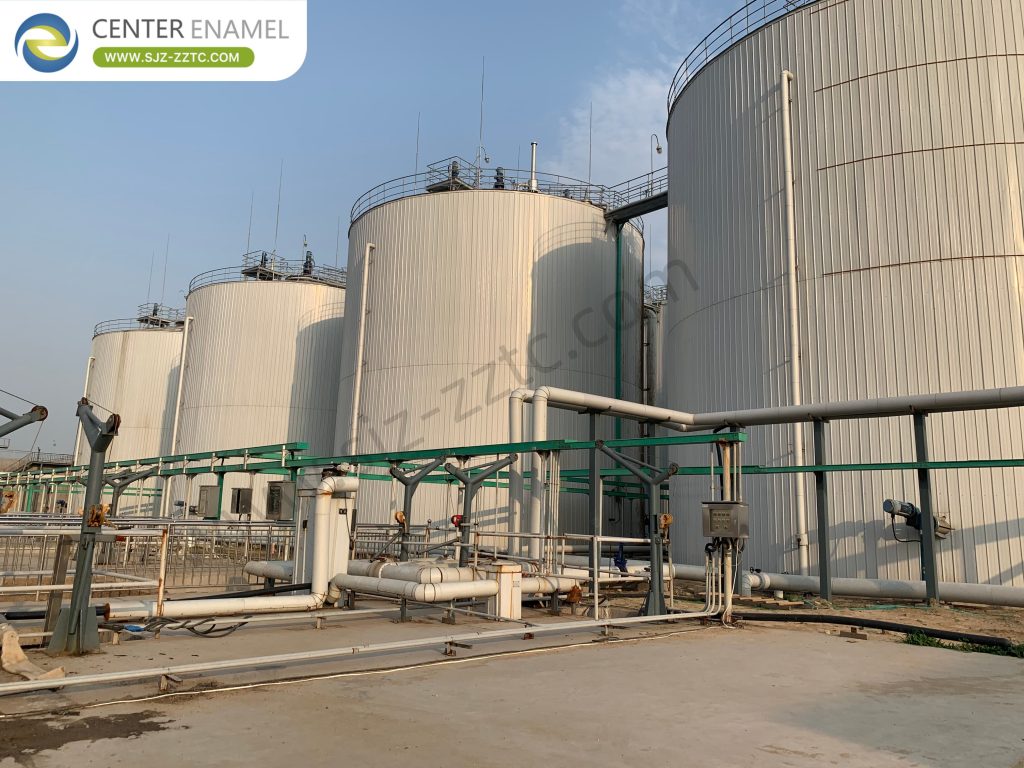
Within the anaerobic process segment, UASB, EGSB, and IC reactors-valued for high loading rates, small footprints, and stable operation-are widely used for high-concentration organic wastewater pretreatment in food processing, pharmaceutical fermentation, alcohol brewing, chemical, and other industries. These reactors rely on steel tank shells, and their corrosion resistance and gas-tightness directly determine long-term operational stability. That is why the application value of glass-fused-to-steel tanks in such scenarios is increasingly prominent, and why every Industrial Wastewater Treatment Project now hinges on getting the shell, the Anaerobic Digestion core, and the roof right.
Why GFS Tanks Outlast Concrete in Aggressive Service
Center Enamel's independently developed double-sided double-layer enameling technology is the industry's leading coating anti-corrosion technology, with corrosion resistance completely surpassing concrete tanks. Concrete tank interiors are riddled with pores, allowing wastewater and acid/alkaline media to easily penetrate and corrode the structural layer. Long-term use leads to irreversible problems such as internal wall spalling, water seepage, and rebar corrosion, which are difficult to repair and cannot be fundamentally resolved.
GFS tanks feature high-temperature enameling on both the interior and exterior surfaces of steel panels, with a dense, non-porous enamel finish that completely blocks corrosive liquids and biogas permeation. The enamel layer has extremely strong chemical stability, resisting acids, alkalis, salts, and microbial corrosion. Concrete tanks will develop extensive corrosion and leakage after 5–8 years of use, while GFS tank anti-corrosion service life can exceed 30 years, with no need for frequent internal lining repairs throughout the service life. This significantly reduces long-term anti-corrosion maintenance investment and fundamentally eliminates environmental risks of medium leakage contaminating sites and groundwater. Compared to traditional concrete and FRP tanks, GFS tank coatings have no risk of peeling or blistering, and are adaptable to highly corrosive conditions such as palm oil mill effluent, livestock manure, and chemical high-salinity wastewater, with outstanding long-term comprehensive cost advantages.
IC Reactor: The Third-Generation Anaerobic Digestion Core
The IC, or Internal Circulation Anaerobic Reactor, is the third-generation high-efficiency anaerobic treatment technology built upon UASB. Its core innovation is the built-in gas-lift internal circulation system, enabling autonomous wastewater recirculation without external return pumps. The reactor features a dual-zone configuration with a lower main reaction zone and an upper polishing zone. Biogas gas-lift creates hydraulic internal circulation, significantly increasing upflow velocity and enhancing sludge-wastewater contact. With extremely high compactness, it is specifically designed for high-concentration, high-flow industrial organic wastewater, combining high efficiency, energy savings, and minimal footprint. This makes IC technology the core process for modern industrial high-strength wastewater treatment and a decisive element of any well-designed Anaerobic Digestion train.
Where Chemical Wastewater Comes From-and Why Source Matters
Chemical wastewater originates from the entire production chain of petrochemicals, coal chemicals, fine chemicals, fertilizers and pesticides, and consumer chemicals, making it one of the heaviest pollution loads and most complex wastewater categories in industry. Key pollution stages include chemical reaction synthesis, raw material refining and separation, product purification and crystallization, catalyst regeneration, and solvent recovery. Auxiliary discharges include equipment and pipeline washing, reactor cleaning, floor washing, cooling water, and scrubber drainage. Petrochemical wastewater is primarily oily wastewater and alkaline residue, rich in hydrocarbons, phenols, and sulfides. Coal chemical wastewater is mainly coal gasification scrubber water, rich in ammonia nitrogen, cyanides, phenols, and heterocyclic compounds. Fine chemical wastewater has diverse compositions with various synthesis intermediates, residual raw materials, and byproducts. Pesticide wastewater contains organophosphorus and organochlorine pesticide residues. Wastewater generation is continuous, with significant fluctuations as product lines change. Large petrochemical plants have high continuous discharge volumes, while small and medium-sized chemical plants have intermittent discharges with extremely unstable water quality. Understanding this source profile is the first step any competent partner takes when scoping an Industrial Wastewater Treatment Project.
Thirty Years of Building the Full Chain
Center Enamel has been deeply engaged in the environmental bolted storage equipment field for over 30 years. Starting with proprietary enamel anti-corrosion material technology, the company has gradually completed the full-industry-chain upgrade from a single tank manufacturer to a comprehensive environmental EPC service provider. Throughout its 30+ year history, the company has been recognized as a National High-Tech Enterprise, National Specialized and Sophisticated "Little Giant," Manufacturing Single Champion, and Provincial Green Factory. It has successfully delivered over 30,000 environmental projects globally, establishing itself as a leading enterprise in the global GFS tank storage industry. The company has fully integrated the entire chain from enamel frit R&D, intelligent environmental equipment manufacturing, to EPC project contracting-every business breakthrough achieved through proprietary core anti-corrosion technology.
| Milestone Metric | Figure |
| Years in environmental bolted storage | 30+ |
| Environmental projects delivered globally | 30,000+ |
| National recognitions | High-Tech Enterprise, "Little Giant," Manufacturing Single Champion, Provincial Green Factory |
| Integrated chain | Enamel frit R&D → equipment manufacturing → EPC contracting |
| Global standing | Leading enterprise in GFS tank storage industry |
The R&D Team Behind Every Formulation
Center Enamel has built a full-chain professional team covering R&D, design, marketing, installation, and after-sales. The R&D team is led by national-level materials technology experts, specializing in enamel frit and tank anti-corrosion core technologies. External senior environmental engineering and mechanical structure engineers are retained to strengthen R&D capabilities, focusing on anti-corrosion coating formulations, specialty corrosion-resistant tanks, and anaerobic supporting integrated equipment, continuously breaking through industry technological barriers. The team operates through proprietary laboratories with external university research collaboration, conducting year-round new material and new process durability pilot testing and long-term corrosion simulation testing. Specialized enamel formulations are iteratively developed for extreme conditions such as high-salinity wastewater, strong acid and alkali POME, and high-organic livestock manure, providing core technical support for the company's annual new invention and utility patents and building a proprietary material technology barrier that directly benefits every Anaerobic Digestion system the company delivers.
Aluminum Geodesic Dome Roof: Lightweight, Sealed, Maintenance-Free
A complete Industrial Wastewater Treatment Project also depends on what covers the tank. The Aluminum Geodesic Dome Roof independently developed by Center Enamel is manufactured using high-strength aluminum alloy plates through integral stamping. It features a triangular grid spherical self-supporting structure, enabling large-span full coverage without internal support columns. Made of aluminum alloy, the roof offers excellent weather resistance and corrosion resistance, capable of long-term protection against acid rain, salt spray, and UV radiation, suitable for various extreme outdoor climate conditions. The structural design complies with international AWWA D108 standards, with aluminum plate thickness, rib cross-sections, and joint connections all verified by finite element stress analysis, ensuring wind and snow load resistance that meets building code requirements across different global regions.
The weight of the Aluminum Geodesic Dome Roof is only one-third to one-half of a steel roof with the same span, significantly reducing the load on the tank top and allowing direct installation without tank wall reinforcement. The roof provides superior overall sealing performance, with double sealing between panels using specialized sealant strips and mechanical interlocking, enabling both airtight gas storage and enclosed odor control, suitable for biogas collection and storage, wastewater tank odor control, and drinking water contamination prevention. The support-column-free design does not interfere with the installation and operation of internal equipment such as mixers and water distributors. The aluminum material does not support microbial growth, requiring no anticorrosion maintenance over long-term use, resulting in low total life-cycle costs.
| Aluminum Dome Roof Feature | Benefit |
| Triangular grid self-supporting structure | Large-span coverage with no internal columns |
| High-strength aluminum alloy | Resists acid rain, salt spray, and UV |
| AWWA D108 compliant design | Verified wind and snow load performance |
| One-third to one-half steel roof weight | No tank wall reinforcement needed |
| Double sealant strip + mechanical interlock | Airtight gas storage and odor control |
| Microbial-resistant aluminum | No anticorrosion maintenance, low lifecycle cost |
Frequently Asked Questions
Why are GFS tanks preferred over concrete for Industrial Wastewater Treatment Projects?
GFS tanks use a dense, non-porous enamel layer that resists acids, salts, and biogas permeation, lasting 30+ years versus concrete's 5–8 years before major corrosion and leakage.
What role does Anaerobic Digestion play in high-strength wastewater treatment?
Anaerobic digestion, especially via IC reactors, removes COD rapidly with a small footprint, produces biogas for energy recovery, and tolerates shock loads common in chemical and food processing effluent.
Does the aluminum geodesic dome roof suit biogas collection?
Yes. Its double-sealed, mechanically interlocked panels provide airtight gas storage and odor control, while its lightweight structure needs no tank wall reinforcement.
Ready to move your project from concept to commissioning with one accountable partner? Share your effluent data and site conditions with Center Enamel's engineers, and we will return a tailored Industrial Wastewater Treatment Project plan built around proven Anaerobic Digestion technology. You are also welcome to browse our 30,000+ global project references to see how our tanks and reactors perform in real operating environments.