
Anaerobic Fermentation Solution: Process, Tankage, And Biogas Recovery
An anaerobic fermentation solution is a sealed, heated biological system that converts organic waste into biogas through microbial fermentation. The reactor - usually a CSTR at 35-38 C for uniform slurry or a UASB for low-solid warm effluent - and its tankage must be engineered as one system, because the vessel wall, the mixing, and the gas seal all define how much methane is actually recovered.
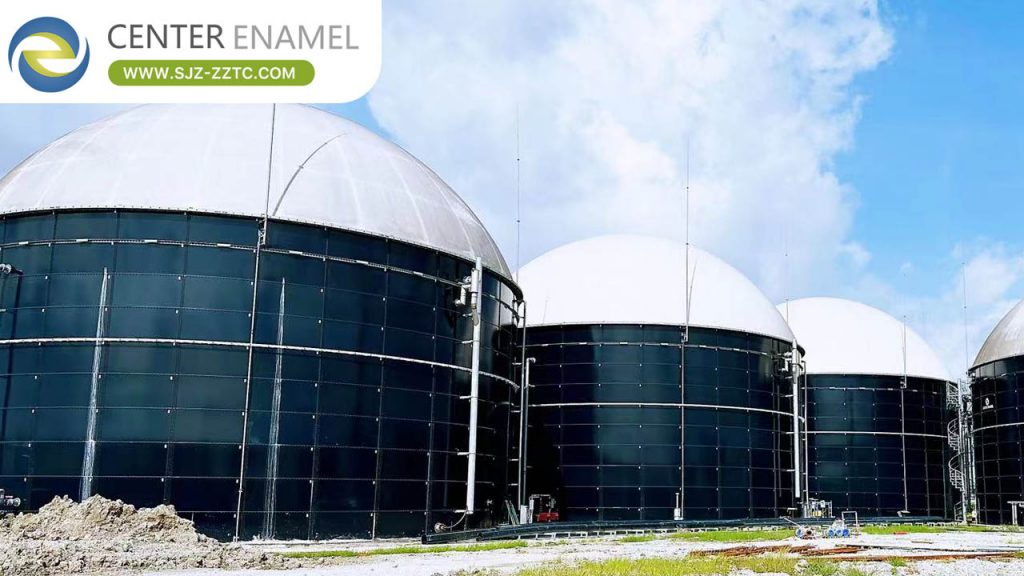
What Anaerobic Fermentation Does
In the absence of oxygen, hydrolytic and methanogenic microbes break volatile solids into biogas. The gas is roughly 55-65% methane, with the rest mostly carbon dioxide. At 35-38 C the mesophilic community converts about 0.30-0.45 m3 of biogas per kg of COD removed, and the process produces far less sludge than aerobic treatment.
| Parameter | Typical Value | Why It Matters |
| Methane content | 55-65% of biogas | Sets fuel value |
| Biogas yield | 0.30-0.45 m3 / kg COD removed | Sets digester size |
| Mesophilic temperature | 35-38 C | Stable microbiology |
| Retention time | 20-40 days (CSTR) | Sets reactor volume |
Choosing The Reactor
A CSTR is mixed and heated, which suits uniform manure or food slurry. A UASB needs low solids and warm, soluble feed, and it runs at a high organic loading rate (5-15 kg COD/m3/day) with hours of retention rather than days. For poultry or coarse feed, a USR holds solids without fine mixing. The choice is driven by solids and temperature, not by brand.
A Boundary Condition
Anaerobic fermentation is not suited to cold, low-strength sewage or to feed with heavy suspended solids unless those are removed upstream. A UASB will wash its granular bed out if solids or temperature drift; a CSTR will underperform if the feed is too dilute to sustain the biology. Co-digestion can steady the carbon-to-nitrogen ratio toward 20-30:1.
Project Case Study: Bangladesh Poultry Farm Waste Treatment Project
Project / Application: Poultry manure waste treatment, Bangladesh. Industry: Livestock (poultry). Tank Type: CSTR plus UASB anaerobic reactors. Key Requirements: Reliable biogas and compliant effluent from high-strength manure.
| Field | Value | Source / Evidence |
| Daily Treatment Capacity | 47 t/d (poultry manure) | Company project reference |
| Treatment Process | CSTR + UASB anaerobic reactors | Company project reference |
| Biogas Production | approx 4,900 m3/day | Company project reference |
| Power Generation | approx 9,800 kWh/day (2.0 kWh/m3 biogas) | Company project reference |
| Effluent Standard | Complies with local regulations | Company project reference |
| Installation Year | 2026 | Company project reference |
| Tank Dimensions | Not Provided In The Available Source | Process and capacity documented |
| Pollutant | Influent | Effluent Standard |
| COD | 50,000 mg/L | less than or equal to 200 mg/L |
| BOD | 25,000 mg/L | less than or equal to 100 mg/L |
| SS | 50,000 mg/L | less than or equal to 100 mg/L |
About The Supplier
Shijiazhuang Zhengzhong Technology Co., Ltd (Center Enamel) manufactures Glass-Fused-to-Steel tanks rated for anaerobic fermentation of livestock and food waste, with enamel firing at 820-930 C and certifications including ISO 9001, NSF/ANSI 61, and CE-EN 1090. The bolted CSTR and UASB packages support rapid deployment for biogas projects.
Comparison: Reactor Choices For Fermentation
| Reactor | Best Feed | Note |
| CSTR | Uniform manure or food slurry | Mixed and heated |
| UASB | Low-solid warm effluent | High loading, low energy |
| USR | Coarse high-solid feed | Holds solids without fine mixing |
An anaerobic fermentation solution is a biology problem wrapped in a tank problem. Choose the reactor from the solids and temperature, engineer the vessel and the mixing as one, and the biogas recovery becomes a measured output rather than a hope.
Frequently Asked Questions
Q1: What is an anaerobic fermentation solution? A1: A sealed, heated biological system that converts organic waste into biogas through microbial fermentation.
Q2: Which reactor suits fermentation? A2: A CSTR for uniform slurry, a UASB for low-solid warm effluent, a USR for coarse feed.
Q3: How much biogas from fermentation? A3: About 0.30-0.45 m3 per kg of COD removed at 35-38 C, at 55-65% methane.
Q4: When is anaerobic fermentation not suitable? A4: For cold, low-strength sewage or high solids without upstream removal.
Q5: What temperature does it need? A5: Mesophilic fermentation typically runs at 35-38 C.
Q6: How is biogas used? A6: It can be burned for heat and power, or upgraded to biomethane.
Q7: What tankage resists the corrosion? A7: A Glass-Fused-to-Steel tank with a factory-fired enamel lining.
Q8: Can the system expand? A8: Yes, modular GFS panels add digester volume as feedstock grows.
Suggested CTA
Describe your organic feedstock and off-take goal to an engineer, or request an anaerobic fermentation solution scope.