
Reliable Anaerobic Solutions for Your Beverage Wastewater Treatment Project
The global regulatory landscape for industrial wastewater is shifting rapidly. Policies are evolving from simple "compliance discharge" to mandatory "resource recovery" and even "zero liquid discharge" (ZLD). This transformation directly impacts how industries, especially food and beverage sectors, must approach their effluent management. For project planners, understanding this policy framework is the first critical step in selecting a sustainable and compliant treatment approach.
The European Union, through its Circular Economy Action Plan, requires member states to increase industrial wastewater reuse rates and extends carbon footprint accounting to the full life cycle of wastewater treatment. Meanwhile, China continuously updates and tightens industrial water pollutant discharge standards, with increasingly stringent limits on total nitrogen, total phosphorus, and characteristic pollutants for industries such as chemicals, pharmaceuticals, and printing and dyeing. In some water-scarce regions and highly polluting industries, authorities mandate the adoption of zero or near-zero liquid discharge technologies. Germany has established a differentiated pretreatment technical standard system by industry, requiring industrial wastewater to meet specific quality requirements before discharge into municipal wastewater treatment plants, thus implementing strict source control.
Given these stringent and varied international requirements, choosing a treatment system with proven adaptability and robust performance is essential. This is where advanced anaerobic solutions, particularly those utilizing Glass-Fused-to-Steel (GFS) tank technology, demonstrate their significant value in meeting and exceeding these global standards.
The Role of GFS Tanks in Modern Plant Layouts
To comply with tightening global standards, treatment facilities must be both highly efficient and cost-effective. Modern industrial plant design increasingly favors intensive, compact layouts that maximize land utilization and operational efficiency. This trend poses a challenge for traditional construction methods, such as poured concrete tanks.
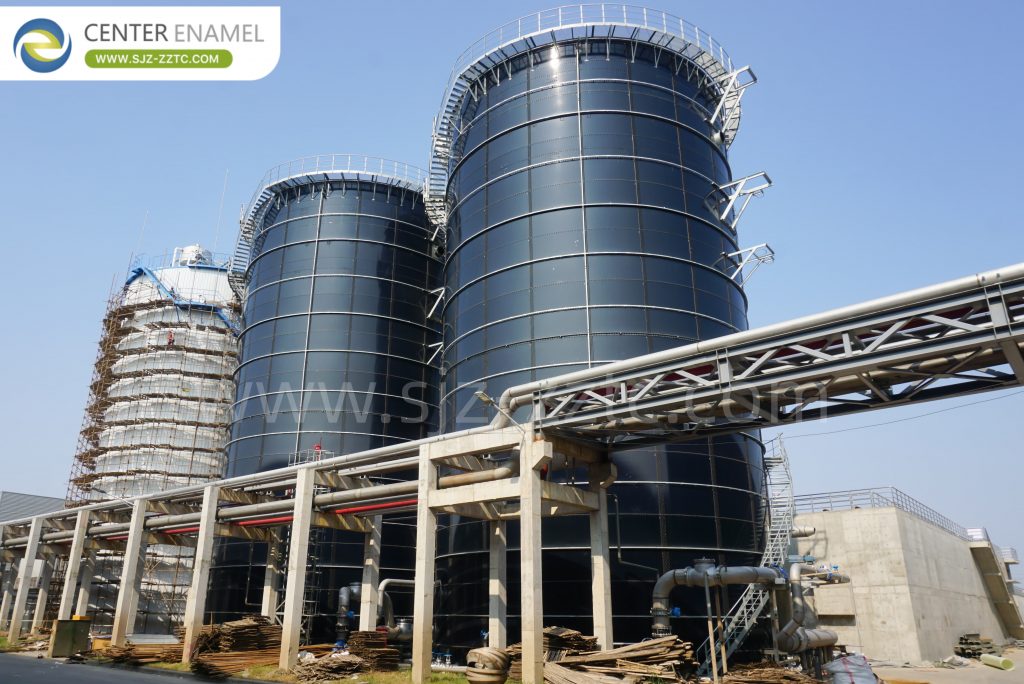
GFS tanks offer flexible customization of size and appearance, with higher land utilization rates, ideally suited for modern compact plant layouts. They present significant advantages over fixed poured concrete tanks. Concrete tanks cannot alter volume or shape after pouring, with heavy bases occupying large areas, making placement difficult on narrow or irregular plots. Furthermore, their rough, uniform appearance cannot match modern facility aesthetic requirements, which is an increasingly important consideration for brand-conscious corporations.
In contrast, GFS tank volume can be precisely customized as needed, with capacities ranging from dozens of cubic meters to 50,000 cubic meters freely selectable. Tank height and diameter can be flexibly combined to fit narrow or irregularly shaped plots, effectively saving plant land occupation. Enamel color customization is also supported, achieving visual harmony with plant buildings and environmental facilities. During later plant expansion, GFS tanks can be directly adjusted in layout and expanded; concrete tanks, being monolithic structures, must be demolished and rebuilt, offering less flexibility in land resource utilization. This adaptability makes GFS tanks the ideal choice for implementing efficient anaerobic solutions, as they align perfectly with the intensive construction and aesthetic operation and maintenance needs of industrial parks.
Core Anaerobic Technology for Wastewater Treatment
At the heart of many modern, high-efficiency treatment plants is a robust biological process that can handle high organic loads. A proven and widely adopted technology for this purpose is the Upflow Anaerobic Sludge Blanket (UASB) reactor, a cornerstone of many effective anaerobic solutions.
UASB Process: The Benchmark for Organic Wastewater
UASB, or Upflow Anaerobic Sludge Blanket Reactor, is the benchmark mainstream technology for medium-to-high concentration soluble organic wastewater treatment. It requires no mechanical mixing or media carriers, relying on the upward flow of wastewater to suspend and expand granular sludge within the reactor, forming a stable sludge bed layer. Highly active anaerobic granular sludge efficiently degrades pollutants, with excellent settleability and high microbial concentration. UASB innovatively integrates reaction, sedimentation, and gas-liquid-solid separation functions, simplifying the anaerobic treatment process with advantages of high efficiency, energy savings, and compactness. This process is widely used in various medium-to-high concentration soluble organic wastewater treatment applications, making it a critical component of comprehensive anaerobic solutions for industries like beverage production.
Specialized Application: Beverage Wastewater Treatment
The principles of anaerobic digestion are particularly effective when applied to specific, high-strength waste streams. The beverage industry, with its characteristic high-sugar and high-organic wastewater, is an ideal candidate for these treatment solutions.
Understanding Beverage Wastewater Sources and Characteristics
Beverage wastewater originates from the entire processing chain of carbonated beverages, fruit juices, tea drinks, bottled water, energy drinks, and other beverage products. It is a typical high-sugar, high-concentration organic wastewater in the food processing sector. Key pollution stages include raw material pretreatment (fruit washing, crushing, juicing, syrup preparation), blending/mixing (beverage compounding, syrup mixing-high-sugar wastewater), filtration/clarification (juice and tea filtration-fruit/tea residue), filling/packaging (filler and bottle wash-low-concentration high-volume wastewater), CIP cleaning (pipeline, tank, mixer cleaning-core high-concentration wastewater), and floor cleaning.
Juice processing wastewater contains pectin, fruit pulp, and juice residues-extremely high organic concentration; carbonated beverage wastewater contains syrup, phosphoric acid, and CO₂ residues; tea beverage wastewater contains tea polyphenols and tea residues. Large and medium-sized beverage plants discharge hundreds to thousands of tons daily, with water quality varying with product type and CIP cleaning cycles. Designing an effective Beverage Wastewater Treatment Project requires a deep understanding of these variable characteristics to select the most robust and flexible anaerobic solutions.
Global Success: Ghana Municipal Wastewater Project
The effectiveness of these technologies is not just theoretical; it has been proven in diverse global settings. A compelling example is a municipal wastewater treatment project in Ghana, which, while designed for domestic waste, showcases the reliability and efficiency of GFS-based biological treatment systems under challenging conditions.
Case Study: UBF + A²/O Process with GFS Tanks in Ghana
Completed installation in 2021, this project treats 1,800 m³/day of municipal wastewater using UBF anaerobic + A²/O nitrogen/phosphorus removal mature processes. It is equipped with multiple Center Enamel GFS tanks including 1 UBF anaerobic reactor, 1 secondary clarifier, and 2 internal/external double-layer A²/O biological tanks. Influent has high COD, BOD, suspended solids, and nitrogen/phosphorus concentrations. After full treatment, effluent parameters are significantly reduced with pH stable at 6.5-9.0, fully meeting local environmental discharge standards. The corrosion-resistant, conveniently assembled GFS tanks efficiently solve urban domestic wastewater pollution while balancing treatment effectiveness and O&M economics. This project serves as a mature municipal wastewater case in Africa, demonstrating how robust anaerobic solutions and reliable tank systems can be deployed successfully in remote or challenging locations.
About Center Enamel: A Legacy of Innovation
The success of projects like the one in Ghana is underpinned by the expertise and dedication of the engineering and manufacturing partner. Center Enamel's long history in the environmental equipment sector ensures that every project benefits from decades of refined technology and project management experience.
Over 30 Years of Excellence in Environmental Storage Solutions
Center Enamel has been deeply engaged in the environmental bolted storage equipment field for over 30 years. Starting with proprietary enamel anti-corrosion material technology, the company has gradually completed the full-industry-chain upgrade from a single tank manufacturer to a comprehensive environmental EPC service provider. Throughout its 30+ year history, the company has been recognized as a National High-Tech Enterprise, National Specialized and Sophisticated "Little Giant," Manufacturing Single Champion, and Provincial Green Factory. It has successfully delivered over 30,000 environmental projects globally, establishing itself as a leading enterprise in the global GFS tank storage industry. The company has fully integrated the entire chain from enamel frit R&D, intelligent environmental equipment manufacturing, to EPC project contracting. Every business breakthrough has been achieved through proprietary core anti-corrosion technology, ensuring that their anaerobic solutions and tank systems are at the forefront of the industry.
Installation and Service Support
Delivering a successful Beverage Wastewater Treatment Project, or any large-scale environmental installation, requires more than just superior equipment—it demands a world-class support infrastructure. Center Enamel’s commitment to its clients extends from the manufacturing plant to the final site handover.
Global Manpower and Construction Team Reserves
Center Enamel has established its own domestic and international certified construction teams, with regular practical training on GFS tank installation and overseas construction standards for various countries. Domestically, regional construction teams cover multiple zones, capable of simultaneously deploying multiple teams for large tank farm projects. Internationally, cross-border professional installation teams are equipped to various country construction standards. This sufficient manpower reserve ensures uninterrupted construction delivery for remote African sites, high-standard European/American facilities, and other projects worldwide. With over 2,000 wastewater projects and 1,000 biogas projects completed, their experience in deploying efficient anaerobic solutions is unparalleled.
Frequently Asked Questions (FAQ)
1. Why are anaerobic solutions preferred for high-strength beverage wastewater?
Anaerobic processes like UASB/UBF are highly effective for high-sugar, high-COD wastewater from beverage production. They offer significant advantages: lower energy consumption (no aeration), produce valuable biogas as a renewable energy source, generate less sludge, and have a much smaller footprint compared to aerobic systems, making them ideal for compact plant layouts.
2. What is the role of GFS tanks in a beverage wastewater treatment project?
Glass-Fused-to-Steel (GFS) tanks provide a durable, corrosion-resistant, and watertight containment solution essential for reactors, clarifiers, and storage. Their modular design allows for flexible sizing, easy shipping, and rapid on-site assembly, which is crucial for meeting tight project schedules. Their aesthetic customization also helps integrate the treatment plant seamlessly into modern industrial facilities.
3. How does Center Enamel ensure the quality and longevity of its treatment systems?
Center Enamel has over 30 years of experience and controls the entire production chain, from developing proprietary enamel frit to manufacturing and EPC project contracting. They employ certified international construction teams and use high-quality GFS tanks proven in over 30,000 projects globally. This vertical integration and rigorous quality control ensure systems are built to last and perform reliably under diverse conditions.