
High-Performance Anaerobic Solutions for Beverage Wastewater Treatment Projects
The beverage industry generates wastewater that is both a challenge and an opportunity. High in sugars, highly biodegradable, yet wildly fluctuating in strength, this stream demands treatment approaches that recover value rather than merely dispose of waste. Center Enamel addresses this precisely-combining advanced anaerobic reactor technology with glass-fused-to-steel tank engineering to deliver beverage wastewater treatment projects that turn pollution into biogas and compliance into operational savings.
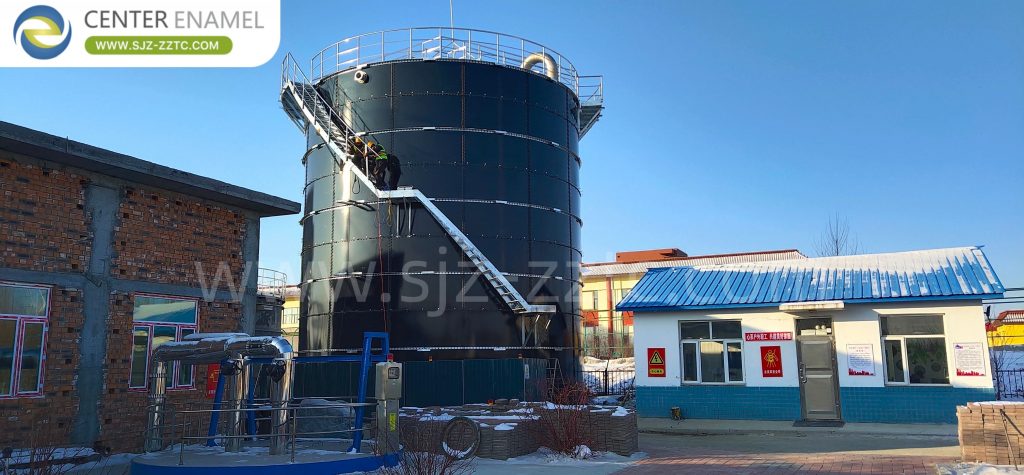
Why Beverage Wastewater Demands Specialized Attention
Beverage wastewater possesses characteristics that set it apart from generic industrial effluent. COD typically ranges from 3,000 to 20,000 mg/L, with CIP cleaning cycles pushing concentrations above 50,000 mg/L. The core pollutants-sucrose, fructose, and glucose-are highly soluble and readily degradable, yielding BOD/COD ratios of 0.5 to 0.65, among the highest in industrial wastewater. Suspended solids remain low, consisting mainly of fruit pulp, tea residues, and fiber impurities. pH leans acidic, particularly for juice streams at 3–4, while carbonated beverage wastewater introduces phosphoric acid. Temperature sits in the moderate 20–40°C band. Intermittent fluctuations follow product changeovers and cleaning schedules, alternating high-strength CIP discharges with dilute filling wastewater. This profile makes anaerobic treatment not just viable, but exceptionally attractive for energy recovery.
Anaerobic Solutions Tailored to High-Strength Organic Streams
Among anaerobic configurations, UASB, EGSB, and IC reactors have earned widespread adoption for high-concentration organic wastewater pretreatment across food processing, pharmaceutical fermentation, alcohol brewing, and chemical sectors. Their shared advantages-high loading rates, compact footprints, and stable operation-derive from their ability to retain dense granular sludge without external separation steps. These reactors rely on steel tank shells, where corrosion resistance and gas-tightness directly determine long-term stability. This is where Center Enamel’s glass-fused-to-steel (GFS) tanks deliver distinct value: the vitreous enamel surface, fused to steel at 820–930°C, resists acid and alkali attack across a broad pH spectrum while maintaining the structural integrity required for gas collection.
The IC (Internal Circulation) reactor exemplifies how process intensification benefits beverage applications. Pretreated high-strength wastewater enters the lower reaction zone, mixing with recirculated sludge-water and rising rapidly. Anaerobic microorganisms degrade organic matter and generate substantial biogas. The gas-lift effect carries mixed liquor upward to a top gas-liquid separator, where biogas is collected and degassed liquid returns by gravity through downcomers to the reactor bottom. This autonomous internal circulation repeatedly enhances pollutant degradation without external pumping. After multiple cycles, wastewater enters the upper polishing zone for final reaction and sludge separation. Treated effluent overflows from the top, aged sludge discharges periodically, and the system operates continuously with minimal intervention.
Proven Performance: Sweden Organic Waste Biogas Project
The credibility of any technology rests on field performance. In 2024, Center Enamel completed a UASB anaerobic process installation in Northern Sweden, employing GFS tanks as the primary reaction equipment. The project specifications demonstrate the scale and engineering precision involved.
| Parameter | Specification |
| Location | Northern Sweden |
| Completion Year | 2024 |
| Process | UASB Anaerobic |
| Tank Type | Center Enamel GFS |
| Single Tank Dimensions | 19.11 m diameter × 19.2 m height |
| Key Challenge | Acid/alkali and low-temperature corrosion |
| Corrosion Protection | 30-year design life |
| Outcome | Organic waste treatment + biogas recovery |
The tanks were engineered to withstand Nordic fermentation conditions, where low temperatures and corrosive organic acids would quickly degrade conventional materials. GFS assembly convenience proved equally critical in remote northern locations, enabling efficient construction despite logistical constraints. The project achieves dual objectives: harmless treatment of organic waste and clean biogas energy recovery-a European biomass environmental demonstration.
Manufacturing Depth: The Foundation Beneath Every Project
Delivering beverage wastewater treatment projects at global scale requires manufacturing infrastructure that matches ambition. Center Enamel’s core intelligent manufacturing base in Hebei Province, China, spans over 150,000 m² across two coordinated facilities: a mature Phase I manufacturing plant and a Phase II high-end environmental equipment industrial park. Dedicated R&D office buildings, proprietary material laboratories, and finished product testing centers operate under full-process quality systems meeting ISO, NSF, CE, and other international standards. The facility holds Provincial Green Factory certification, balancing production efficiency with energy conservation. With six marketing service centers across China, a nationwide production-sales network, and adjacency to expressway networks and major logistics hubs, the base supports simultaneous large-scale tank projects worldwide. Over 500 employees operate multiple parallel automated production lines-capacity that positions Center Enamel firmly among the global top tier of GFS tank equipment manufacturers.
Integrated Delivery: From Enamel Frit to Commissioned Plant
What distinguishes Center Enamel in the beverage wastewater treatment project landscape is vertical integration. The company stands alone globally in combining proprietary enamel frit R&D, self-manufactured tanks, and EPC general contracting under one roof. This means full-process self-control from solution design through equipment production, cross-border logistics, overseas construction, and post-construction operation and maintenance. Clients interact with one accountable partner rather than coordinating fragmented suppliers, significantly reducing time costs and interface risks.
Roof Selection for Beverage Wastewater Applications
Not every tank in a beverage wastewater treatment project requires gas-tight anaerobic conditions. FRP roofs offer a general-purpose economical solution for atmospheric pressure storage tanks without air-tightness requirements-suitable for drinking water storage, firewater reserve, and general production wastewater temporary storage. Available in flat and dome styles, these integrally molded resin-fiberglass roofs resist rust and rot in humid environments, eliminating the frequent anti-corrosion maintenance metal roofs demand. The dome style sheds water, dust, and snow effectively; the flat style accommodates walkways, level gauges, and vents for convenient inspection. Fully insulated and free from galvanic corrosion risk, FRP roofs meet environmental standards for domestic water storage. Modular low-weight components simplify hoisting and assembly. However, for anaerobic fermentation gas-producing conditions-the core of beverage wastewater treatment-FRP roofs are not recommended, and Center Enamel specifies appropriate gas-tight solutions instead.
Frequently Asked Questions
What makes beverage wastewater suitable for anaerobic treatment?
Beverage wastewater carries high concentrations of readily biodegradable sugars, with BOD/COD ratios of 0.5–0.65. Anaerobic solutions convert this organic load into biogas while reducing COD, offering energy recovery alongside treatment.
Which anaerobic reactor type suits fluctuating beverage wastewater?
UASB, EGSB, and IC reactors all perform effectively. IC reactors excel where footprint is constrained and loading is high, while UASB remains reliable for moderate fluctuations. Center Enamel engineers select based on specific flow and strength profiles.
Why choose GFS tanks for anaerobic reactors?
Glass-fused-to-steel provides corrosion resistance across a wide pH range, maintains gas-tightness for biogas collection, and delivers a 30-year design life with minimal maintenance-critical for reactor stability.
Ready to transform your beverage wastewater challenge into an energy recovery opportunity? Contact Center Enamel today to discuss a tailored anaerobic solution for your facility. Our engineers are prepared to evaluate your wastewater profile and propose a system designed for your specific operational realities.