
Leading Anaerobic Solutions with UASB Process for High-Strength Beverage Wastewater Treatment Projects
In response to the global trend of policies evolving from "compliance discharge" to mandatory "resource recovery" and "zero liquid discharge," industries require robust treatment infrastructure . Shijiazhuang Zhengzhong Technology Co., Ltd (Center Enamel) has established itself as a premier global manufacturer of advanced Glass-Fused-to-Steel (GFS) tanks, providing comprehensive Anaerobic Solutions for complex industrial wastewater challenges . A key element of these solutions is the proven Upflow Anaerobic Sludge Blanket (UASB) Process, which is particularly effective for high-organic-load effluents such as those found in Beverage Wastewater Treatment Projects.
Industrial Wastewater Global Policy Framework
Global industrial wastewater treatment policies are escalating from "compliance discharge" to mandatory "resource recovery" and "zero liquid discharge." The EU, through its Circular Economy Action Plan, requires member states to increase industrial wastewater reuse rates and extends carbon footprint accounting to the full life cycle of wastewater treatment. China continuously updates and tightens industrial water pollutant discharge standards, with increasingly stringent limits on total nitrogen, total phosphorus, and characteristic pollutants for industries such as chemicals, pharmaceuticals, and printing and dyeing. Some water-scarce regions and highly polluting industries are mandated to adopt zero or near-zero liquid discharge technologies. Germany has established a differentiated pretreatment technical standard system by industry, requiring industrial wastewater to meet specific quality requirements before discharge into municipal wastewater treatment plants, implementing strict source control.
This strict regulatory landscape necessitates efficient and reliable Anaerobic Solutions. The UASB Process, a cornerstone of Center Enamel's offerings, directly addresses these demands by effectively reducing organic pollutants to meet discharge standards while enabling biogas recovery for energy cost offsets .
GFS tanks Bolted Assembly Construction
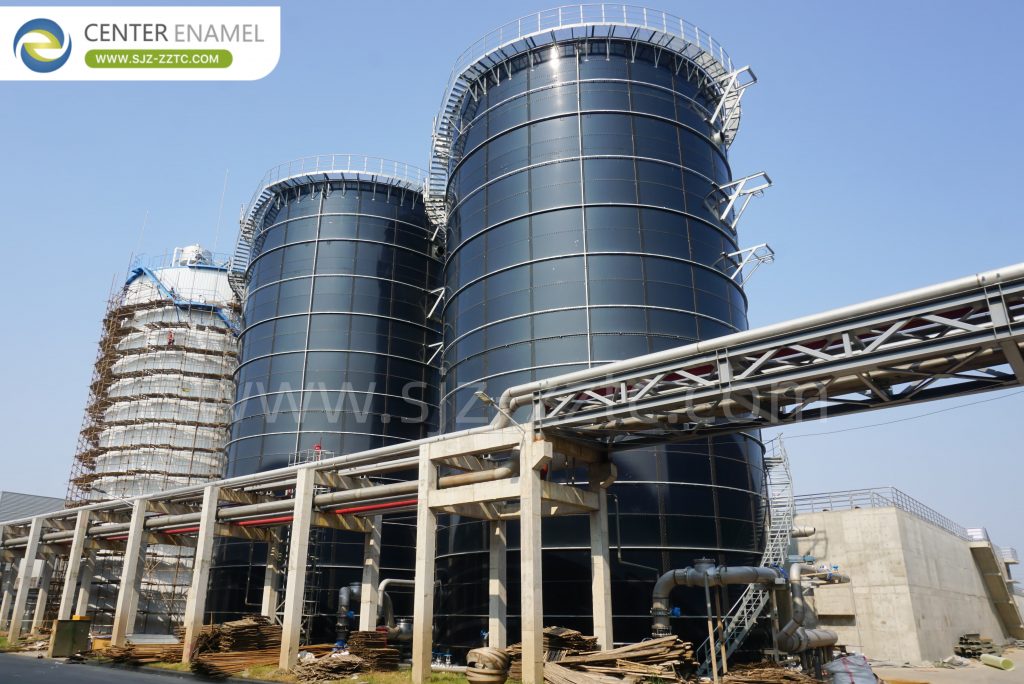
To deliver the required infrastructure, the construction method of the reactor tank is paramount. GFS tanks are assembled on-site from prefabricated panels, with short construction periods and support for expansion, relocation, and reuse-advantages distinctly different from immovable concrete tanks. Concrete tank pouring requires formwork, rebar tying, pouring, and long curing periods, with a single tank construction taking months. Rain, snow, and low temperatures force work stoppages and delays. Once poured, they are permanent fixed structures that cannot be dismantled, expanded, or relocated-project relocation means complete abandonment.
GFS tank panels are all factory-prefabricated, transported to site, and directly assembled in panels with simple procedures. Construction can proceed even in low-temperature, light-rain conditions, with installation time only one-third that of concrete tanks-construction schedules are controllable. For expansion, additional steel panels can be installed to increase volume; for plant relocation, tanks can be fully disassembled with panels transported to new sites for reassembly and reuse, significantly reducing material and construction costs for new construction and reconstruction. This is ideally suited for short-term environmental projects, phased expansion projects, and relocated construction projects. The modular bolted GFS technology ensures that the physical asset matches the flexibility needed to adapt to evolving regulatory standards and project lifecycles .
UASB Reaction Process
Understanding the biological process housed within these robust GFS tanks is essential. The UASB reaction process is the core of many anaerobic treatment systems. After pretreatment through screens and equalization tanks to remove impurities and balance water quality and flow, wastewater is uniformly fed into the reactor through the bottom distribution system. The wastewater rises at a constant rate through the high-concentration granular sludge bed at the bottom, where anaerobic microorganisms rapidly degrade most organic matter, converting it into biogas, clean water, and a small amount of sludge. Gentle hydraulic mixing maintains sludge suspension, expanding microbial contact area. Remaining pollutants continue to degrade in the mid-section suspended sludge layer, with the mixed liquor finally entering the top three-phase separator for gas, solid, and liquid separation. Biogas is collected upward for utilization, sludge settles back to the reaction zone, treated effluent overflows from the top, and aged sludge is periodically discharged-fully automated continuous operation. This highly efficient UASB Process has been proven in various industrial applications, making it the preferred biological solution for high-strength wastewater like that from beverage production .
Key Water Quality Characteristics of Beverage Wastewater
The UASB Process is particularly well-suited for Beverage Wastewater Treatment Projects due to the specific characteristics of this effluent. High COD, high sugar content, low suspended solids, slightly acidic, excellent biodegradability-with significant fluctuations. COD typically 3,000-20,000 mg/L, with high-concentration CIP cleaning wastewater peaking above 50,000 mg/L. Core pollutants are soluble sugars-sucrose, fructose, glucose-highly degradable organics, with BOD/COD typically 0.5-0.65-industry-leading biodegradability. Low suspended solids-primarily fruit pulp, tea residues, fiber impurities. pH slightly acidic-juice wastewater pH 3-4, carbonated beverage wastewater contains phosphoric acid. Clear to slightly turbid-color varies by beverage type (juice high color, tea with tea color). Moderate temperature-20-40°C. Water quality fluctuates intermittently with CIP cleaning cycles and product changeovers-alternating high-concentration CIP and low-concentration filling wastewater. These properties make the UASB Process highly effective in breaking down the easily degradable organic content and managing the variable organic load common in this industry .
Indonesia Palm Oil Biogas Upgrade Project
The practical application of these combined technologies is demonstrated in global benchmark projects. Commissioned in 2013 as the core anaerobic digestion reactor for the POME treatment station, with 3 GFS tanks in two sizes: 17.58 m dia. × 8.4 m height / 16.82 m dia. × 7.2 m height. The tanks serve as the core anaerobic reaction equipment specifically for high-organic palm oil production wastewater-anaerobic digestion degrades pollutants and recovers biogas. Tanks are adapted to local palm industry wastewater needs. GFS tank assembly is convenient with corrosion resistance for Southeast Asia's hot humid high-corrosion environment-a mature biomass energy environmental benchmark project. This long-standing project illustrates Center Enamel's extensive experience in implementing Anaerobic Solutions under challenging climatic conditions, with the plant having operated successfully for over 15 years .
Center Enamel's Smart Manufacturing Base Scale
The global leadership in providing these Anaerobic Solutions is underpinned by significant manufacturing capabilities. Center Enamel's core intelligent manufacturing base is located in Hebei Province, China, covering a total area of over 150,000 m², with Phase I mature manufacturing facility and Phase II high-end environmental equipment industrial park-dual-base synergy ensures stable production capacity. The base includes dedicated R&D office buildings, proprietary material laboratories, and finished product testing centers, with full-process quality control systems meeting ISO, NSF, CE, and other international standards. The facility operates to green manufacturing standards, certified as a Provincial Green Factory-balancing efficient production with energy conservation and emission reduction. The company has 6 marketing service centers across China, establishing a nationwide production-sales network ensuring stable global order delivery. The base is adjacent to expressway networks and major logistics hubs, with complete container shipping capabilities-supporting simultaneous large-scale tank projects globally. The base employs over 500 staff, with multiple parallel automated production lines-facility scale and production capacity firmly placing it among the global top tier of GFS tank equipment manufacturers .
Over a Decade of Global Installation Experience
This manufacturing strength is complemented by unmatched international project experience, which is critical for the success of any Beverage Wastewater Treatment Project or UASB process application. Unmatched global practical experience among domestic peers-over a decade covering multiple regions and all industry sectors. In 2009, Center Enamel completed the first overseas GFS tank installation-sending a team to Niger, Africa for drinking water storage tank installation. In 2015, it broke industry ground with China's first GFS tank export and installation to the US-passing strict US acceptance standards. All installed projects have operated stably for many years, covering livestock biogas, POME, municipal wastewater, and drinking water storage applications. Construction has covered Southeast Asia, Africa, the Americas, and other regions-accumulating specialized solutions for complex sites including mountainous terrain, coastal salt spray, tropical high temperatures, and high-standard European/American facility conditions-maturely addressing global special construction requirements. This extensive history demonstrates the company's ability to deliver reliable, code-compliant infrastructure anywhere in the world.
Frequently Asked Questions (FAQ)
1. Why is the UASB Process particularly effective for beverage wastewater treatment projects?
The UASB Process excels in treating high-strength organic wastewater typical of the beverage industry. Beverage effluent is characterized by high COD (3,000-20,000 mg/L), excellent biodegradability (BOD/COD 0.5-0.65), and contains soluble sugars which are rapidly degraded by the anaerobic granular sludge in the UASB reactor, leading to high pollutant removal and biogas recovery .
2. What are the key advantages of Center Enamel's GFS tanks for anaerobic solutions?
Center Enamel's GFS tanks offer superior corrosion resistance against biogenic acids and H2S, a 30+ year service life, and rapid modular bolted assembly. Compared to concrete or welded steel, GFS tanks provide excellent gas-tightness, near-zero maintenance, and the flexibility to be expanded or relocated, significantly reducing project lifecycle costs .
3. How do Center Enamel's Anaerobic Solutions comply with global policy frameworks?
Center Enamel's systems, which often integrate the UASB Process, enable industries to meet tightening global standards for resource recovery and zero liquid discharge. By efficiently removing pollutants and capturing biogas, these solutions help clients comply with policies such as the EU's Circular Economy Action Plan and China's stringent industrial discharge limits, facilitating a shift from compliance discharge to resource recovery .