
How Anaerobic Solutions and GFS Tanks Are Reshaping Industrial Wastewater Treatment
The industrial wastewater treatment market is diverging. Leading companies are building integrated service capabilities through technical integration and capital operations, while industry concentration gradually increases. Chinese companies continue to consolidate their advantages in mid-tier equipment exports. International giants target high-end customers and complex industrial wastewater markets, while local players occupy the mid- to low-end and industrial park centralized treatment markets with service responsiveness and cost advantages.
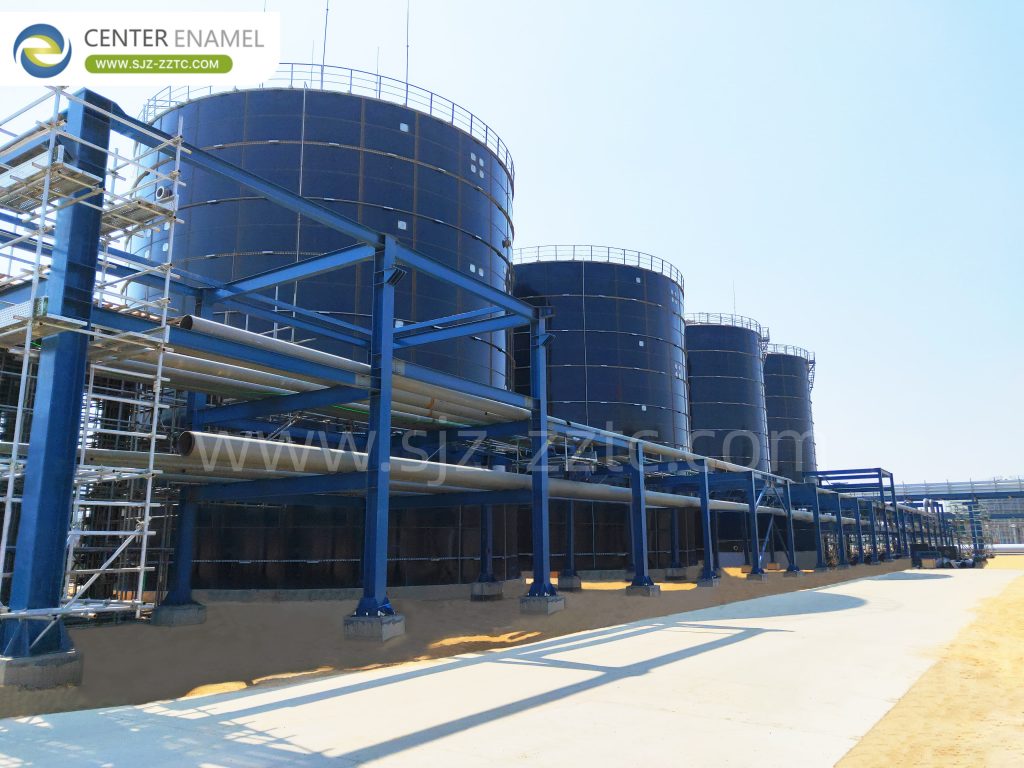
In the anaerobic process segment, UASB, EGSB, and IC anaerobic reactors-with advantages of high loading rates, small footprints, and stable operation-are widely used in high-concentration organic wastewater pretreatment across food processing, pharmaceutical fermentation, alcohol brewing, and chemical industries. These reactors use steel tank shells, and their corrosion resistance and gas-tightness directly determine long-term operational stability. This is where Anaerobic Solutions paired with GFS Tanks become increasingly prominent in application value.
Industrial Wastewater Treatment Competitive Landscape
The competitive landscape shows clear divergence. Leading companies build integrated service capabilities through technical integration and capital operations, with industry concentration gradually increasing. Chinese companies continue to consolidate their advantages in mid-tier equipment exports. International giants target high-end customers and complex industrial wastewater markets, while local players occupy the mid- to low-end and industrial park centralized treatment markets with service responsiveness and cost advantages.
In the anaerobic process segment, UASB, EGSB, and IC anaerobic reactors are widely used in high-concentration organic wastewater pretreatment. Their steel tank shells demand corrosion resistance and gas-tightness that directly determine long-term operational stability-making GFS Tanks a natural fit for these demanding conditions.
Anaerobic Reactor Comparison for High-Concentration Organic Wastewater
| Reactor Type | Key Advantages | Typical Applications | Tank Shell Requirement |
| UASB | High loading rate, stable operation | Food processing, pharmaceutical fermentation | Corrosion-resistant, gas-tight |
| EGSB | Small footprint, high loading rate | Alcohol brewing, chemical | Corrosion-resistant, gas-tight |
| IC | High loading rate, compact design | High-concentration organic wastewater | Corrosion-resistant, gas-tight |
USR Process-Dedicated Anaerobic Solution for High-Solids Wastewater
USR, or Upflow Solids Reactor, is an upflow anaerobic process modified for high-suspended-solids, high-solids organic wastewater. It is specifically designed to solve problems of clogging, sludge washout, and uneven reaction common in traditional anaerobic processes for high-solids wastewater.
The process eliminates complex three-phase separators, simplifies internal structure, and relies on upflow hydraulics to promote thorough mixing of solid materials and anaerobic sludge. No strict granular sludge formation conditions are required-flocculent sludge can operate stably. The key feature is high solids tolerance and impurity resistance, with very high influent suspended solids tolerance. It is a dedicated high-efficiency Anaerobic Solution for livestock manure, agricultural organic waste, and high-solids livestock wastewater, specifically developed for agricultural and environmental applications.
Food Waste Wastewater-Sources and Characteristics
Food waste wastewater originates from the resource recovery process of kitchen waste from catering services, canteens, and food processing/distribution-a typical high-concentration organic wastewater in urban solid waste resource recovery.
Major sources include:
Food waste pretreatment sorting wastewater (from bag breaking, crushing, sorting operations)
Oil separation wastewater (oily wastewater from three-phase oil extraction)
Anaerobic digestion digestate (residual liquid after food waste anaerobic digestion)
Equipment and vehicle wash water
Food waste consists primarily of food residues, rich in animal/vegetable oils, starches, proteins, cellulose, salts, and seasoning residues. After pretreatment crushing and sorting, this wastewater demands robust Anaerobic Solutions capable of handling high organic loads and oil content-where GFS Tanks provide the necessary corrosion protection and gas-tightness.
Case Study-Bangladesh Large-Scale Poultry Farm Manure Resource Recovery Project
This benchmark project targets local poultry farm manure resource recovery with daily treatment of 47 tons. Influent COD, BOD, and SS were as high as 50,000 mg/L, 25,000 mg/L, and 50,000 mg/L respectively. After CSTR + UASB anaerobic treatment, all three parameters were reduced to below 200 mg/L, 100 mg/L, and 100 mg/L-effluent compliant with local environmental discharge standards. The project produces approximately 4,900 m³ biogas daily-each m³ biogas can generate 2 kWh of electricity, with daily power generation of 9,800 kWh-simultaneously achieving pollutant reduction and clean energy recovery.
Bangladesh Poultry Farm Manure Project-Key Performance Data
| Parameter | Influent | Effluent | Removal Rate |
| COD | 50,000 mg/L | <200 mg/L | >99.6% |
| BOD | 25,000 mg/L | <100 mg/L | >99.6% |
| SS | 50,000 mg/L | <100 mg/L | >99.8% |
| Daily Treatment Capacity | 47 tons | - | - |
| Daily Biogas Production | 4,900 m³ | - | - |
| Daily Power Generation | 9,800 kWh | - | - |
This is a benchmark project for livestock waste recycling in Southeast Asia, demonstrating the combined power of Anaerobic Solutions and GFS Tanks in real-world agricultural applications.
Center Enamel-30+ Years of Environmental Equipment Innovation
Center Enamel has been deeply engaged in the environmental bolted storage equipment field for over 30 years. Starting with proprietary enamel anti-corrosion material technology, the company has gradually completed the full-industry-chain upgrade from a single tank manufacturer to a comprehensive environmental EPC service provider.
Throughout its 30+ year history, the company has been recognized as a National High-Tech Enterprise, National Specialized and Sophisticated "Little Giant," Manufacturing Single Champion, and Provincial Green Factory. It has successfully delivered over 30,000 environmental projects globally, establishing itself as a leading enterprise in the global GFS Tanks storage industry. The company has fully integrated the entire chain from enamel frit R&D, intelligent environmental equipment manufacturing, to EPC project contracting-every business breakthrough has been achieved through proprietary core anti-corrosion technology.
Innovative Material Technology-Enamel Formulations for 30+ Year Service Life
Center Enamel has independently developed over 200 anti-corrosion enamel formulations, with proprietary double-sided double-layer enameling technology. GFS Tanks anti-corrosion service life exceeds 30 years-far surpassing concrete and ordinary equipment-making them suitable for global high-corrosion wastewater and biogas fermentation conditions. This material advantage directly supports the long-term stability of Anaerobic Solutions in the most demanding industrial and agricultural environments.
Aluminum Alloy Trough Deck Roof-Cost-Effective Tank Cover Solution
Aluminum Alloy Trough Deck Roof is a cost-effective economical tank cover solution for clean water and wastewater storage scenarios, primarily designed for drinking water, production wastewater, and firewater reserve tanks, balancing practicality and cost advantages.
The main body is integrally formed from anti-corrosion aluminum alloy plates, paired with aluminum support trusses. Its lightweight design imposes less load on the tank foundation, reducing civil construction investment. A naturally formed dense oxide protective layer on the surface resists rain and mild wastewater corrosion, withstands outdoor sun and rain exposure, and effectively blocks wind, rain, insects, fallen leaves, and odor volatilization-protecting water quality by preventing dust and debris from falling in and causing secondary contamination.
The flat roof structure is neat and orderly, allowing installation of maintenance walkways, guardrails, vents, and level monitoring ports on top, facilitating daily inspection and equipment maintenance. The simple sealing structure enables straightforward installation with short construction timelines, and virtually eliminates the need for anti-corrosion painting maintenance, resulting in extremely low operational costs. It is suitable for various small, medium, and large atmospheric pressure water storage tanks, and has been widely implemented in waterworks clear water tanks, industrial circulating water tanks, park firewater tanks, and domestic wastewater temporary storage facilities. It is highly compatible with water storage applications that do not require biogas collection or high-pressure sealing.
Aluminum Alloy Trough Deck Roof-Application Summary
| Feature | Benefit |
| Lightweight aluminum alloy | Reduced foundation load, lower civil investment |
| Dense oxide protective layer | Resists rain, mild wastewater corrosion |
| Flat roof structure | Easy installation of walkways, vents, level ports |
| Simple sealing | Short construction timeline, low maintenance |
| No anti-corrosion painting | Extremely low operational costs |
| Wide compatibility | Waterworks, circulating water, firewater, domestic wastewater |
Ready to implement proven Anaerobic Solutions and GFS Tanks for your wastewater project? Contact Center Enamel today for a customized design tailored to your waste stream, climate, and regulatory requirements.
With 30,000+ global projects and 30+ years of enamel expertise, we deliver end-to-end support from material R&D to EPC contracting. Reach out now and let's turn your wastewater challenge into a resource recovery opportunity.
FAQ
1. What makes USR process different from traditional anaerobic solutions?
USR (Upflow Solids Reactor) eliminates complex three-phase separators and relies on upflow hydraulics for mixing. It tolerates high suspended solids without requiring granular sludge formation, making it ideal for livestock manure and high-solids agricultural wastewater.
2. Why are GFS Tanks preferred over concrete for anaerobic reactor shells?
GFS Tanks offer enamel anti-corrosion service life exceeding 30 years, superior gas-tightness, and factory-prefabricated quality control. Concrete tanks are prone to cracking, corrosion, and gas leakage-compromising long-term anaerobic process stability.
3. What results did the Bangladesh poultry farm project achieve?
The project treats 47 tons daily, reducing COD from 50,000 to below 200 mg/L, BOD from 25,000 to below 100 mg/L, and SS from 50,000 to below 100 mg/L. It produces 4,900 m³ biogas daily, generating 9,800 kWh of clean electricity.