
Proven GFS Tanks and Anaerobic Solutions for Livestock Manure Treatment and Resource Recovery
The livestock manure treatment market is undergoing a fundamental transition-moving from environmental compliance-driven approaches to dual-value-driven models centered on energy and fertilizer valorization. The European digestate concentration fertilizer market has reached maturity, while large-scale biogas projects in North America commonly incorporate digestate processing centers. Business model innovation is accelerating: the asset-light model of farmers paying per volume treated has been piloted successfully in several countries, and China's "biogas operation outsourcing" model is beginning to penetrate county-level projects.
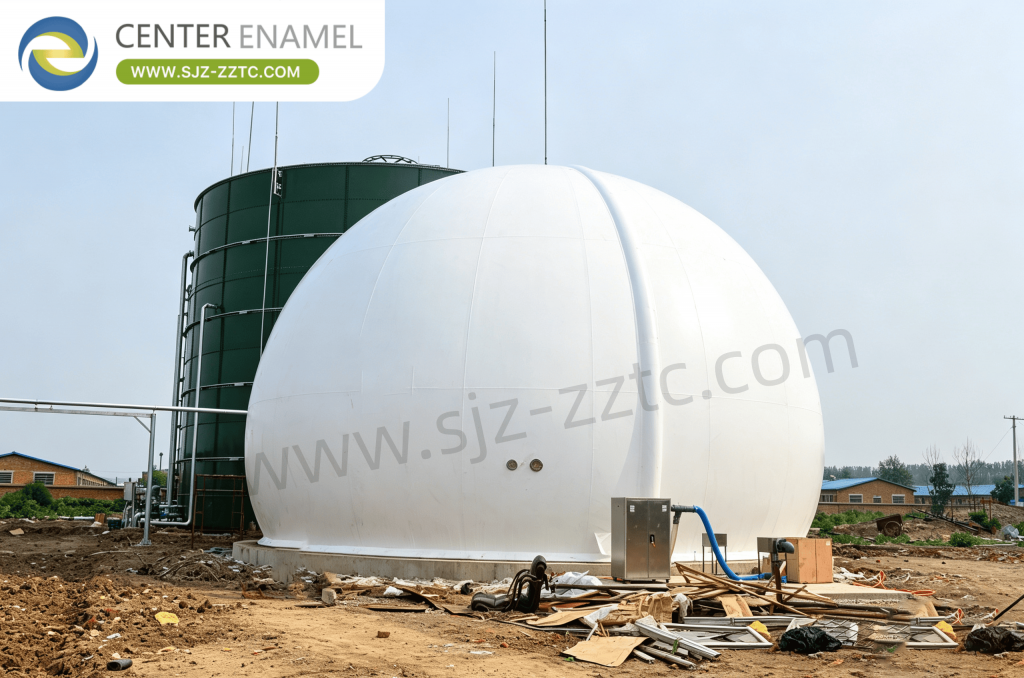
Digital technology-driven precision nutrient management platforms are emerging as new industry links connecting farms, treatment centers, and agricultural end-users. On the process equipment side, CSTR remains the mainstream anaerobic digestion process for treating livestock manure. After anaerobic digestion, manure produces biogas for power generation or grid-injection purification, while digestate is processed into organic fertilizer for farmland application. GFS Tanks, with strong corrosion resistance and low maintenance costs, are widely used in manure treatment projects on large-scale farms across North America, Europe, and China-particularly suited to the corrosive environments of high ammonia-nitrogen and high hydrogen sulfide in manure. These market shifts create strong demand for robust, adaptable equipment and process solutions.
GFS Tanks: Flexible Fit for Modern Intensive Plant Layouts
GFS Tanks offer flexible customization of size and appearance, with higher land utilization rates ideally suited for modern compact plant layouts-delivering significant advantages over fixed poured concrete tanks. Concrete tanks cannot alter volume or shape after pouring, and their heavy bases occupy large areas, making placement difficult on narrow or irregular plots. Their rough, uniform appearance also cannot match modern facility aesthetic requirements. GFS Tank volume can be precisely customized as needed, with capacities ranging from dozens of cubic meters to 50,000 cubic meters freely selectable. Tank height and diameter can be flexibly combined to fit narrow or irregularly shaped plots, effectively saving plant land occupation. Enamel color customization is also supported, achieving visual harmony with plant buildings and environmental facilities. During later plant expansion, GFS Tanks can be directly adjusted in layout and expanded, whereas concrete tanks, being monolithic structures, must be demolished and rebuilt-offering less flexibility in land resource utilization. This aligns well with the intensive construction and aesthetic operation and maintenance needs of industrial parks.
Anaerobic Solutions: USR Reactor Applications for Agricultural High-Solids Wastewater
The USR Reactor serves as a dedicated process for agricultural high-solids wastewater, primarily suitable for large-scale livestock manure, livestock soaking water, agricultural straw leachate, and livestock slaughterhouse high-solids wastewater. For high-suspended-solids, high-organics, high-impurity wastewater conditions, it stands as the core process for rural livestock pollution treatment and agricultural organic waste resource utilization. It is equally suitable for township decentralized wastewater treatment and small to medium-sized agricultural enterprise wastewater treatment. The USR Reactor can serve as the primary process for large livestock base manure resource recovery, combining wastewater treatment with biogas recovery. It is also suitable for various high-solids, easily clogged, difficult-to-treat organic wastewater pretreatment, with superior suitability in agricultural environmental applications compared to other anaerobic processes.
Livestock Wastewater O&M Cost Analysis: Excellent Input-Output Ratio
O&M costs for livestock wastewater treatment are relatively low with an excellent input-output ratio-the highest cost-effectiveness among the five major wastewater types. Core treatment units are primarily physical separation, anaerobic digestion, and ecological polishing-requiring no high-end precision equipment or expensive chemicals. Equipment is simple with low failure rates and low maintenance costs. Anaerobic digestion produces stable biogas for plant heating and power generation, offsetting energy costs. Ecological treatment units have virtually no ongoing O&M costs. Only periodic cleaning of sedimentation tanks and polishing ponds is required, with low labor costs. Manure solids, sludge, and digestate can be sold as resources, further reducing net treatment costs. This favorable cost profile makes anaerobic solutions particularly attractive for agricultural operations seeking both environmental compliance and economic returns.
Bangladesh Large-Scale Poultry Farm Manure Resource Recovery Project
This benchmark project targets local poultry farm manure resource recovery with a daily treatment capacity of 47 tons. Influent COD, BOD, and SS concentrations reach as high as 50,000 mg/L, 25,000 mg/L, and 50,000 mg/L respectively. After CSTR + UASB anaerobic treatment, all three parameters are reduced to below 200 mg/L, 100 mg/L, and 100 mg/L-effluent compliant with local environmental discharge standards. The project produces approximately 4,900 m³ of biogas daily; each cubic meter of biogas can generate 2 kWh of electricity, yielding daily power generation of 9,800 kWh. This simultaneously achieves pollutant reduction and clean energy recovery, establishing it as a benchmark project for livestock waste recycling in Southeast Asia.
Table 1: Bangladesh Poultry Farm Manure Treatment Project Performance Data
| Parameter | Influent Concentration | Effluent Concentration | Treatment Performance |
| COD | 50,000 mg/L | < 200 mg/L | >99.6% removal |
| BOD | 25,000 mg/L | < 100 mg/L | >99.6% removal |
| SS | 50,000 mg/L | < 100 mg/L | >99.8% removal |
| Biogas Production | - | ~4,900 m³/day | - |
| Power Generation | - | 9,800 kWh/day | 2 kWh per m³ biogas |
| Daily Treatment Capacity | 47 tons | - | - |
24/7 Full-Lifecycle After-Sales Support
The after-sales team adheres to the service principles of rapid response, professional efficiency, and full-cycle support-providing 24/7 full-lifecycle O&M support to global clients. Standard remote services include fault diagnosis, process parameter adjustment, and tank anti-corrosion maintenance guidance. For domestic and long-distance overseas clients, overseas technical service personnel can be dispatched for on-site inspection, annual inspection, and equipment refurbishment as needed. The team also maintains long-term client feedback tracking mechanisms, regularly collecting tank and anaerobic equipment operational data to continuously optimize product structure and support processes. Supporting external technical expert teams provide specialized support for anaerobic process commissioning, biogas upgrading O&M, and wastewater upgrade/retrofit projects-ensuring long-term stable operation of domestic and overseas projects, continuously improving global client satisfaction and repurchase rates.
Flexible and Efficient Service Delivery System
Center Enamel combines its own cross-border construction teams with a global localized agent network. Modular GFS Tank assembly offers short construction periods and dismantlable/reusable capability-suitable for overseas short-term projects, phased expansions, and relocation needs. Full-lifecycle after-sales O&M support ensures long-term stable client operations. This flexible delivery model, backed by comprehensive service infrastructure, allows the company to respond rapidly to project requirements across diverse geographic and regulatory environments.
Table 2: Center Enamel Service and Delivery Capabilities
| Service Dimension | Capability | Client Benefit |
| After-Sales Support | 24/7 full-lifecycle O&M | Rapid fault resolution |
| Remote Services | Fault diagnosis, parameter adjustment, corrosion guidance | Reduced downtime |
| On-Site Services | Inspection, annual audit, equipment refurbishment | Extended equipment life |
| Expert Support | Anaerobic commissioning, biogas upgrading, retrofit | Process optimization |
| Delivery Model | Cross-border teams + localized agent network | Fast deployment |
| Tank Assembly | Modular, dismantlable, reusable | Flexibility for phased projects |
Ready to transform your livestock manure treatment into a value-generating operation? Contact Center Enamel today for a tailored GFS Tank and anaerobic solution designed around your farm's specific scale and site conditions.
Discover why over 10,000 global installations rely on Center Enamel for durable, low-maintenance equipment and responsive full-lifecycle support-reach out now to discuss your project requirements.
Frequently Asked Questions
Q1: What types of wastewater are best suited for USR Reactor anaerobic solutions?
USR Reactors excel with agricultural high-solids wastewater including livestock manure, soaking water, straw leachate, and slaughterhouse effluent-particularly where high suspended solids and impurities would clog other systems.
Q2: How do GFS Tanks reduce long-term costs in manure treatment projects?
GFS Tanks resist corrosion from high ammonia-nitrogen and hydrogen sulfide, require minimal maintenance, and can be expanded or relocated without demolition-unlike concrete tanks that must be rebuilt.
Q3: What after-sales support does Center Enamel provide for overseas projects?
Center Enamel offers 24/7 remote diagnostics, dispatches overseas technical personnel for on-site inspection and refurbishment, and provides expert support for anaerobic commissioning and biogas upgrading.