
How Can the IC Process and Proven Anaerobic Solutions Solve Your Toughest Industrial Wastewater Challenges?
Industrial operators today are no longer asked simply to discharge treated water within legal limits-they are expected to recover resources, cut carbon footprints and, in an increasing number of regions, move toward zero liquid discharge. Behind that shift sits one question every plant manager eventually faces: which treatment core can handle concentrated, variable and often corrosive wastewater without ballooning footprint or operating cost? At Center Enamel, our answer is built around the IC Process and a full package of Anaerobic Solutions that pair advanced reactor engineering with purpose-built tanks, covers and construction capability.
Global Industrial Wastewater Policy: From Compliance Discharge to Resource Recovery
Regulators worldwide are raising the bar. The EU's Circular Economy Action Plan requires member states to increase industrial wastewater reuse rates and extends carbon footprint accounting across the full life cycle of treatment plants. China continues to tighten discharge standards for total nitrogen, total phosphorus and characteristic pollutants in chemicals, pharmaceuticals and textile sectors, while water-scarce regions and heavily polluting industries are being mandated toward zero or near-zero liquid discharge. Germany has gone a step further, building a differentiated pretreatment standard system by industry so that wastewater entering municipal plants already meets strict quality thresholds.
This global trend matters for engineers and EPC contractors alike: end-of-pipe polishing is no longer enough. A robust, compact and energy-positive biological stage-typically anaerobic-has become the foundation of any future-proof industrial plant, and that is exactly where the IC Process earns its place.
What Is the IC Process and How Does It Work?
The IC Process, or Internal Circulation Anaerobic Reactor, is the third-generation high-efficiency anaerobic technology built upon UASB. Its core breakthrough is a built-in gas-lift internal circulation system that recirculates wastewater autonomously, without external return pumps. The reactor uses a dual-zone configuration-a lower main reaction zone where the bulk of organic load is degraded, and an upper polishing zone that polishes the effluent before discharge.
Biogas produced in the lower zone rises, drives a hydraulic internal circulation through the gas-solid separator, and dramatically increases upflow velocity inside the reactor. The result is far more frequent contact between sludge granules and incoming wastewater, substantially higher organic loading rates, and an extremely compact footprint. Because the process generates biogas rather than consuming aeration energy, it turns high-strength wastewater from a cost center into a potential energy source-making it the centerpiece of modern Anaerobic Solutions for concentrated industrial effluent.
Why Anaerobic Solutions Fit High-Strength Industrial Wastewater
Not every industrial stream is a candidate for activated sludge. High-COD, high-temperature, readily biodegradable wastewaters from breweries, palm oil mills, distilleries, starch plants and livestock operations are degraded most economically by anaerobic bacteria, which convert organics into biogas at a fraction of the aeration cost. As one of the most widely adopted Anaerobic Solutions worldwide, the IC Process excels precisely here: it tolerates organic loads that would wash out a conventional UASB, operates at high upflow velocities, and can be scaled from a few hundred cubic meters to thousands per day.
For operators choosing among treatment routes, the decision usually comes down to load strength, biodegradability, footprint constraints and whether biogas recovery is desired. The table below summarizes where the IC Process typically sits relative to other common anaerobic configurations.
| Reactor Type | Typical COD Load (kg/m³·d) | Footprint | External Recycle | Best-Fit Effluent |
| UASB | 5–10 | Medium | Usually required | Medium-strength soluble wastewater |
| IC Process | 15–30 | Very compact | Self-driven by gas lift | High-COD, high-flow brewery / chemical / POME |
| EGSB | 10–20 | Compact | External pump | Low- to medium-strength, dilute streams |
| CSTR | 2–6 | Large | Required | High-solids sludge and manure streams |
Chemical Wastewater: Sources and Treatment Complexity
Among all industrial categories, chemical wastewater is routinely described as one of the heaviest and most complex. It originates across the entire production chain of petrochemicals, coal chemicals, fine chemicals, fertilizers and pesticides, and consumer chemicals. Key pollution stages include reaction synthesis, raw material refining and separation, product purification and crystallization, catalyst regeneration, and solvent recovery. Auxiliary discharges come from equipment and pipeline washing, reactor cleaning, floor washing, cooling water blowdown and scrubber drainage.
The challenge for Anaerobic Solutions is not only the concentration but the variability of these streams. Petrochemical wastewater is oily and alkaline, rich in hydrocarbons, phenols and sulfides. Coal chemical wastewater comes mainly from gasification scrubbers and carries ammonia nitrogen, cyanides, phenols and heterocyclic compounds. Fine chemical effluents shift composition almost batch by batch, carrying synthesis intermediates, residual raw materials and byproducts. Pesticide wastewater may contain organophosphorus and organochlorine residues that are toxic to anaerobic granules. The table below captures these source-to-pollutant differences at a glance.
| Sub-Industry | Typical Source Stream | Key Pollutants | Discharge Pattern |
| Petrochemical | Refinery, cracked-gas scrubbing | Oils, hydrocarbons, phenols, sulfides | Large, continuous, steady |
| Coal Chemical | Gasification, liquefaction scrubbing | Ammonia-N, cyanide, phenols, heterocyclics | Continuous, high-temperature |
| Fine Chemical | Multi-product batch synthesis | Intermediates, solvents, residual monomers | Intermittent, highly variable |
| Pesticide / Agrochemical | Formulation, synthesis washing | Organophosphorus, organochlorine, toxic residuals | Batch-discontinuous, shock loads |
This is why a successful chemical wastewater plant almost always pairs the IC Process with equalization, pretreatment and, where needed, polishing stages-and why the equipment holding these streams must itself survive corrosive, high-salinity or acid-alkaline conditions year after year.
Real-World Delivery: A Brewery Wastewater Case in South Africa
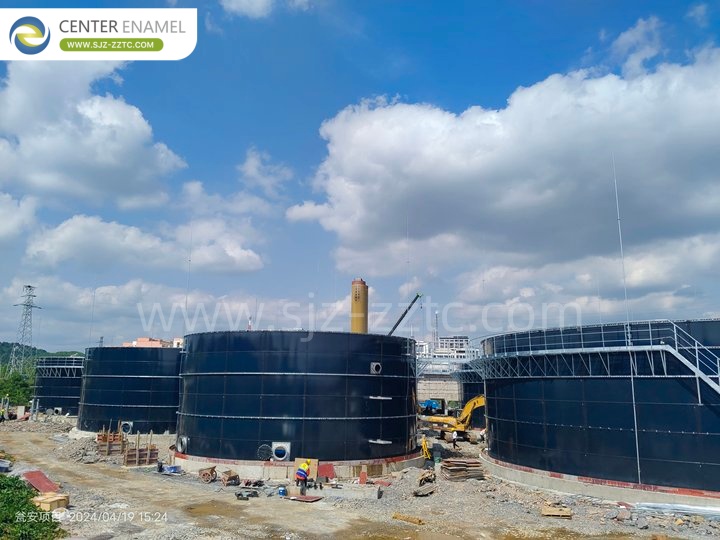
The proof of any Anaerobic Solutions package is in the field. A representative reference is Center Enamel's high-strength wastewater treatment project for a South African brewery, designed specifically for the high-COD, high-sugar and readily decomposable effluent typical of brewing operations. The core treatment line uses Center Enamel GFS tanks as the primary anaerobic digestion system, supported by stainless steel tanks for wastewater transfer and chemical storage. The equipment package delivers excellent corrosion resistance, flexible on-site assembly and long-term stable treatment of both production and cleaning-in-place wastewater-addressing a long-standing pollution bottleneck for African brewers.
To put this project in context, the table below contrasts it with typical reference deliveries Center Enamel has engineered across sectors.
| Project | Industry | Core Treatment | Main Equipment | Key Challenge | Outcome |
| South Africa Brewery | Brewing / beverage | Anaerobic high-load digestion | GFS tanks + stainless steel tanks | High COD, high sugar, seasonal peaks | Stable year-round treatment, mature African reference |
| Chemical plant (generic) | Fine / petrochemical | IC Process + pretreatment + polishing | GFS anaerobic reactors, coated steel covers | Variable composition, toxic shocks | Granular sludge protection, compliant discharge |
| POME / palm oil mill | Agro-processing | High-rate anaerobic biogas system | GFS digesters, aluminum or dual-membrane roofs | High temperature, oil and solids | Biogas recovery + effluent reuse |
| Livestock / swine farm | Agricultural | Anaerobic manure digestion | GFS digesters, gas-tight roofs | High solids, odor, nutrient load | Odor control, biogas, nutrient stabilization |
Center Enamel's Backbone: R&D, Tanks and Global Construction
Delivering the IC Process reliably in the field depends on more than reactor hydraulics. It depends on the tanks that hold the wastewater, the covers that contain odor and biogas, and the crews that erect them on remote sites. Center Enamel has built a full-chain team spanning R&D, design, marketing, installation and after-sales. The R&D group is led by national-level materials technology specialists focused on enamel frit and tank anti-corrosion core technologies, and is reinforced by senior environmental engineering and mechanical structure experts. Their labs-operated in collaboration with universities-run year-round durability pilots and long-term corrosion simulation tests, and have developed specialized enamel formulations for extreme conditions such as high-salinity wastewater, strong acid-alkali POME, and high-organic livestock manure. This material-level innovation directly underpins the performance of our Anaerobic Solutions in hostile service.
Equally important is construction readiness. Center Enamel maintains its own domestically and internationally certified installation teams, with recurring training on GFS tank erection and host-country construction standards. Domestically, regional crews can deploy in parallel across multi-tank farms; internationally, cross-border teams are equipped to local standards in Africa, Europe, North America and Southeast Asia. The manpower reserve ensures that remote African sites, high-spec European plants and fast-track brewery projects all receive uninterrupted on-site delivery-so the IC Process you design on paper actually performs as modeled on startup day.
Tank Cover Choice: The Aluminum Alloy Trough Deck Roof
Inside an Anaerobic Solutions train, not every tank needs a gas-tight biogas cover. Equalization, neutralization, clarified water storage and firewater reserves call for an economical, weather-resistant cover rather than a pressure-rated biogas holder. The Aluminum Alloy Trough Deck Roof is Center Enamel's cost-effective answer for these clean-water and wastewater storage scenarios, spanning drinking water, production wastewater and firewater reserve tanks.
Fabricated integrally from corrosion-resistant aluminum alloy plates on aluminum support trusses, the roof is lightweight, imposing minimal load on the tank foundation and reducing civil works investment. A naturally dense oxide layer on the aluminum surface resists rain and mild wastewater corrosion, while the closed roof effectively blocks wind, rain, insects, leaves and odor volatilization-preventing dust and debris from causing secondary contamination. The flat deck also accommodates walkways, guardrails, vents and level-monitoring ports, simplifying inspection and maintenance. With a simple sealing system, short erection schedule and virtually no anti-corrosion repainting, its lifetime operating cost is exceptionally low. It is widely deployed on waterworks clear-water tanks, industrial circulating water tanks, park firewater reservoirs and domestic wastewater equalization tanks-an ideal complement to biogas-tight dual-membrane roofs on the IC Process digesters themselves.
Frequently Asked Questions
Q1. What kind of wastewater is the IC Process best suited for?
A. The IC Process is most cost-effective for high-COD, soluble, readily biodegradable industrial streams such as brewery, distillery, starch, POME and chemical wastewater, where its self-recirculating design delivers high loading rates in a compact footprint.
Q2. How do Center Enamel's Anaerobic Solutions handle variable chemical wastewater?
A. We combine the IC Process with equalization, pH and temperature control, and selective pretreatment to protect granular sludge from shock loads and toxic compounds, backed by enamel-coated GFS tanks rated for corrosive service.
Q3. Does Center Enamel supply only tanks, or complete treatment packages?
A. Center Enamel delivers integrated Anaerobic Solutions covering process design, GFS and stainless steel tanks, aluminum or dual-membrane roofs, plus certified global installation and after-sales support.
Ready to evaluate how the IC Process and a fully engineered Anaerobic Solutions package can shrink your plant footprint, recover biogas and bring your industrial discharge into compliance? Send us your wastewater flow, COD range and target effluent standard, and our engineers will return a tailored process and tank configuration within two business days. From the first process flow diagram to the last roof bolt tightened on site, Center Enamel stands behind every cubic meter of treated water.