
How Anaerobic Solutions Transform Food Waste Treatment?
The Asia-Pacific region, particularly China, has become the world's largest industrial wastewater treatment market, with the operation and maintenance service segment's contribution continuing to rise, marking a shift from project construction to long-term operational management. The North American market focuses on upgrading existing facilities, while Europe emphasizes high-value-added resource recovery technologies.
Wastewater from the new energy industry chain-lithium batteries, photovoltaics, and hydrogen-has become the most notable emerging growth area due to its complex composition and high treatment difficulty, generating significant demand for customized Anaerobic Solutions. The maturity of third-party treatment models in industrial parks continues to improve, driving consolidation in the professional operation market. The Middle East has strong demand for advanced treatment and reuse of industrial wastewater due to water scarcity, while manufacturing transfer in Southeast Asia drives local industrial wastewater treatment facility construction demand.
USR Reactor Supporting Equipment
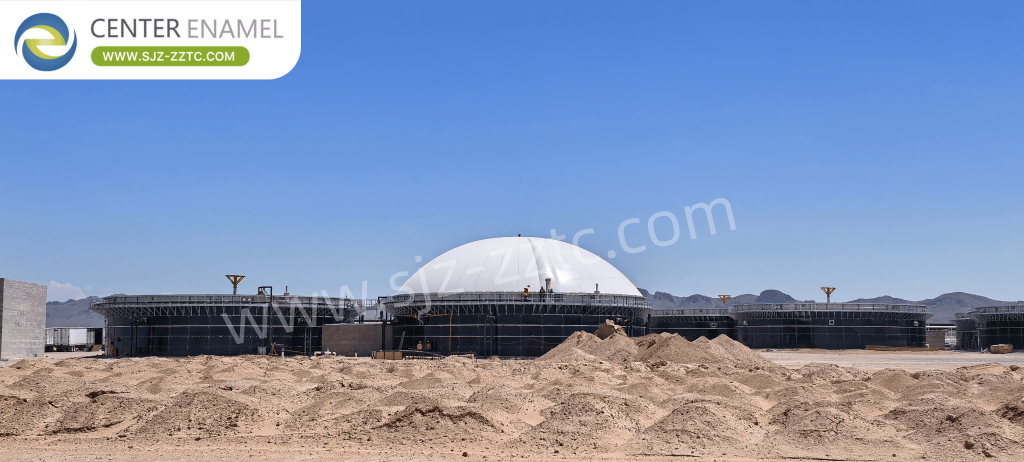
At the core of these treatment systems lies the USR Reactor, supported by carefully engineered auxiliary equipment. The main unit is a GFS tank with no complex media or precision three-phase separators, featuring a rugged clog-resistant structure. A bottom large-diameter anti-clogging distribution system suits high-solids wastewater, preventing pipe clogging.
Supporting equipment includes influent lift pumps, simple pretreatment screens, and equalization tanks for impurity removal and water quality balancing. Simple top gas collection devices and biogas conveying/desulfurization equipment enable biogas resource recovery. Temperature, level, and pH online monitoring equipment ensures stable operation. Bottom large-diameter sludge discharge pipes and pumps allow rapid removal of high-concentration residual sludge, suitable for high-solids conditions. The complete system has extremely low failure rates, outstanding wear and clog resistance, and is far easier to maintain than conventional anaerobic processes.
Standardized Food Waste Treatment Solutions
Building on the USR Reactor platform, food waste treatment requires a tailored approach. The core treatment uses a combination process of "pretreatment oil/grease/solids removal + anaerobic digestion + aerobic treatment + advanced treatment," specifically addressing high oil, high salt, and high organic load characteristics.
Pretreatment uses mechanical sorting and crushing/screening to remove inorganic impurities like plastics and bone fragments. Three-phase separators recover oil for sale, significantly reducing wastewater oil content, while DAF further removes emulsified oil to prevent oil entry into biological systems. The main stage uses the CSTR anaerobic process, suitable for high-solids, high-oil organic fermentation with strong shock resistance, simultaneously producing biogas for energy recovery. Anaerobic effluent then undergoes aerobic and advanced treatment to meet discharge or reuse standards.
Bangladesh Poultry Farm Manure Resource Recovery Project
Real-world performance demonstrates the value of these Anaerobic Solutions. In Bangladesh, a large-scale poultry farm manure resource recovery project targets daily treatment of 47 tons. Influent COD, BOD, and SS reach as high as 50,000 mg/L, 25,000 mg/L, and 50,000 mg/L respectively. After CSTR + UASB anaerobic treatment, all three parameters are reduced to below 200 mg/L, 100 mg/L, and 100 mg/L-effluent fully compliant with local environmental discharge standards.
The project produces approximately 4,900 m³ of biogas daily. Each cubic meter of biogas can generate 2 kWh of electricity, yielding daily power generation of 9,800 kWh-simultaneously achieving pollutant reduction and clean energy recovery. This stands as a benchmark project for livestock waste recycling in Southeast Asia.
Bangladesh Poultry Farm Project Performance
| Parameter | Influent | Effluent | Reduction |
| COD | 50,000 mg/L | <200 mg/L | >99.6% |
| BOD | 25,000 mg/L | <100 mg/L | >99.6% |
| SS | 50,000 mg/L | <100 mg/L | >99.8% |
| Biogas Production | - | 4,900 m³/day | - |
| Power Generation | - | 9,800 kWh/day | - |
Full-Category Product Matrix from Center Enamel
Delivering these results requires a complete equipment ecosystem. Center Enamel has built a full product matrix of "core storage tanks + supporting covers + specialty pressure vessels + complete environmental engineering services"-the only company globally to achieve integrated enamel frit R&D, self-manufacturing, and GFS tank application.
Core: Proprietary GFS Tanks use proprietary double-sided hot-rolled double-layer enamel anti-corrosion technology-resistant to strong acids/alkalis, high salinity, and microbial corrosion-with modular quick assembly suitable for all strong-corrosion conditions in wastewater, biogas, and chemical applications.
Supporting: Fusion Bonded Epoxy Tanks are produced on China's first intelligent standardized production line, primarily for drinking water, fire water, and neutral medium storage.
Sealing: Aluminum Dome Covers feature a proprietary high-strength aluminum alloy self-supporting structure meeting international waterproof and load-bearing standards, suitable for tank sealing and biogas collection.
Other Tanks include carbon steel tanks, stainless steel tanks, composting tanks, and various non-standard pressure vessels.
Engineering Services cover environmental EPC general contracting and anaerobic process section subcontracting-one-stop coverage across food waste, leachate, municipal wastewater, livestock biogas, petrochemical/metallurgical, and seawater desalination industries-customizable tank volume, corrosion protection grade, and complete process solutions with integrated equipment manufacturing and engineering construction.
Comprehensive International Authoritative Certifications
Supporting global project delivery, Center Enamel holds CE, NSF, WRAS, ISO9001, BSCI, ASME, and other global certifications-fully clearing EU, North American, Southeast Asian, and African project tendering barriers-providing critical hard credential advantages for large overseas project bidding.
Aluminum Geodesic Dome Roof
Completing the tank system, the Aluminum Geodesic Dome Roof independently developed by Center Enamel is manufactured using high-strength aluminum alloy plates through integral stamping. It features a triangular grid spherical self-supporting structure, enabling large-span full coverage without internal support columns.
Made of aluminum alloy, the roof offers excellent weather resistance and corrosion resistance, capable of long-term protection against acid rain, salt spray, and UV radiation, suitable for various extreme outdoor climate conditions. The structural design complies with international AWWA D108 standards, with aluminum plate thickness, rib cross-sections, and joint connections all verified by finite element stress analysis, ensuring wind and snow load resistance that meets building code requirements across different global regions.
The weight of the Aluminum Geodesic Dome Roof is only one-third to one-half of a steel roof with the same span, significantly reducing the load on the tank top and allowing direct installation without tank wall reinforcement. The roof provides superior overall sealing performance, with double sealing between panels using specialized sealant strips and mechanical interlocking, enabling both airtight gas storage and enclosed odor control. This makes it suitable for biogas collection and storage, wastewater tank odor control, and drinking water contamination prevention. The support-column-free design does not interfere with the installation and operation of internal equipment such as mixers and water distributors. The aluminum material does not support microbial growth, requiring no anti-corrosion maintenance over long-term use, resulting in low total life-cycle costs.
Partner with Center Enamel
Ready to turn your food waste challenge into a resource recovery opportunity? Contact our team today to explore how our Anaerobic Solutions and USR Reactor systems can be customized for your project.
Let's discuss your treatment goals together-reach out to Center Enamel for a free consultation and discover why 1000+ biogas projects worldwide trust our expertise.
FAQ
What is a USR Reactor and how does it work?
A USR Reactor (Upflow Solids Reactor) treats high-solids organic wastewater by feeding material through a bottom distribution system. The upward flow mixes solid substrates with anaerobic sludge, degrading pollutants and producing biogas without complex separation structures.
Why are Anaerobic Solutions better for food waste treatment?
Anaerobic Solutions handle high oil, high salt, and high organic loads efficiently. They produce biogas for energy recovery, reduce sludge production, and resist shock loads-ideal for food waste with COD up to 80,000 mg/L.
What certifications does Center Enamel hold for global projects?
Center Enamel holds CE, NSF, WRAS, ISO9001, BSCI, and ASME certifications, clearing tendering barriers in the EU, North America, Southeast Asia, and Africa.