
Anaerobic Solutions That Turn Beverage Wastewater Challenges Into Energy Assets
Industrial wastewater treatment confronts a persistent triad of high difficulty, high cost, and high energy consumption. For beverage producers specifically, effluent streams carry dissolved sugars, cleaning chemicals, and organic loads that fluctuate wildly between production cycles. Traditional aerobic treatment consumes power to destroy value; Anaerobic Solutions capture that value as biogas while meeting discharge limits. Center Enamel has spent over three decades refining this equation, pairing high-rate reactor engineering with glass-fused-to-steel containment to deliver Beverage Wastewater Treatment Projects that pay for themselves.
Why High-Strength Beverage Effluent Demands Anaerobic Solutions
The economic case for anaerobic treatment rests on a simple threshold: when chemical oxygen demand exceeds roughly 2,000 mg/L, anaerobic digestion becomes a net energy producer rather than a consumer . Beverage wastewater routinely clears this bar. Brewery streams, soft drink spillage, and syrup-laden cleaning water arrive warm and readily biodegradable-conditions that favor methanogenic conversion. Sugars are, in fact, the preferred substrate for anaerobic digestion, requiring no specialty chemicals beyond minor pH adjustment and flocculant dosing.
The operational profile compounds the advantage. Anaerobic systems generate a fraction of the excess sludge produced by aerobic treatment, cutting disposal costs that often hide in operational budgets. For seasonal producers-breweries with harvest spikes, bottlers with flavor changeovers-the low sludge yield and stable biogas output create a more resilient cost structure. The trade-off is nutrient removal: anaerobic treatment passes ammonia through, meaning a downstream aerobic polish remains necessary where nitrogen limits bind . This is not a weakness but a design parameter that shapes the complete treatment train.
Inside the IC Reactor: Engineering Circulation and Separation
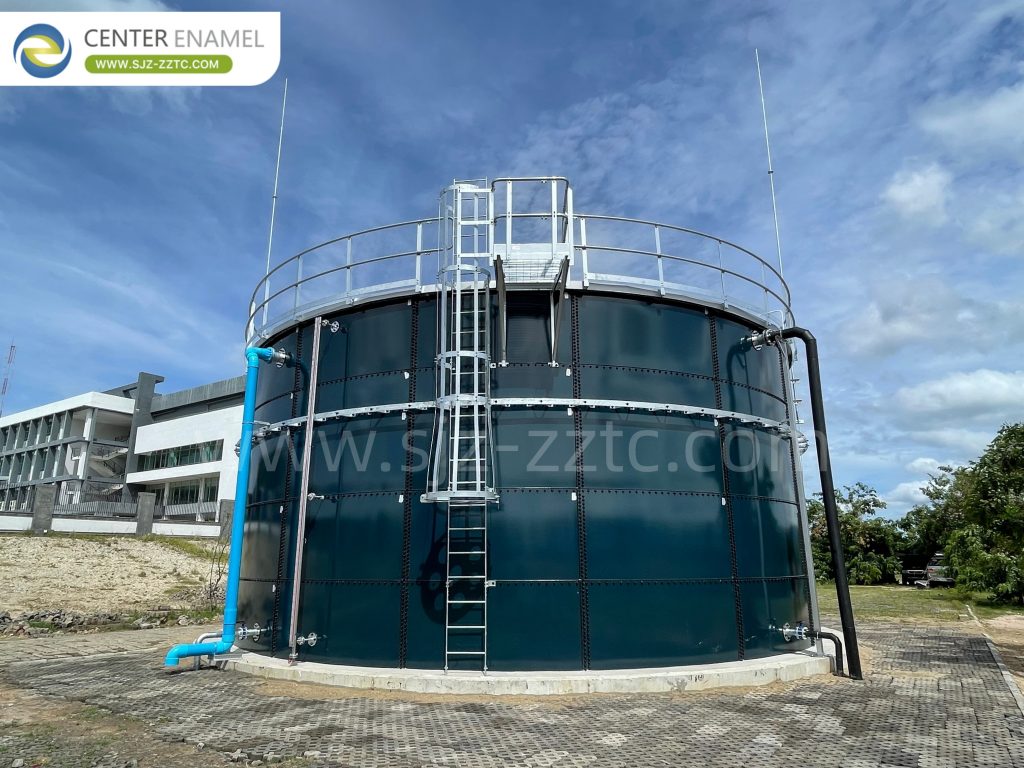
At the heart of Center Enamel's Anaerobic Solutions sits the Internal Circulation reactor, a configuration that achieves high organic loading rates within a compact footprint. The GFS tank shell houses a built-in gas-lift circulation system and upper/lower three-phase separators that drive autonomous mixing without external return pumps. A bottom precision distribution system and pressure-regulating feed device ensure uniform influent contact with the granular sludge bed, preventing short-circuiting that erodes treatment efficiency.
Supporting equipment is deliberately integrated rather than sprawling. Influent lift pumps, equalization tanks, and flow meters provide front-end control. Top-mounted biogas collection, desulfurization, dehydration, and storage form a complete gas handling train. Online monitoring tracks temperature, pH, COD, and level in real time. Dedicated sludge discharge pipes at the bottom and mid-section complete the system. The result is a reactor train with no excess external equipment-a meaningful advantage for overseas projects where spare parts logistics and operator training time directly affect total cost of ownership.
A Complete Beverage Wastewater Treatment Project Framework
The standard train for beverage effluent follows a deliberate sequence: pretreatment, anaerobic digestion, aerobic polishing, and final advanced treatment. Screens and sieves remove fruit pulp, tea residues, and suspended solids that would otherwise clog downstream equipment. Equalization tanks buffer the extreme swings between high-concentration CIP discharge and low-concentration rinse water. Alkali addition neutralizes acidic streams-a fundamental requirement given that soft drink spillage can drive pH well below 4.
The anaerobic stage does the heavy lifting. Center Enamel's IC reactors convert dissolved organics to biogas with COD removal rates typically exceeding 80%, delivering the energy recovery that justifies the anaerobic choice. Subsequent A/O or SBR aerobic processes degrade residual organics and address nitrogen and phosphorus. Final sedimentation, filtration, and disinfection close the compliance loop. The entire train is designed for the intermittent and seasonal discharge patterns characteristic of beverage production, with automation that reduces operator burden.
Table 1: Malaysia Biogas Project (2026)
| Parameter | Specification |
| Location | Malaysia |
| Application | Biogas from high-strength organic wastewater |
| Tank Type | Glass-Fused-to-Steel (GFS) |
| Tank Quantity | 5 tanks |
| Single Tank Volume | 5,400 m³ (Ø24.46 × 12 m) |
| Total Effective Volume | 27,000 m³ |
| Daily Biogas Production | 22,000 m³ total |
| Digestibility | ≈ 80% |
| Gas Production Rate | 0.45 m³/kg COD removed |
Global Delivery: From Southeast Asia to the Middle East
Center Enamel's reach extends across more than 100 countries, with installation teams experienced in climates ranging from Nordic cold to tropical high-salt spray. The delivery model combines company cross-border construction crews with localized agent coordination, covering site survey, installation, process commissioning, and operator training. This dual-service structure allows projects in remote regions to proceed without sacrificing technical oversight.
The project portfolio reflects this geographic spread. In Malaysia, a five-tank biogas installation achieved approximately 80% digestibility with 4,400 m³ daily biogas per tank . In Sweden, UASB reactors housed in GFS tanks addressed organic waste fermentation under Nordic conditions, with 30-year corrosion protection specified for acid and low-temperature exposure. In Saudi Arabia, aluminum dome covers on municipal wastewater tanks have demonstrated the sealing and odor control capabilities that beverage facilities also require. For beverage producers evaluating Anaerobic Solutions, these references confirm that containment performance and process reliability travel well across borders.
After-Sales Support and the Economics of Long-Term Operation
The O&M profile of anaerobic beverage treatment is genuinely favorable. Equipment is simple and durable-conventional pumps, distributors, and three-phase separators rather than high-precision wear parts. Failure rates are low, and maintenance demands minimal. Biogas revenue generally covers operational energy costs, with surplus available for plant heating or power generation. Automation keeps labor requirements modest, and stable effluent quality reduces the risk of compliance penalties.
Center Enamel's after-sales framework reinforces these economics. A 24/7 support team provides remote fault diagnosis, process parameter adjustment, and corrosion maintenance guidance. Where on-site intervention is required, overseas technical personnel can be dispatched for inspection, annual servicing, and equipment refurbishment. External expert teams are available for anaerobic commissioning, biogas upgrading O&M, and retrofit projects. The company maintains long-term feedback tracking, collecting operational data from tanks and anaerobic equipment to refine future designs. For a Beverage Wastewater Treatment Project where uptime directly affects production schedules, this support depth matters as much as reactor specifications.
Table 2: Sri Lanka Palm Oil Wastewater Treatment Project (2026)
| Parameter | Specification |
| Location | Sri Lanka |
| Application | Palm oil mill effluent |
| Process | SBR (Sequencing Batch Reactor) |
| Treatment Capacity | 250 tonnes/day |
| Reactor Configuration | 2 sets, Ø24.46 × 6 m |
| Influent COD | 65,600 mg O₂/L |
| Discharge COD | ≤ 400 mg O₂/L |
| Influent BOD | 7,480 mg O₂/L |
| Discharge BOD | ≤ 250 mg O₂/L |
When Anaerobic Solutions Fit-and When They Need a Partner Stage
Anaerobic treatment is not a universal answer. It suits high-concentration, high-flow soluble organic wastewater: brewery, beverage, starch, pharmaceutical, chemical, and papermaking streams. It performs poorly on high-solids or high-viscosity wastewater where mass transfer becomes limiting. It does not remove nitrogen or phosphorus, making a downstream aerobic stage mandatory wherever nutrient limits apply . Center Enamel scopes each Beverage Wastewater Treatment Project around these boundaries rather than forcing a single reactor type onto every effluent.
The combined train-anaerobic for bulk COD removal and energy recovery, aerobic for nitrogen polishing-is the standard configuration for producers facing comprehensive discharge permits. This integration is where Center Enamel's EPC capability becomes operationally relevant: single-point responsibility for reactor design, GFS tank manufacturing, equipment integration, and commissioning. The alternative-coordinating separate vendors for containment, process, and controls-introduces interface risks that surface during startup, when schedule pressure is highest.
FAQ
Q: How quickly does an anaerobic beverage system pay back through biogas savings?
A: For high-COD streams above 2,000 mg/L, biogas typically offsets a significant portion of O&M energy costs, with payback influenced by local energy prices and reactor loading rates.
Q: Can Center Enamel handle projects outside China?
A: Yes. With installations in 100+ countries and certifications including CE, NSF, and ISO 9001, Center Enamel delivers complete Beverage Wastewater Treatment Projects across Southeast Asia, Africa, Europe, and the Americas.
Q: What reactor type suits a seasonal beverage plant with variable load?
A: IC or UASB reactors paired with adequate equalization handle load swings effectively; the equalization volume is sized to buffer CIP spikes and low-production periods.
Ready to evaluate whether Anaerobic Solutions fit your beverage plant's effluent profile? Share your COD range, discharge limits, and site conditions with our engineering team for a preliminary process assessment.
Contact Center Enamel today to discuss a Beverage Wastewater Treatment Project scoped to your production cycle, climate, and compliance targets.