
Professional Anaerobic Technologies and Durable GFS Tanks for Beverage Wastewater Treatment Projects
As the global industrial wastewater treatment market evolves, the demand for efficient, durable, and flexible infrastructure is paramount. The Asia-Pacific region, particularly China, has emerged as the world's largest market for these solutions, driven by rapid industrialization and stringent environmental regulations . Shijiazhuang Zhengzhong Technology Co., Ltd (Center Enamel) stands at the forefront, offering integrated systems that combine cutting-edge Anaerobic Technologies with premium GFS Tanks to deliver complete solutions for complex applications like Beverage Wastewater Treatment Projects.
Regional Development Trends Shape the Demand for Industrial Wastewater Solutions
Understanding regional market dynamics is crucial for selecting the right treatment system. The Asia-Pacific region, particularly China, has become the world's largest industrial wastewater treatment market, with the operation and maintenance service segment's contribution continuing to rise, marking a shift from project construction to long-term operational management. The North American market focuses on upgrading existing facilities, while Europe emphasizes high-value-added resource recovery technologies. Wastewater from the new energy industry chain (lithium batteries, photovoltaics, hydrogen) has become the most notable emerging growth area due to its complex composition and high treatment difficulty, generating significant demand for customized solutions. The maturity of third-party treatment models in industrial parks continues to improve, driving consolidation in the professional operation market. The Middle East has strong demand for advanced treatment and reuse of industrial wastewater due to water scarcity; manufacturing transfer in Southeast Asia drives local industrial wastewater treatment facility construction demand.
In response to these diverse regional needs, Center Enamel's advanced Anaerobic Technologies and robust GFS Tanks offer a versatile and reliable solution, adaptable to the specific requirements of any project, from North American facility upgrades to new builds in Southeast Asia.
GFS Tank Bolted Assembly Offers Unmatched Construction Flexibility
The construction method of the treatment infrastructure is a key differentiator, directly impacting project timelines and long-term flexibility. GFS tanks are assembled on-site from prefabricated panels, with short construction periods and support for expansion, relocation, and reuse-advantages distinctly different from immovable concrete tanks. Concrete tank pouring requires formwork, rebar tying, pouring, and long curing periods, with a single tank construction taking months. Rain, snow, and low temperatures force work stoppages and delays. Once poured, they are permanent fixed structures that cannot be dismantled, expanded, or relocated-project relocation means complete abandonment.
GFS tank panels are all factory-prefabricated, transported to site, and directly assembled in panels with simple procedures. Construction can proceed even in low-temperature, light-rain conditions, with installation time only one-third that of concrete tanks-construction schedules are controllable. For expansion, additional steel panels can be installed to increase volume; for plant relocation, tanks can be fully disassembled with panels transported to new sites for reassembly and reuse, significantly reducing material and construction costs for new construction and reconstruction. This is ideally suited for short-term environmental projects, phased expansion projects, and relocated construction projects. The modularity of Center Enamel's GFS Tanks makes them an ideal choice for dynamic markets like Southeast Asia and for supporting the flexible infrastructure needs of growing sectors such as new energy.
Supporting Equipment Ensures Optimal UASB Reactor Performance
To ensure the high efficiency of the biological process, the reactor must be equipped with precise supporting systems. Core equipment includes the GFS anaerobic reactor tank, with the internal three-phase separator being the key component for gas-liquid-solid separation and sludge retention. The bottom high-precision distribution system (distribution pipes, distributors, pressure regulators) ensures uniform influent distribution, preventing short-circuiting and sludge accumulation. Supporting equipment includes influent lift pumps, equalization tanks, and flow meters to stabilize influent conditions. The top biogas collection system includes gas collection hoods, gas piping, desulfurization/dehydration equipment, and gas storage. Online temperature, pH, and COD monitoring instruments are integrated. Bottom sludge discharge pipes and pumps periodically remove excess sludge. The complete equipment package is compact, with no rotating wear parts, low equipment loss, and high operational stability. This comprehensive integration ensures that Center Enamel's Anaerobic Technologies operate at peak performance, providing reliable treatment and energy recovery for complex industrial streams.
Standardized Treatment Solutions Effectively Address Beverage Wastewater Challenges
Given the specific challenges of beverage production, a standardized but adaptable treatment train is essential. Uses a mature treatment train of "pretreatment + anaerobic digestion + aerobic treatment + advanced treatment," perfectly suited for high-sugar, easily biodegradable organic wastewater. Pretreatment uses screens and sieves to remove fruit pulp, tea residues, and other suspended impurities to prevent pipeline and equipment clogging. Equalization tanks balance high-concentration CIP and low-concentration wastewater to stabilize influent load. Alkali addition neutralizes acidic wastewater as needed.
The main stage uses UASB/IC anaerobic processes for high-efficiency high-concentration sugar degradation-sugars are readily anaerobically degraded with high biogas production and COD removal exceeding 80%-outstanding energy recovery benefits. Subsequent A/O or SBR aerobic processes deeply degrade residual organics and remove nitrogen/phosphorus. Final sedimentation, filtration, and disinfection ensure compliance. Anaerobic digesters use Center Enamel GFS tanks resistant to organic acid and sugar fermentation corrosion. The entire process is simple and stable, suitable for beverage industry's intermittent and seasonal discharge patterns, with high automation and convenient O&M. This process design, centered on robust Anaerobic Technologies and corrosion-resistant GFS Tanks, makes it the standard solution for any new Beverage Wastewater Treatment Project, ensuring compliance and energy efficiency.
Indonesia Palm Oil Biogas Project Demonstrates Proven Field Performance
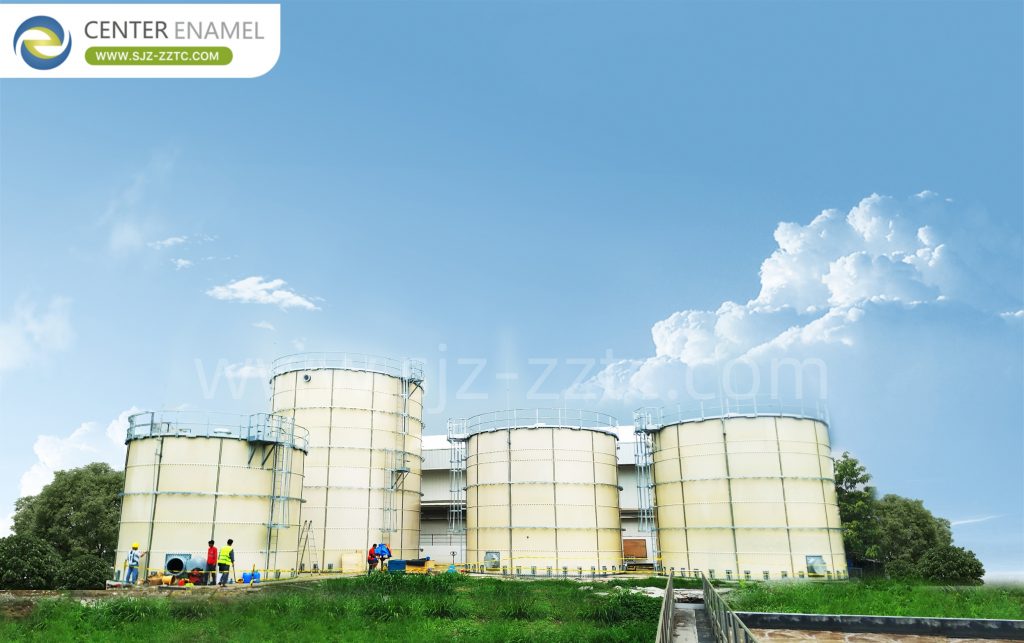
The efficacy of these combined technologies and equipment is proven in real-world applications around the globe. Commissioned in 2013 as the core anaerobic digestion reactor for the POME treatment station, with 3 GFS tanks in two sizes: 17.58 m dia. × 8.4 m height / 16.82 m dia. × 7.2 m height. The tanks serve as the core anaerobic reaction equipment specifically for high-organic palm oil production wastewater-anaerobic digestion degrades pollutants and recovers biogas. Tanks are adapted to local palm industry wastewater needs. GFS tank assembly is convenient with corrosion resistance for Southeast Asia's hot humid high-corrosion environment-a mature biomass energy environmental benchmark project. The long-term success of this project highlights the durability of GFS Tanks and the effectiveness of Center Enamel's Anaerobic Technologies in challenging tropical climates, a key consideration for many Beverage Wastewater Treatment Projects in similar regions.
A Professional Marketing Team Delivers Globally Tailored Solutions
The global delivery of such complex projects is supported by a highly experienced team. The marketing team brings together environmental industry multi-skilled professionals and multilingual foreign trade specialists, with deep expertise in global biogas, wastewater treatment, and biomass new energy markets-accumulating extensive practical project experience in Southeast Asia, Africa, Europe, and the Americas.
The team is proficient in various countries' wastewater discharge regulations, biogas subsidy policies, and carbon trading rules-providing one-stop preliminary site survey, solution planning, and investment return analysis consulting services. With multilingual capabilities (English, French, Spanish, Arabic), the team effectively communicates with clients worldwide-precisely matching regional industrial resources, project budgets, and environmental requirements-customizing high-cost-performance GFS tanks and anaerobic reactor solutions based on client production capacity, treatment targets, and gas production expectations. Leveraging extensive overseas project experience, the team proactively helps clients avoid risks in overseas approvals, equipment import, and construction implementation-building a globally adaptable integrated environmental equipment business service system. This expert team ensures that every Beverage Wastewater Treatment Project receives not just equipment, but a tailored solution that navigates local regulations and maximizes return on investment.
Comprehensive International Certifications Validate Quality and Compliance
This global service capability is underpinned by rigorous quality and safety standards. Center Enamel holds CE, NSF, WRAS, ISO9001, BSCI, ASME, and other global certifications-fully clearing EU, North American, Southeast Asian, and African project tendering barriers-providing critical hard credential advantages for large overseas project bidding. These certifications provide clients with absolute confidence in the quality and safety of our GFS Tanks and integrated Anaerobic Technologies, ensuring that projects meet the highest international standards.
Frequently Asked Questions (FAQ)
1. Why are Center Enamel's GFS Tanks the preferred choice for anaerobic treatment in beverage wastewater projects?
Center Enamel's GFS Tanks offer superior corrosion resistance against organic acids and sulfides present in beverage wastewater. Their modular bolted design allows for rapid installation, easy future expansion, and even relocation, which is ideal for the industry's growing and changing production needs. The glass-fused-to-steel coating also ensures a long, low-maintenance service life .
2. How do your Anaerobic Technologies adapt to the intermittent discharge patterns of beverage plants?
The treatment train includes equalization tanks which balance the flow and load from high-strength CIP cleaning cycles and low-strength production discharge. This stabilizes the influent before it enters the UASB reactor, ensuring the anaerobic bacteria are not shocked and maintain high COD removal efficiency (over 80%) and consistent biogas production .
3. What specific international certifications do your tanks and systems hold?
Center Enamel holds a comprehensive suite of international certifications that facilitate global project procurement, including CE, NSF, WRAS, ISO9001, BSCI, and ASME. These certifications ensure our GFS Tanks and Anaerobic Technologies meet the rigorous safety, quality, and performance standards required for projects in the EU, North America, and other regions .