
How Anaerobic Technologies Are Solving Biogas Plant Wastewater Challenges Worldwide
The global biogas industry is expanding at unprecedented scale, but the real engineering challenge lies beneath the surface: treating the wastewater that biogas production itself generates. As regional markets diverge in application focus-Europe chasing energy output, China prioritizing comprehensive utilization, and emerging markets targeting pollution control-the demand for robust, clog-resistant Anaerobic Technologies has never been higher. Paired with corrosion-proof GFS Tanks, these technologies determine whether a biogas plant operates profitably for decades or struggles with downtime from year one.
Regional Development Status: Divergent Paths in Global Biogas Expansion
The global biogas industry is in a phase of large-scale expansion, with China contributing the major share of new capacity, becoming the fastest-growing single market. Europe's mainstream model focuses on combined heat and power (CHP) and biomethane grid injection, with active biomethane certificate trading and application scenarios covering power generation, heating, and transportation fuel.
China, in contrast, emphasizes vehicle fuel and industrial heating while actively promoting the fertilizer utilization of digestate, showing significant differentiation in application scenarios. Southeast Asian emerging markets show rapidly growing food waste treatment demand, becoming key areas for global companies; while African and Latin American markets remain in the early stages, primarily relying on low-cost direct application models.
Countries show differentiated development paths in biogas resource utilization: Europe focuses on energy output, China emphasizes comprehensive utilization, and emerging markets prioritize pollution control. Regardless of the regional model, the underlying requirement is the same-durable GFS Tanks and proven Anaerobic Technologies that perform across varying climates, feedstocks, and regulatory environments.
Regional Biogas Development Models Compared
| Region | Primary Focus | Main Application | Market Stage |
| Europe | Energy output | CHP, biomethane grid injection, transport fuel | Mature; certificate trading active |
| China | Comprehensive utilization | Vehicle fuel, industrial heating, digestate fertilizer | Fastest-growing single market |
| Southeast Asia | Pollution control + resource recovery | Food waste treatment | Rapidly emerging |
| Africa & Latin America | Low-cost treatment | Direct application models | Early stage |
Full-Process Factory Standardization: Why GFS Tanks Outperform Concrete
GFS Tanks are fully factory-prefabricated to standardized specifications, with finished product quality stability far exceeding cast-in-place concrete tanks. All concrete tank processes are completed in the open air, with rebar tying, concrete pouring, and curing heavily influenced by worker skill, temperature, and rainfall. Wall thickness, density, and strength vary significantly between batches, with hidden defects like honeycombing, voids, and insufficient wall thickness common-quality cannot be uniformly controlled.
Center Enamel's GFS Tank steel panels, seals, and reinforcement components are all mass-produced in automated factories. Steel stamping, high-temperature enameling, and dimensional cutting are all controlled by CNC equipment, with each panel's parameters and enamel thickness strictly following unified national standards. All components are uniformly packaged and transported to site, with assembly strictly following standardized construction drawings.
Full-process quality inspection from raw materials to finished components ensures highly consistent product performance parameters, completely eliminating the uncontrollable quality risks of on-site concrete construction. Every tank delivers stable, consistent performance-the reliable vessel that allows Anaerobic Technologies to operate at design efficiency.
GFS Tanks vs. Concrete Tanks for Anaerobic Digesters
| Dimension | GFS Tanks | Concrete Tanks |
| Quality Control | Factory-prefabricated; CNC-controlled parameters | On-site casting; dependent on labor and weather |
| Corrosion Resistance | Double-sided fused glass coating; resistant to H₂S, organic acids, high salinity | Requires anti-corrosion lining; prone to failure |
| Gas Tightness | Precision-bolted, gas-tight construction | Curing cracks common; methane leakage risk |
| Installation Timeline | Modular assembly; weeks vs. months | Cast-in-place; weather-dependent |
| Service Life | 30+ years with minimal maintenance | 15–20 years with lining upkeep |
USR Applicable Scenarios: Purpose-Built for Agricultural High-Solids Wastewater
The USR process is a dedicated anaerobic technology for agricultural high-solids wastewater, primarily suitable for large-scale livestock manure, livestock soaking water, agricultural straw leachate, and livestock slaughterhouse high-solids wastewater.
For high-suspended-solids, high-organics, high-impurity wastewater conditions, it is the core process for rural livestock pollution treatment and agricultural organic waste resource utilization. It suits township decentralized wastewater treatment and small to medium-sized agricultural enterprise wastewater treatment. It can serve as the primary process for large livestock base manure resource recovery, combining wastewater treatment with biogas recovery. It is also suitable for various high-solids, easily clogged, difficult-to-treat organic wastewater pretreatment, with superior suitability in agricultural environmental applications compared to other Anaerobic Technologies.
Biogas Plant Wastewater Sources: Understanding the Real Treatment Challenge
Biogas plant wastewater is secondary wastewater from organic waste resource recovery-primarily digestate from anaerobic digestion, distinct from primary production wastewater. It originates from anaerobic digestion of livestock manure, crop straw, food waste, and brewery residues, as a byproduct of biogas fermentation.
Auxiliary wastewater includes equipment washing, digester tank cleaning, desulfurization system drainage, and plant floor washdown. Production is continuous and stable, with only minor variations tracking feedstock input and fermentation cycles. Pollutants are significantly transformed through anaerobic digestion, with composition distinct from primary high-concentration organic wastewater-it is the core wastewater requiring treatment in biogas plants, and the reason Anaerobic Technologies must be selected for digestate characteristics rather than generic industrial parameters.
Biogas Plant Wastewater Composition and Sources
| Source Type | Origin | Characteristics |
| Primary digestate | Anaerobic digestion of manure, straw, food waste, brewery residues | Transformed pollutants; high residual organics |
| Equipment washing | Mixers, pumps, piping | Dilute; low solids |
| Digester cleaning | Periodic tank maintenance | High solids; variable load |
| Desulfurization drainage | Biogas cleaning system | Sulfur compounds; corrosive |
| Floor washdown | Plant operations | Dilute; intermittent |
Center Enamel's Global Market Presence
Center Enamel's global business covers over 100 countries and regions, with 30,000+ successful overseas projects. Products are exported to all major regions including Europe, the Americas, the Middle East, Africa, Southeast Asia, and Latin America, with a well-established global localized service network.
Domestically, the company is organized into North, South, Central, East, and Southwest marketing regions, covering environmental, water utility, livestock, and petrochemical customers nationwide. Internationally, the company adopts a "standardized products + localized adaptation" model-adjusting tank corrosion protection, sealing, and pressure standards for different national water quality and environmental regulations.
Multiple global landmark projects demonstrate this capability: large-volume GFS Tanks in Italy, 20 m tower water supply tanks in Colombia, coastal seawater treatment tanks in Costa Rica, and large municipal wastewater aluminum dome projects in Saudi Arabia. The company has established long-term stable strategic partnerships with many Fortune 500 companies, applying Anaerobic Technologies and GFS Tanks across diverse regulatory and climatic conditions.
Global Market Footprint
| Metric | Figure |
| Countries & Regions Served | 100+ |
| Overseas Projects Completed | 30,000+ |
| Domestic Marketing Regions | North, South, Central, East, Southwest |
| Landmark Projects | Italy (large-volume GFS tanks), Colombia (20 m tower tanks), Costa Rica (coastal seawater tanks), Saudi Arabia (municipal wastewater aluminum domes) |
| Client Profile | Fortune 500 partnerships |
After-Sales and Technical Support: Full-Lifecycle O&M for Anaerobic Systems
The after-sales team adheres to the service principles of rapid response, professional efficiency, and full-cycle support-providing 24/7 full-lifecycle O&M support to global clients.
Standard remote services include fault diagnosis, process parameter adjustment, and tank anti-corrosion maintenance guidance. For domestic and long-distance overseas clients, overseas technical service personnel can be dispatched for on-site inspection, annual inspection, and equipment refurbishment as needed. The team also maintains long-term client feedback tracking mechanisms-regularly collecting tank and anaerobic equipment operational data to continuously optimize product structure and support processes.
Supporting external technical expert teams provide specialized support for anaerobic process commissioning, biogas upgrading O&M, and wastewater upgrade/retrofit projects-ensuring long-term stable operation of domestic and overseas projects, continuously improving global client satisfaction and repurchase rates. This service depth is what makes Center Enamel's Anaerobic Technologies deployment a long-term partnership rather than a one-time equipment sale.
Gas Holder: Independent Double-Membrane Biogas Storage
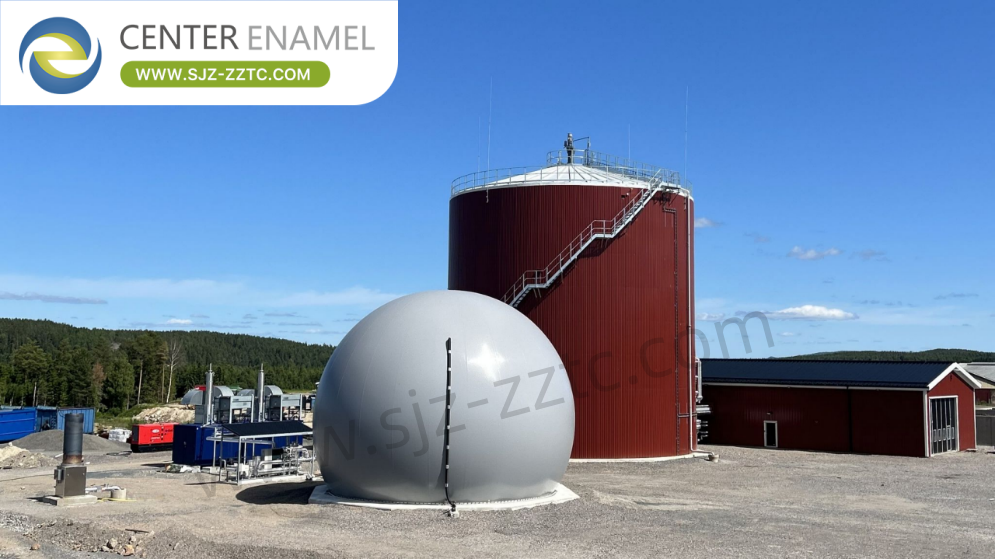
Center Enamel's Gas Holder (independent double-membrane biogas holder) is a ground-mounted biogas storage device installed independently from the fermentation tank. It adopts a double-layer high-strength membrane structure, with the inner membrane forming the gas storage cavity and the outer membrane forming the protective shell. Continuous aeration between the inner and outer membranes maintains constant positive pressure, ensuring stable sealing of the gas storage cavity.
The Gas Holder is installed separately from the fermentation tank and connected via biogas transmission pipelines. Biogas produced from the fermentation tank is sent to the holder for storage after desulfurization and dehydration, then pressure-regulated and stably delivered to end-use equipment, enabling separated management of biogas production, storage, and utilization.
The gasholder volume can be customized from tens to thousands of cubic meters to meet storage and peak-shaving requirements for different production rates and consumption cycles. The Gas Holder is equipped with a comprehensive safety control system, including biogas leak detection, inner membrane overpressure protection, emergency flare stack, and lightning protection grounding, ensuring full operational safety. The membrane material uses high-strength PVDF outer membrane and biogas-corrosion-resistant inner membrane, with a service life of over 15 years. Maintenance is simple, requiring only periodic checks of membrane integrity and aeration system operation, with significantly lower lifecycle maintenance costs than steel gasholders.
Gas Holder Specifications at a Glance
| Parameter | Specification |
| Type | Independent double-membrane biogas holder |
| Structure | Inner gas storage membrane + outer protective membrane |
| Pressure Control | Continuous aeration; constant positive pressure |
| Volume Range | Tens to thousands of cubic meters (customizable) |
| Safety Systems | Leak detection, overpressure protection, emergency flare, lightning grounding |
| Membrane Material | High-strength PVDF outer; biogas-corrosion-resistant inner |
| Service Life | 15+ years |
| Maintenance | Periodic membrane integrity and aeration checks |
Let's Build Your Anaerobic Solution Together
Stop coordinating multiple contractors and start building. Contact Center Enamel today for a free feedstock assessment and a tailored design combining proven Anaerobic Technologies with our own GFS Tanks - one contract, one guarantee.
1,000+ biogas projects. 100+ countries. Talk to our engineers now and get your anaerobic system and GFS Tank budget estimate within 48 hours.
Frequently Asked Questions About Anaerobic Technologies and GFS Tanks
Q1: Which Anaerobic Technologies does Center Enamel deploy for high-solids wastewater?
A: We deploy USR and CSTR as core anaerobic technologies, with IC reactors available for high-load industrial streams. USR is preferred for livestock manure and agricultural high-solids wastewater because it tolerates high suspended solids, resists clogging, and requires no granular sludge cultivation-enabling fast start-up.
Q2: Why are GFS Tanks critical to anaerobic digestion performance?
A: Anaerobic Technologies depend on stable, gas-tight, corrosion-resistant vessels. GFS Tanks provide a fused glass coating that resists H₂S and organic acids, precision-bolted construction that prevents methane leakage, and modular panels that allow individual replacement without tank demolition-protecting gas yield and extending service life beyond 30 years.
Q3: How does the double-membrane Gas Holder improve plant safety?
A: It separates biogas production from storage, maintains constant positive pressure via continuous aeration, and includes leak detection, overpressure protection, and an emergency flare stack. This decoupling stabilizes gas delivery to CHP or upgrading units and reduces methane release risk.