
How Does Center Enamel Deliver Reliable Anaerobic Technologies for Every Industrial Wastewater Treatment Project?
The global industrial wastewater market is evolving fast, and the pressure to choose the right partner has never been greater. The Asia-Pacific region, particularly China, has become the world's largest industrial wastewater treatment market, with the operation and maintenance service segment's contribution continuing to rise-marking a shift from project construction to long-term operational management. North America focuses on upgrading existing facilities, while Europe emphasizes high-value-added resource recovery technologies.
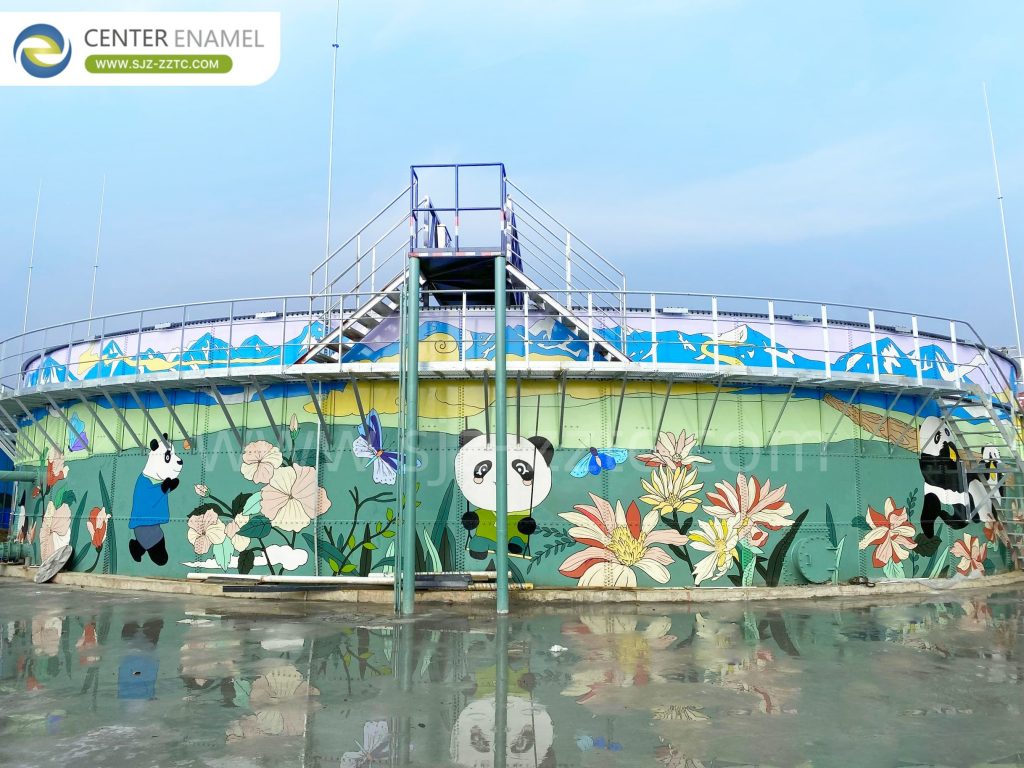
Wastewater from the new energy industry chain (lithium batteries, photovoltaics, hydrogen) has become the most notable emerging growth area due to its complex composition and high treatment difficulty, generating significant demand for customized solutions. Meanwhile, the maturity of third-party treatment models in industrial parks continues to improve, driving consolidation in the professional operation market. The Middle East has strong demand for advanced treatment and reuse due to water scarcity, and manufacturing transfer in Southeast Asia drives local facility construction demand. Across all these regions, Anaerobic Technologies have become the backbone of cost-effective, high-strength organic wastewater treatment-and every successful Industrial Wastewater Treatment Project depends on getting the reactor design right.
How Does the IC Reaction Process Work Inside Anaerobic Technologies?
At the heart of modern Anaerobic Technologies is the Internal Circulation (IC) reaction process. Pretreated high-strength organic wastewater enters the lower main reaction zone from the bottom, mixing with recirculated sludge-water mixture and rising rapidly. Anaerobic microorganisms efficiently degrade organic matter, producing large volumes of biogas. The gas-lift action of biogas carries the mixed liquor upward to the top gas-liquid separator where biogas is collected. Degassed sludge-water mixture returns by gravity through downcomers to the reactor bottom, creating autonomous internal circulation that repeatedly enhances pollutant degradation. After multiple circulation cycles, the wastewater enters the upper polishing zone for further reaction and sludge-water separation. Remaining trace organics are fully degraded, sludge settles back to the lower reaction zone, treated effluent overflows from the top, and aged sludge is periodically discharged-fully autonomous circulation, efficient continuous operation. This self-sustaining circulation is what makes the IC process one of the most energy-efficient Anaerobic Technologies available for high-strength industrial streams.
What Makes Chemical Wastewater the Toughest Test for Anaerobic Technologies?
Chemical wastewater represents one of the highest treatment difficulty categories in industrial wastewater, and it is where Anaerobic Technologies face their sternest challenge. Its composition is extremely complex, with severe fluctuations, high pollution load, and poor biodegradability. COD ranges widely, typically 5,000–80,000 mg/L for chemical wastewater, with coal chemical high-strength wastewater exceeding 100,000 mg/L. BOD/COD is generally below 0.25, with large quantities of synthetic refractory macromolecules. The wastewater is rich in benzene series, phenols, cyanides, sulfides, halogenated hydrocarbons, and various toxic characteristic pollutants. Salinity is very high, with inorganic salts reaching tens of thousands to over 100,000 mg/L, primarily sodium chloride and sodium sulfate. pH fluctuates wildly, with strong acid and strong alkaline wastewater discharged alternately. Deep color and strong odor are common, with some wastewater containing heavy metal ions. Water quality and quantity vary dramatically with production batch changes, with no stable patterns, frequent shock loads, and extremely difficult biochemical system acclimation. For any Industrial Wastewater Treatment Project handling chemical effluent, robust pretreatment and proven Anaerobic Technologies are non-negotiable.
How Does Center Enamel's Manufacturing Scale Support Large Industrial Wastewater Treatment Projects?
Delivering reliable Anaerobic Technologies at scale requires manufacturing depth, and Center Enamel's core intelligent manufacturing base is located in Hebei Province, China, covering a total area of over 150,000 m². It features a Phase I mature manufacturing facility and a Phase II high-end environmental equipment industrial park-dual-base synergy ensures stable production capacity. The base includes dedicated R&D office buildings, proprietary material laboratories, and finished product testing centers, with full-process quality control systems meeting ISO, NSF, CE, and other international standards. The facility operates to green manufacturing standards, certified as a Provincial Green Factory-balancing efficient production with energy conservation and emission reduction. The company has 6 marketing service centers across China, establishing a nationwide production-sales network ensuring stable global order delivery. The base is adjacent to expressway networks and major logistics hubs, with complete container shipping capabilities-supporting simultaneous large-scale tank projects globally. The base employs over 500 staff, with multiple parallel automated production lines-facility scale and production capacity firmly placing it among the global top tier of GFS tank equipment manufacturers.
Table 1: Center Enamel Manufacturing Base at a Glance
| Metric | Detail |
| Total area | Over 150,000 m² |
| Facility structure | Phase I manufacturing + Phase II high-end equipment park |
| Quality certifications | ISO, NSF, CE |
| Green certification | Provincial Green Factory |
| Marketing service centers | 6 across China |
| Workforce | 500+ staff |
| Logistics | Expressway-adjacent, full container shipping capability |
What Proof Exists That These Anaerobic Technologies Perform in the Field?
Manufacturing scale means little without field-proven results. Center Enamel holds unmatched global practical experience among domestic peers-over a decade covering multiple regions and all industry sectors. In 2009, the company completed its first overseas GFS tank installation, sending a team to Niger, Africa for a drinking water storage tank installation. In 2015, it broke industry ground with China's first GFS tank export and installation to the US-passing strict US acceptance standards. All installed projects have operated stably for many years, covering livestock biogas, POME, municipal wastewater, and drinking water storage applications. Construction has covered Southeast Asia, Africa, the Americas, and other regions-accumulating specialized solutions for complex sites including mountainous terrain, coastal salt spray, tropical high temperatures, and high-standard European/American facility conditions, maturely addressing global special construction requirements.
Table 2: Milestones in Global Installation Experience
| Year / Scope | Milestone |
| 2009 | First overseas GFS tank installation, Niger, Africa |
| 2015 | China's first GFS tank export and installation to the US |
| Regions covered | Southeast Asia, Africa, the Americas, and beyond |
| Applications | Livestock biogas, POME, municipal wastewater, drinking water |
| Site challenges solved | Mountainous terrain, coastal salt spray, tropical heat, EU/US standards |
How Does Engineering Design Strengthen Every Industrial Wastewater Treatment Project?
Behind every successful Industrial Wastewater Treatment Project is a design team that anticipates site realities. Center Enamel's design team includes senior engineers registered in the Hebei Provincial Science and Technology Expert Database, with design standards aligned with strict European/American high-end equipment safety standards. The team can provide complete integrated design for differentiated overseas projects in livestock biogas, POME, municipal wastewater, hazardous waste storage, and seawater desalination-covering tank structure, anticorrosion/sealing systems, biogas piping, and anaerobic process integration. Pre-design thoroughly investigates local seismic zone, wind pressure, soil bearing capacity, water quality corrosivity, and local environmental discharge standards-applying thickened panels, reinforced anchored bases, and optimized sealing/corrosion structures as needed. Complete customized equipment solutions can be tailored to customer plant area, wastewater load, treatment targets, and budget-balancing safety, economics, and local adaptation, providing compliant, stable, and highly adaptable equipment structural design support for global environmental projects.
Why Choose Center Enamel for End-to-End Industrial Wastewater Treatment Project Delivery?
Center Enamel is the only company globally integrating proprietary enamel frit R&D, self-manufactured tanks, and EPC general contracting-full-process self-control from solution design, equipment production, cross-border logistics, overseas construction, to post-construction O&M-significantly reducing client coordination and time costs. This integrated model means your Industrial Wastewater Treatment Project is delivered by one accountable team, with Anaerobic Technologies engineered, built, and supported under a single quality system. From the first process calculation to long-term operational support, every stage stays in-house.
FAQ
Q1: Which industries benefit most from IC-based Anaerobic Technologies?
Brewery, beverage, starch, pharmaceutical, chemical, and papermaking sectors with high-strength soluble organic wastewater benefit most, especially where land is constrained and COD/BOD removal must be rapid.
Q2: Can Center Enamel handle chemical wastewater with extreme salinity and toxicity?
Yes. We combine segregated pretreatment, advanced oxidation, and robust anaerobic reactor design, with corrosion protection engineered for high-salt, strongly oxidizing conditions.
Q3: Does Center Enamel provide EPC delivery overseas?
Yes. We integrate enamel frit R&D, tank manufacturing, cross-border logistics, overseas construction, and post-construction O&M into a single EPC contract.
Planning an industrial wastewater project with high-strength organic loads? Send our engineers your water quality data and treatment targets for a tailored process recommendation.
Talk to Center Enamel about your next Industrial Wastewater Treatment Project and discover how our Anaerobic Technologies can lower operating costs from day one.