
Anaerobic Technologies for High-Solids Wastewater: What an EPC Contractor Delivers
The global biogas industry competitive landscape shows divergence, and this shapes how an EPC contractor must position its services. Leading companies dominate major project market shares through the "EPC + Operation" integrated model, while small and medium-sized enterprises focus on county-level distributed projects and specialized equipment segments.
China's biogas equipment exports continue to expand, with generator sets primarily flowing to emerging markets. Business model innovation is accelerating, with carbon asset development becoming a standard feature of large projects, converting methane emission reductions into tradable carbon credits. Some countries have piloted digestate fertilizer carbon credit trading, encouraging the integration of digestate application to farmland with carbon accounting. The "biogas operation outsourcing" service model is emerging, improving operational efficiency of county-level projects through professional management.
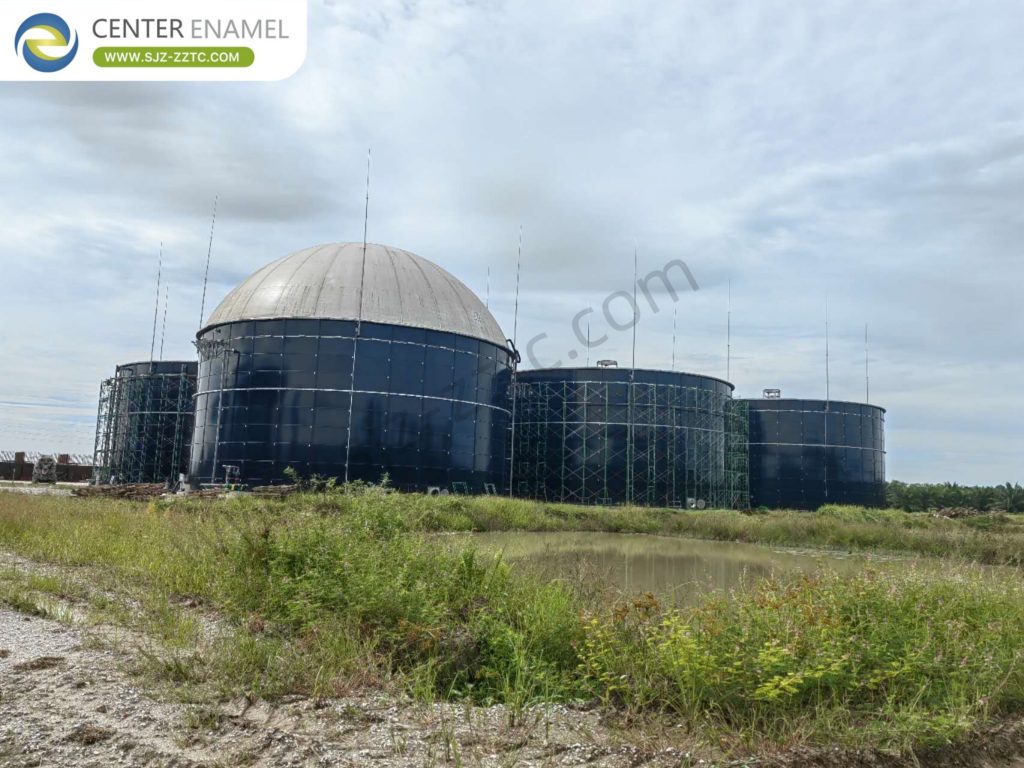
From a technology and equipment perspective, anaerobic technologies form the core process of biogas engineering. Glass-fused-to-steel (GFS) tanks, with their excellent sealing, corrosion resistance, and construction convenience, have become the mainstream choice for large anaerobic digestion tanks. Their modular design can be combined with membrane gas holders to form an integrated "fermentation + gas storage" solution, with penetration rates continuing to rise in new projects in biogas industry clusters.
| Market Trend | Impact on Project Delivery |
| "EPC + Operation" integrated model | Larger contracts, longer service cycles |
| Carbon asset development | New revenue streams from methane reduction |
| Digestate fertilizer carbon credits | Farmland application linked to carbon accounting |
| Biogas operation outsourcing | Professional management of county-level projects |
| GFS tank + membrane gas holder | Integrated fermentation and gas storage solution |
GFS Tanks Adaptable to Complex Operating Conditions Across All Industries
Center Enamel has independently developed over 200 specialized enamel frit formulations and supporting patents, capable of customizing anti-corrosion enamel based on customer storage media. The adaptability of GFS tanks is comprehensively superior to concrete tanks.
Concrete tanks use a single material, only suitable for neutral clean water storage. When storing corrosive materials such as livestock manure, palm oil mill effluent, chemical wastewater, food waste digestate, or high-salinity wastewater, additional anti-corrosion linings must be applied. These linings are prone to failure, preventing long-term stable operation and cannot adapt to alternating high/low concentration storage conditions.
GFS tanks can be specifically formulated with specialized enamels resistant to strong acids, strong alkalis, high organic content, and high salinity. A single tank can switch between multiple wastewater and fermentation feedstock storage requirements. They are universally applicable across biogas anaerobic digestion, municipal wastewater, livestock farming, food processing, and industrial water treatment scenarios-eliminating the need to rebuild tanks for media changes.
| Comparison Factor | Traditional Concrete Tanks | Center Enamel GFS Tanks |
| Anti-corrosion service life | 5–8 years before major degradation | Exceeding 30 years |
| Surface structure | Highly porous; prone to penetration | Dense, non-porous enamel finish |
| Maintenance requirement | Frequent lining repairs | No internal lining repairs needed |
| Chemical resistance | Limited; degrades with acids/alkalis | Resists acids, alkalis, salts, microbial corrosion |
| Leakage risk | High after 5–8 years | Negligible |
| Adaptability | Poor for high-salinity/high-corrosion media | Excellent for POME, manure, chemical wastewater |
USR Process Advantages: Why Anaerobic Technologies Excel on High-Solids Wastewater
Within the anaerobic technologies toolkit, the USR process delivers high solids tolerance, clog resistance, and strong adaptability-perfectly suited for high-suspended-solids, high-impurity, high-solids organic wastewater.
Key advantages include:
Extremely simple equipment structure - no precision wear parts, low capital investment, long service life, virtually no clogging failures, and extremely low subsequent maintenance costs
No strict requirements on sludge morphology - no need to cultivate mature granular sludge; flocculent sludge can operate stably, with fast start-up and short sludge acclimation period for rapid commissioning
Gentle hydraulic disturbance - low sludge washout, high sludge utilization, and stable organic pollutant degradation
Simple operation - low automation requirements and high error tolerance, suitable for remote sites and farms with limited O&M capabilities
These characteristics make USR one of the most practical anaerobic technologies for agricultural and high-solids industrial applications.
Biogas Plant Digestate Operation and Maintenance Cost Analysis
O&M costs are low and controllable, with outstanding resource recovery benefits-excellent overall cost-effectiveness. Treatment processes are simple and mature, with no complex pretreatment or high-end degradation equipment. Conventional equipment with low failure rates and simple maintenance keeps costs predictable.
| Cost Factor | Impact on Biogas Plant O&M |
| Water quality stability | Stable, no drastic fluctuations - no frequent parameter adjustments, low labor requirements |
| Chemical consumption | No large quantities of specialty chemicals required; controlled chemical and energy costs |
| Resource recovery value | Compliant digestate and treated effluent usable as ecological fertilizer, reducing chemical fertilizer use |
| Commercial fertilizer potential | Digestate can be concentrated into commercial liquid fertilizer |
| Net economics | Resource recovery revenues generally covering routine O&M costs - industry-leading economics |
Full-Process Standardized Installation Quality Control
Demonstrating high-standard installation quality through long-term stable global project performance, Center Enamel has established full-chain quality control standards across four dimensions: factory protection, on-site assembly construction, completion inspection, and long-term warranty-ensuring quality control for every GFS tank.
At the factory stage, all enameled panels, seals, and structural components receive rust-proof and moisture-proof independent packaging with dedicated protective supports-preventing damage during sea and land transport and avoiding enamel coating damage. On-site construction strictly follows unified assembly process specifications-panel by panel tightening and leak testing in layers, with airtightness and verticality testing after each tank section completion. Dual-membrane covers and anaerobic piping undergo simultaneous pressure testing and acceptance.
Differentiated quality acceptance standards are customized for different regions:
| Region | Acceptance Standard |
| EU / US projects | Stringent CE/NSF inspection criteria |
| Southeast Asian hot humid regions | Enhanced corrosion protection and sealing acceptance |
| Remote African sites | Additional foundation settlement re-inspection procedures |
Upon project completion, complete construction inspection reports, pressure test records, and anti-corrosion appearance acceptance documents are issued, with full photo/video archives retained. Over 10,000 tanks delivered globally have operated long-term without large-scale leakage or structural deformation-preventing future O&M issues at source.
Global Benchmark Project Experience
Center Enamel's project portfolio covers over 100 countries across Southeast Asia, Africa, Europe, and the Americas-30,000+ mature projects-accumulating complete industry solutions across palm oil, livestock, municipal, brewing, and food waste biogas. This depth of experience allows rapid matching of customized solutions for different regional climates, water quality, and regulations.
As an EPC contractor, this global footprint means clients benefit from proven designs rather than experimental approaches-every tank configuration, process train, and sealing system has been validated across multiple projects and operating conditions.
Gas Holder: Independent Double-Membrane Biogas Storage
Center Enamel's Gas Holder (independent double-membrane biogas holder) is a ground-mounted biogas storage device installed independently from the fermentation tank. It adopts a double-layer high-strength membrane structure, with the inner membrane forming the gas storage cavity and the outer membrane forming the protective shell. Continuous aeration between the inner and outer membranes maintains constant positive pressure, ensuring stable sealing of the gas storage cavity.
The Gas Holder is installed separately from the fermentation tank and connected via biogas transmission pipelines. Biogas produced from the fermentation tank is sent to the holder for storage after desulfurization and dehydration, then pressure-regulated and stably delivered to end-use equipment, enabling separated management of biogas production, storage, and utilization.
| Feature | Specification |
| Storage volume | Customizable from tens to thousands of cubic meters |
| Safety system | Biogas leak detection, inner membrane overpressure protection, emergency flare stack, lightning protection grounding |
| Outer membrane material | High-strength PVDF |
| Inner membrane material | Biogas-corrosion-resistant |
| Service life | Over 15 years |
| Maintenance | Periodic checks of membrane integrity and aeration system operation |
| Lifecycle cost | Significantly lower than steel gasholders |
The Gas Holder is equipped with a comprehensive safety control system, ensuring full operational safety.
Frequently Asked Questions
What does an EPC contractor like Center Enamel deliver for biogas projects?
We deliver full-scope biogas projects-design, GFS tank and gas holder manufacturing, anaerobic process integration, overseas construction, and O&M support. With 30,000+ projects in 100+ countries, we manage everything from site survey to commissioning.
Which anaerobic technologies does Center Enamel apply?
We apply USR for high-solids wastewater, CSTR and UASB for livestock and food waste, and AO/A²O for digestate nitrogen and phosphorus removal. Process selection is based on influent characteristics, treatment targets, and local discharge standards.
How does the independent double-membrane gas holder improve biogas plant operation?
It separates biogas production from storage, allowing stable pressure-regulated delivery to end-use equipment. With PVDF membranes rated over 15 years and full safety controls, it reduces lifecycle maintenance costs compared with steel gasholders.
Ready to Work with a Reliable EPC Contractor?
Center Enamel combines 30+ years of engineering expertise with proven anaerobic technologies, GFS tanks, and independent gas holders to deliver complete biogas and wastewater projects. Contact our team to discuss your project requirements and receive a customized proposal.
Get your tailored biogas solution today-our engineers are ready to help.