
Professional Anaerobic Technologies for Industrial Wastewater Treatment Projects Using Durable GFS Tanks
The core challenges of industrial wastewater treatment center on the "three highs"-high difficulty, high cost, and high energy consumption. Wastewater from new energy, chemical, and pharmaceutical industries is complex in composition with numerous characteristic pollutants, and traditional treatment processes are difficult to remove effectively. These challenges are particularly acute for any industrial wastewater treatment project that must balance regulatory compliance with economic viability. Chinese companies have significant price advantages in the mid-to-low-end equipment segment, yet the industry also faces continuous technological upgrade pressure from increasingly stringent emission standards, as well as new requirements for digitalization and low-carbon transformation on operational refinement management capabilities. Consequently, project developers are seeking integrated solutions that combine robust infrastructure like GFS tanks with efficient biological processes such as anaerobic technologies to address these multifaceted challenges.
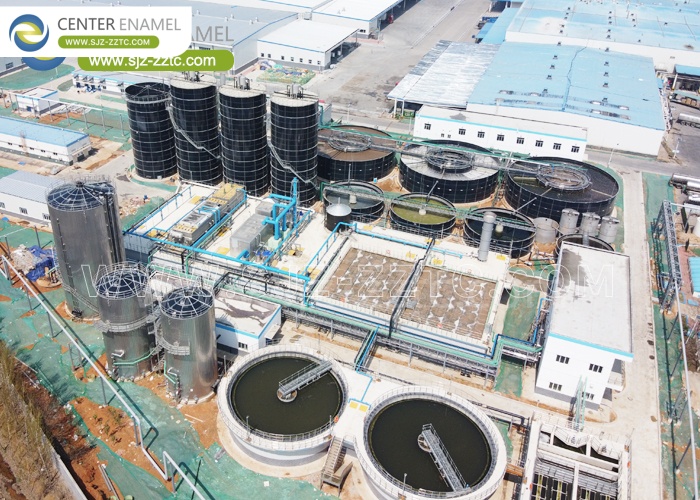
Durable GFS Tanks for Diverse Industrial Wastewater Treatment
Given the demanding nature of industrial effluents, the selection of appropriate storage and treatment infrastructure is critical for long-term project success. Center Enamel has independently developed over 200 specialized enamel frit formulations and supporting patents, capable of customizing anti-corrosion enamel based on customer storage media, with adaptability comprehensively superior to concrete tanks. This capability is particularly vital for any industrial wastewater treatment project that must handle corrosive or variable effluents. Concrete tanks use a single material, suitable primarily for neutral clean water storage, and when storing corrosive materials such as livestock manure, palm oil mill effluent, chemical wastewater, food waste digestate, high-salinity wastewater, etc., additional anti-corrosion linings must be applied. These linings are prone to failure, preventing long-term stable operation and cannot adapt to alternating high and low concentration storage conditions.
In contrast, GFS tanks can be specifically formulated with specialized enamels resistant to strong acids, strong alkalis, high organic content, and high salinity, a feature that is essential for the robust treatment of diverse industrial effluents. A single tank can switch between multiple wastewater and fermentation feedstock storage requirements, offering unparalleled operational flexibility. They are universally applicable across biogas anaerobic digestion, municipal wastewater, livestock farming, food processing, and industrial water treatment scenarios, eliminating the need to rebuild tanks for media changes, perfectly meeting the needs of diversified, multi-condition environmental protection projects. For any industrial wastewater treatment project seeking long-term reliability and adaptability, GFS tanks represent a cornerstone technology that directly addresses the "three highs" by providing durable, low-maintenance storage.
UASB Process and Its Applicable Scenarios for Industrial Effluents
At the heart of many successful industrial wastewater treatment projects lies the UASB (Upflow Anaerobic Sludge Blanket) process, a highly effective biological treatment stage that leverages advanced anaerobic technologies. The UASB process is suitable for soluble medium-to-high concentration organic wastewater, covering light industrial wastewater from brewing, sugar refining, starch, papermaking, food processing, printing and dyeing, etc. This broad applicability makes it a versatile choice for various manufacturing sectors. It is particularly suitable for wastewater where organics are predominantly soluble with low suspended solids content, and it is not suitable for high-solids, high-viscosity wastewater.
The UASB process can be used alone as the primary treatment process or as a pretreatment for high-strength wastewater to reduce downstream aerobic load, offering flexibility in treatment train design. It is also suitable for municipal wastewater anaerobic pretreatment and low-solids livestock wastewater treatment. With its low cost and stable operation advantages, it is suitable for long-term continuous, large-flow industrial wastewater treatment projects. These attributes make UASB a cost-effective and reliable choice, helping to mitigate the high cost and high energy consumption challenges inherent in industrial wastewater treatment.
Operation and Maintenance Cost Analysis for Textile Wastewater
Understanding the operational economics is crucial for the long-term viability of any industrial wastewater treatment project. Operation and maintenance (O&M) costs are moderate to high with generally moderate economics, a factor that directly influences technology selection. Pretreatment requires pH adjustment chemicals, coagulants, and decolorizing agents, resulting in moderate to high chemical costs. However, the anaerobic + aerobic processes are mature and stable with controllable equipment O&M costs, offering a balanced approach to organic pollutant removal.
Advanced decolorization (ozone generators, Fenton oxidation) has high energy consumption and chemical costs, representing a major cost driver in textile applications. Membrane water reuse systems have high capital investment and frequent membrane replacement, leading to high maintenance costs. Dye and sizing sludge production is high, with significant disposal costs. High-temperature wastewater requires heat exchange cooling, but heat recovery can offset some energy costs. Frequent water quality fluctuations require frequent parameter adjustments, leading to moderate labor requirements. Water reuse can offset some costs, but overall resource recovery benefits are limited, resulting in generally moderate economics. Despite these cost factors, the integration of efficient anaerobic technologies can significantly reduce the organic load and improve the overall cost-effectiveness of the treatment process.
Global Market Presence and Standardized Product Adaptation
To effectively address the diverse challenges of industrial wastewater treatment projects worldwide, a strong global presence and adaptable product strategy are essential. Center Enamel's global business covers over 100 countries and regions, with more than 30,000 successful overseas projects, demonstrating its capability to deliver solutions across varied regulatory and environmental contexts. Products are exported to all major regions including Europe, the Americas, the Middle East, Africa, Southeast Asia, and Latin America, with a well-established global localized service network that supports clients wherever they operate.
Domestically, the company is organized into North, South, Central, East, and Southwest marketing regions, covering environmental, water utility, livestock, and petrochemical customers nationwide. Internationally, the company adopts a "standardized products + localized adaptation" model, adjusting tank corrosion protection, sealing, and pressure standards for different national water quality and environmental regulations. This approach is exemplified by multiple global landmark projects: large-volume GFS tanks in Italy, 20 m tower water supply tanks in Colombia, coastal seawater treatment tanks in Costa Rica, and large municipal wastewater aluminum dome projects in Saudi Arabia. The company has established long-term stable strategic partnerships with many Fortune 500 companies, underscoring its reliability and technical competence in the industrial wastewater treatment project sector.
Comprehensive After-Sales and Technical Support Team
Beyond the supply of equipment, ongoing technical support and after-sales service are vital for the sustained success of any industrial wastewater treatment project. The after-sales team adheres to the service principles of rapid response, professional efficiency, and full-cycle support, providing 24/7 full-lifecycle O&M support to global clients. This commitment ensures that clients can maintain optimal performance from their GFS tanks and anaerobic systems.
Standard remote services include fault diagnosis, process parameter adjustment, and tank anti-corrosion maintenance guidance, allowing for efficient troubleshooting. For domestic and long-distance overseas clients, overseas technical service personnel can be dispatched for on-site inspection, annual inspection, and equipment refurbishment as needed, ensuring proactive maintenance. The team also maintains long-term client feedback tracking mechanisms, regularly collecting tank and anaerobic equipment operational data to continuously optimize product structure and support processes. Supporting external technical expert teams provide specialized support for anaerobic process commissioning, biogas upgrading O&M, and wastewater upgrade and retrofit projects, ensuring long-term stable operation of domestic and overseas projects and continuously improving global client satisfaction and repurchase rates.
FRP Roof Cover Solution for General-Purpose Storage Tanks
In addition to core treatment and storage tanks, complementary components like roof covers play a significant role in the overall functionality of an industrial wastewater treatment project. The FRP Roof is a general-purpose economical roof for atmospheric pressure storage tanks without air-tightness requirements, suitable for drinking water storage, agricultural irrigation water, firewater reserve, and general production wastewater temporary storage. It is available in two styles: flat and dome, allowing flexible selection based on tank specifications and site aesthetic requirements.
The roof is integrally molded from resin and fiberglass, making it lightweight with natural water resistance and mild acid and alkali corrosion resistance. It will not rust or rot in long-term humid environments, eliminating the frequent anti-corrosion maintenance required for metal roofs. The dome style features excellent drainage performance due to its curved structure, resisting water accumulation, dust buildup, snow load, and strong winds. The flat style facilitates the installation of maintenance walkways, level gauges, and vents on top, making inspection and operation convenient. The product is fully insulated with no risk of galvanic corrosion, will not contaminate drinking water quality, and meets environmental standards for domestic water storage. The modular design with low individual component weight allows for simple on-site hoisting and assembly, offering high construction efficiency and affordable procurement and installation costs. It is only suitable for atmospheric pressure water storage tanks without biogas collection or pressurization requirements, and is not recommended for anaerobic fermentation gas-producing conditions. It is widely used in rural agricultural water storage tanks, industrial park firewater tanks, waterworks buffer tanks, and small to medium-sized domestic wastewater temporary storage facilities, making it a cost-effective general-purpose roof choice for conventional water storage applications within the broader scope of an industrial wastewater treatment project.
Frequently Asked Questions (FAQs)
1. What are the main challenges addressed by anaerobic technologies in industrial wastewater treatment?
Anaerobic technologies effectively tackle the "three highs" of industrial wastewater: high difficulty, high cost, and high energy consumption. They break down complex organic pollutants, reduce sludge production, and generate biogas as a renewable energy source, thereby lowering operational costs and environmental impact compared to purely aerobic systems.
2. Why are GFS tanks preferred over concrete tanks for corrosive industrial effluents?
Glass-Fused-to-Steel (GFS) tanks feature a specialized, inert enamel coating that provides superior resistance to the strong acids, alkalis, salts, and organics found in industrial wastewater. Unlike concrete, they do not require frequent lining replacements, ensuring long-term structural integrity, low maintenance, and adaptability to varying storage conditions.
3. What is the role of the UASB process in a typical industrial wastewater treatment project?
The UASB (Upflow Anaerobic Sludge Blanket) process serves as a highly efficient primary biological treatment step for medium-to-high strength soluble organic wastewater. It significantly reduces the organic load, produces valuable biogas, and generates less sludge, making it a cost-effective and energy-efficient solution that improves the overall performance of the downstream treatment train.