
How Anaerobic Technologies Make Dairy Wastewater Treatment Stable, Compliant and Energy-Smart
Few industrial streams are as biologically willing and practically awkward as dairy effluent. Milk residues, fats, proteins and cleaning chemicals arrive in bursts, change with every product run, and punish any system designed for a steady feed. Handling that reliably takes more than one reactor: it takes a chain of anaerobic technologies, correctly chosen tanks and control logic that keeps the biology working when the plant does not cooperate.
A Shifting Market Rewards Integrated Anaerobic Technologies
The competitive landscape is diverging: leaders are assembling integrated service capabilities through technical integration and capital operations while concentration rises. Chinese manufacturers keep their edge in mid-tier equipment exports, international giants concentrate on high-end and complex industrial wastewater, and local firms hold mid-to-low-end and industrial-park centralized treatment through responsiveness and cost. Within the anaerobic segment itself, UASB, EGSB and IC reactors dominate high-strength organic pretreatment in food processing, pharmaceutical fermentation, brewing and chemicals, valued for high loading rates, small footprints and stable operation.
Every one of those reactors sits inside a steel shell whose corrosion resistance and gas tightness decide whether the process survives year five-where anaerobic technologies stop being a process diagram and become an equipment decision.
Inside an IC Reactor: Where Reliability Is Won
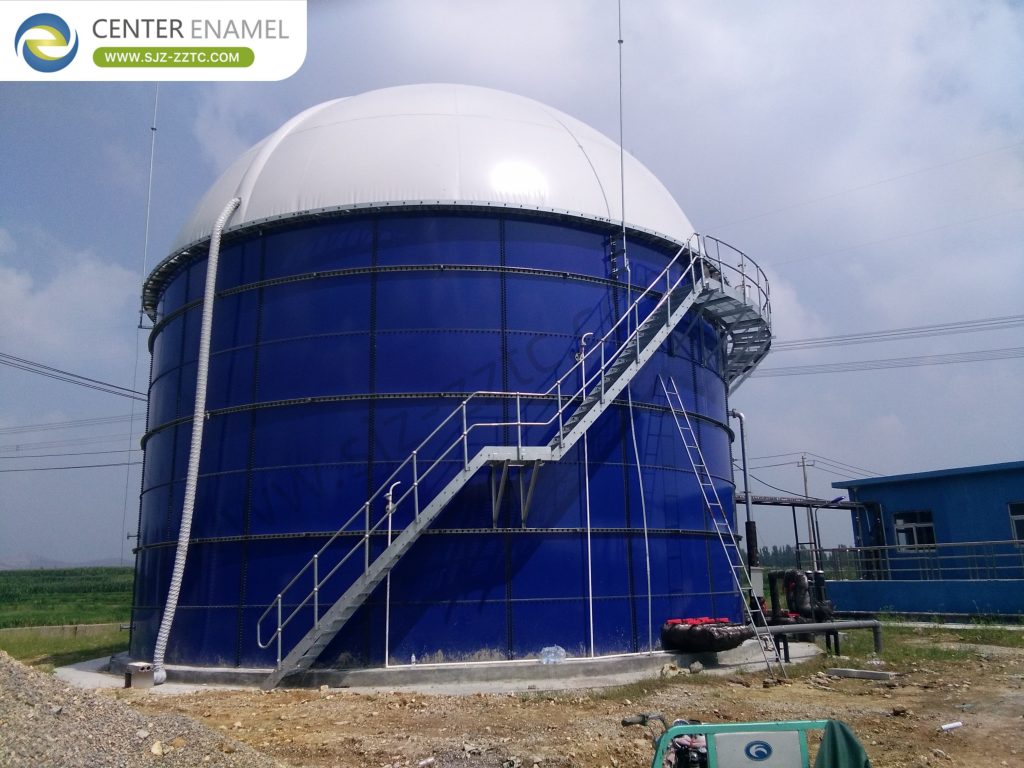
At the centre of the system is a GFS tank fitted with a built-in gas-lift internal circulation loop and upper and lower three-phase separators-the components that make autonomous circulation and sludge-water separation possible. A bottom precision distribution system and pressure-regulating feed device hold influent uniform and steady, supported by lift pumps, equalization tanks and flow meters. The top carries integrated biogas collection, desulfurization, dehydration and storage; online instruments track temperature, pH, COD and level; dedicated sludge discharge and recirculation controls at the bottom and mid-section remove the need for external return pumps. The package is compact, highly automated and free of surplus equipment.
Dairy Wastewater Treatment Built for High-Fat, High-Protein Loads
The proven train runs oil separation pretreatment, anaerobic digestion, aerobic treatment and advanced polishing-a sequence that fits high-oil, high-protein, readily biodegradable effluent. Screens strip packaging debris, equalization tanks flatten the flow curve, and oil separation plus dissolved air flotation remove free and emulsified oil before it can foul biological systems and membranes. High-concentration CIP wastewater is collected separately and fed in batches to avoid shock loading.
In the main stage, UASB or IC duty does the heavy lifting: lactose and milk proteins degrade readily, biogas yield is high and energy recovery becomes a genuine return rather than a slogan. A/O or contact oxidation then polishes residual organics and removes nitrogen and phosphorus, with final sedimentation, filtration and disinfection closing the compliance gap. Digesters here are built from Center Enamel GFS tanks that resist milk fatty acids and hydrogen sulfide, and the whole line stays simple enough to ride the dairy industry's intermittent discharge pattern.
| Treatment stage | Primary job | Typical equipment |
| Pretreatment | Debris removal and flow balancing | Screens, equalization tanks |
| Oil removal | Protect biology and membranes | Oil separation tank, DAF unit |
| CIP handling | Avoid shock loading | Segregated collection, batch feed |
| Anaerobic digestion | Destroy high-strength organics, recover biogas | UASB / IC reactor in GFS tank |
| Aerobic polishing | Residual organics, nitrogen and phosphorus | A/O or contact oxidation |
| Final treatment | Meet discharge limits | Sedimentation, filtration, disinfection |
Why the Tank Decides Long-Term Performance
The table looks like a flowsheet, but its weakest link is usually the vessel. Dairy effluent carries fatty acids and sulfide that attack coatings from inside, while biogas demands a seal that holds at every joint. Center Enamel's double-sided hot-rolled double-layer enamel resists strong acids and alkalis, high salinity and microbial corrosion, and modular panels assemble fast on site-decisive where labour is scarce and schedules are short.
A Brewery in South Africa, One Integrated Equipment Package
The same logic travels beyond dairy. In a South African brewing project focused on high-strength organic wastewater, Center Enamel supplied GFS tanks as the primary anaerobic digestion system alongside stainless steel tanks for transfer and chemical storage. Brewery effluent-high COD, high sugar, readily decomposable-responds well to anaerobic degradation, while the stainless units handle supporting duties and aggressive chemicals. Corrosion resistance and flexible assembly kept the package deliverable as one scope, and the plant has maintained long-term stable treatment of production and cleaning wastewater since.
| Project element | Detail |
| Location and industry | South Africa, brewing |
| Wastewater profile | High-COD, high-sugar brewing and cleaning effluent |
| Core anaerobic equipment | Center Enamel GFS tanks |
| Supporting tanks | Stainless steel for transfer and chemical storage |
| Design priorities | Corrosion resistance, fast assembly, single scope |
| Outcome | Stable long-term treatment, local pollution challenge resolved |
A Product Matrix Wide Enough for Any Plant Configuration
Behind every project sits a portfolio rather than a catalogue of parts. Center Enamel builds core storage tanks, covers, specialty pressure vessels and complete environmental engineering services together-and is the only company globally combining in-house enamel frit research, self-manufacturing and GFS tank application.
| Category | Product | Typical application |
| Core | Proprietary GFS tanks | Anaerobic digestion, biogas, chemical storage |
| Supporting | Fusion bonded epoxy tanks | Drinking water, fire water, neutral media |
| Sealing | Aluminum dome covers | Tank sealing and biogas collection |
| Other vessels | Carbon steel, stainless steel, composting tanks, non-standard pressure vessels | Transfer, storage, composting, process duty |
| Services | Environmental EPC, anaerobic process subcontracting | Food waste, leachate, municipal, livestock biogas, petrochemical, desalination |
That breadth lets one supplier cover food waste, leachate, municipal wastewater, livestock biogas, petrochemical and metallurgical duty and seawater desalination, with volume, corrosion grade and process scope customised rather than improvised.
Certifications That Clear Tender Barriers
Specifications win evaluations, but credentials open the door. CE, NSF, WRAS, ISO 9001, BSCI and ASME certification clear tendering barriers across the EU, North America, Southeast Asia and Africa, and give overseas projects a hard compliance argument that is difficult to substitute.
Aluminum Geodesic Domes: Light, Tight and Low Maintenance
Above the tank, the cover decides how much gas and odour escape. Center Enamel's aluminum geodesic dome is stamped from high-strength alloy into a triangular grid spanning large diameters without internal columns, compliant with AWWA D108, with plate thickness, rib sections and joints verified by finite element analysis for regional wind and snow loads.
It weighs one-third to one-half of a steel roof at the same span and needs no wall reinforcement. Double sealing strips and mechanical interlocking deliver airtight gas storage and enclosed odour control, while the column-free interior leaves mixers and distributors free to work. Aluminum resists microbial growth and needs no repainting, keeping life-cycle cost low.
Questions Buyers Ask Before Committing
What makes dairy wastewater treatment harder than other food-sector effluent?
Fat, protein and lactose push organic loads high and degrade fast, yet fats clog membranes and biology while CIP chemicals arrive in caustic bursts. Dairy wastewater treatment succeeds only when oil removal, segregated CIP handling and equalization come before the reactor, so biology sees a stable feed rather than a shock; skip them and the digester pays for it.
Can anaerobic technologies survive fat, sulfide and cleaning chemicals?
Yes, when the vessel is chosen for the chemistry. GFS tanks resist fatty acids, hydrogen sulfide and high salinity while staying gas-tight, and IC or UASB duty absorbs variable loads. In practice the failure mode is a coated shell that degrades at joints and linings, not the biology itself.
How do I compare quotations for a biogas-ready plant?
Compare scope, not price: tank corrosion grade, gas tightness, separator design, instrumentation, spare parts and who owns commissioning and operator training. A complete package with certifications and one accountable supplier usually costs less across ten years than a low bid followed by retrofits and downtime.
Tell us your flow rate, COD range and discharge limits, and our engineers will size the anaerobic train and tank package around your site. Send your project brief to Center Enamel today and get a process layout, equipment scope and budget estimate back within days.