
Which Anaerobic Technologies Handle High-Strength Pharmaceutical Wastewater Best?
Global industrial wastewater treatment policies are escalating from "compliance discharge" to mandatory "resource recovery" and "zero liquid discharge." The EU, through its Circular Economy Action Plan, requires member states to increase industrial wastewater reuse rates and extends carbon footprint accounting to the full life cycle of wastewater treatment. China continuously updates and tightens industrial water pollutant discharge standards, with increasingly stringent limits on total nitrogen, total phosphorus, and characteristic pollutants for industries such as chemicals, pharmaceuticals, and printing and dyeing.
Some water-scarce regions and highly polluting industries are mandated to adopt zero or near-zero liquid discharge technologies. Germany has established a differentiated pretreatment technical standard system by industry, requiring industrial wastewater to meet specific quality requirements before discharge into municipal wastewater treatment plants, implementing strict source control.
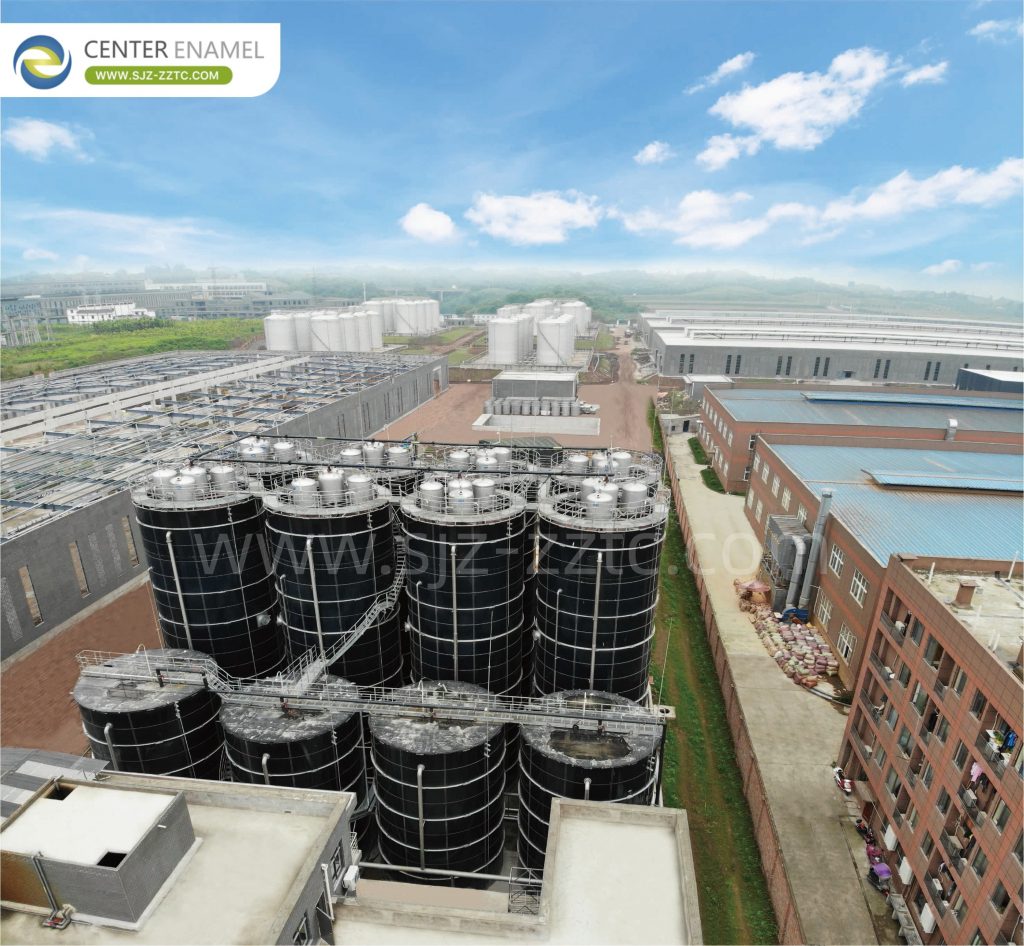
These regulatory pressures directly shape equipment selection. As discharge limits tighten, treatment systems must combine high biological efficiency with long-term structural durability—making Anaerobic Technologies and corrosion-resistant GFS Tanks central to modern industrial wastewater design.
GFS Tanks: Corrosion Resistance Far Superior to Traditional Concrete Tanks
Center Enamel's independently developed double-sided double-layer enameling technology is the industry's leading coating anti-corrosion technology, with corrosion resistance completely surpassing concrete tanks. Concrete tank interiors are riddled with pores, allowing wastewater and acid/alkaline media to easily penetrate and corrode the structural layer. Long-term use leads to irreversible problems such as internal wall spalling, water seepage, and rebar corrosion, which are difficult to repair and cannot be fundamentally resolved.
GFS tanks feature high-temperature enameling on both the interior and exterior surfaces of steel panels, with a dense, non-porous enamel finish that completely blocks corrosive liquids and biogas permeation. The enamel layer has extremely strong chemical stability, resisting acids, alkalis, salts, and microbial corrosion. Concrete tanks will develop extensive corrosion and leakage after 5-8 years of use, while GFS tank anti-corrosion service life can exceed 30 years, with no need for frequent internal lining repairs throughout the service life, significantly reducing long-term anti-corrosion maintenance investment and fundamentally eliminating environmental risks of medium leakage contaminating sites and groundwater. Compared to traditional concrete and FRP tanks, GFS tank coatings have no risk of peeling or blistering, and are adaptable to highly corrosive conditions such as palm oil mill effluent, livestock manure, and chemical high-salinity wastewater, with outstanding long-term comprehensive cost advantages.
Table 1: GFS Tanks vs. Traditional Concrete Tanks
| Feature | GFS Tanks | Concrete Tanks |
| Corrosion Resistance | Excellent (30+ years) | Poor (5–8 years) |
| Porosity | Non-porous enamel | Highly porous |
| Repair Needs | No lining repairs | Frequent spalling/seepage |
| Chemical Stability | Acids, alkalis, salts, microbes | Degrades over time |
| Environmental Risk | Minimal leakage risk | Groundwater contamination risk |
IC Process Applicable Scenarios
Primarily for high-concentration, high-flow soluble industrial organic wastewater, covering brewery, beverage, starch, pharmaceutical, chemical, and papermaking high-strength wastewater. Suitable for land-constrained projects with high treatment efficiency requirements in large industrial wastewater treatment facilities. Can serve as the primary process for high-strength wastewater with rapid COD/BOD removal. Suitable for centralized industrial park WWTPs and large enterprise proprietary treatment systems, particularly for wastewater with significant quality fluctuations and extremely high pollutant concentrations. Not suitable for high-solids, high-viscosity wastewater. It is the preferred anaerobic process for modern high-efficiency industrial wastewater treatment.
Table 2: IC Process Applicable Scenarios at a Glance
| Parameter | Suitability |
| Wastewater Type | High-concentration, high-flow soluble organics |
| Target Industries | Brewery, beverage, starch, pharmaceutical, chemical, papermaking |
| Best Fit | Land-constrained, high-efficiency, fluctuating water quality |
| Not Suitable For | High-solids, high-viscosity wastewater |
Pharmaceutical Wastewater Operation and Maintenance Cost Analysis
O&M costs rank highest among the five wastewater types, with poor overall economic viability. Strong toxicity and poor biodegradability require continuous addition of large quantities of oxidants, flocculants, and desalination agents during pretreatment—chemical costs far exceeding conventional wastewater. High-energy-consuming equipment such as advanced oxidation and reverse osmosis run continuously, with frequent corrosion damage and high repair/replacement costs. Toxic sludge, spent activated carbon, and filter residues are all hazardous waste, with complex compliance disposal procedures and high unit costs—solid waste disposal costs are a significant proportion. Frequent water quality fluctuations require dedicated personnel for 24/7 monitoring and parameter adjustment—high labor costs. Resource recovery benefits are minimal, with overall investment far exceeding returns.
Because chemical and energy inputs dominate costs, equipment durability becomes a decisive factor. Corrosion-resistant GFS Tanks reduce repair and replacement frequency, directly protecting the long-term economics of pharmaceutical wastewater treatment.
Center Enamel Overseas Installation Coverage and Delivery Capability
Center Enamel is the pioneer of Chinese GFS equipment exports, with installation service coverage across over 100 countries and regions—possessing full delivery capability across climates, regulations, and geographies.
Overseas coverage includes Southeast Asia (Vietnam, Thailand, Malaysia, Indonesia, Cambodia, Bangladesh, Nepal, etc.), Africa (Ghana, South Africa, Mali, Guinea, Zambia, Kenya, Pakistan, etc.), Europe/Americas (Sweden, USA, Russia, etc.), the Middle East, and Latin America—adaptable to tropical rainy high-salt spray, high-altitude mountainous, Nordic severe cold, and high-standard European/American facility conditions.
The company uses a dual-service model of "own cross-border construction teams + global localized agent network," combining standardized products with localized adaptation.
Flexible and Efficient Service Delivery System
Center Enamel's own cross-border construction teams + global localized agent network—modular GFS tank assembly with short construction periods and dismantlable/reusable capability—suitable for overseas short-term projects, phased expansions, and relocation needs—full-lifecycle after-sales O&M support ensuring long-term stable client operations.
FRP Roof Cover Solution for Wastewater Treatment
FRP Roof is a general-purpose economical roof for atmospheric pressure storage tanks without air-tightness requirements, suitable for drinking water storage, agricultural irrigation water, firewater reserve, and general production wastewater temporary storage. It is available in two styles: flat and dome, allowing flexible selection based on tank specifications and site aesthetic requirements. The roof is integrally molded from resin and fiberglass, lightweight, with natural water resistance and mild acid/alkali corrosion resistance. It will not rust or rot in long-term humid environments, eliminating the frequent anti-corrosion maintenance required for metal roofs.
The dome style features excellent drainage performance due to its curved structure, resisting water accumulation, dust buildup, snow load, and strong winds. The flat style facilitates the installation of maintenance walkways, level gauges, and vents on top, making inspection and operation convenient. The product is fully insulated with no risk of galvanic corrosion, will not contaminate drinking water quality, and meets environmental standards for domestic water storage. The modular design with low individual component weight allows for simple on-site hoisting and assembly, offering high construction efficiency and affordable procurement and installation costs.
It is only suitable for atmospheric pressure water storage tanks without biogas collection or pressurization requirements, and is not recommended for anaerobic fermentation gas-producing conditions. It is widely used in rural agricultural water storage tanks, industrial park firewater tanks, waterworks buffer tanks, and small to medium-sized domestic wastewater temporary storage facilities, making it a cost-effective general-purpose roof choice for conventional water storage applications.
Ready to align your industrial wastewater treatment with the latest discharge and zero liquid discharge requirements? Contact Center Enamel today for a tailored GFS tank and anaerobic solution.
Our global team is ready to support you from process design to overseas installation—reach out now to discuss your project requirements.
Frequently Asked Questions
Why are GFS tanks preferred for industrial wastewater?
GFS tanks resist acids, alkalis, salts, and microbial corrosion for 30+ years, while concrete tanks leak and spall within 5–8 years, driving higher lifecycle costs.
What wastewater types suit the IC process?
High-concentration, high-flow soluble organics from brewery, beverage, starch, pharmaceutical, chemical, and papermaking industries—ideal for land-constrained sites.
How does Center Enamel support overseas projects?
With installation coverage in 100+ countries, own cross-border construction teams, localized agent networks, and full-lifecycle after-sales O&M support.