
How Anaerobic Technologies and GFS Tank Systems Meet Global Wastewater Standards
Global industrial wastewater treatment policies are escalating from "compliance discharge" to mandatory "resource recovery" and "zero liquid discharge." The EU, through its Circular Economy Action Plan, requires member states to increase industrial wastewater reuse rates and extends carbon footprint accounting to the full life cycle of wastewater treatment. China continuously updates and tightens industrial water pollutant discharge standards, with increasingly stringent limits on total nitrogen, total phosphorus, and characteristic pollutants for industries such as chemicals, pharmaceuticals, and printing and dyeing. Some water-scarce regions and highly polluting industries are mandated to adopt zero or near-zero liquid discharge technologies. Germany has established a differentiated pretreatment technical standard system by industry, requiring industrial wastewater to meet specific quality requirements before discharge into municipal wastewater treatment plants, implementing strict source control.
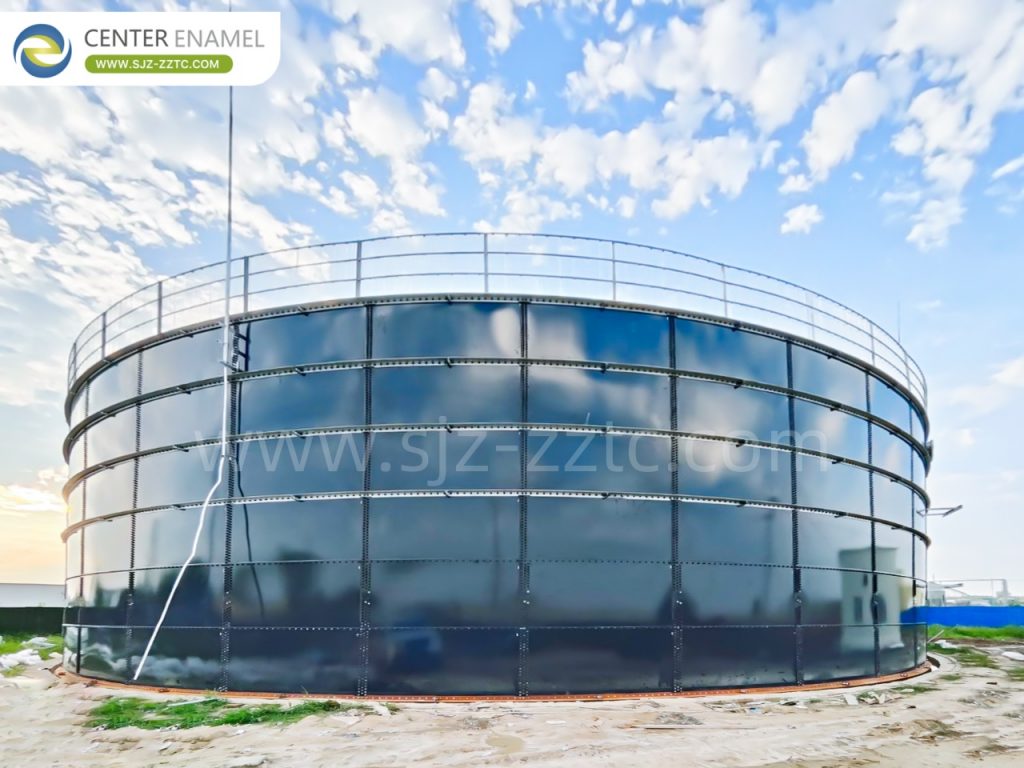
These regulatory shifts place new demands on treatment technology. Compliance now requires not only effective pollutant removal but also resource recovery, energy efficiency, and documented environmental performance. Meeting these demands starts with two foundational choices: the anaerobic process selected and the tank material used to contain it. Center Enamel has built its business around both-advancing Anaerobic Technologies while manufacturing the GFS Tank systems that make long-term stable operation possible.
GFS Tank Adaptability Across Complex Operating Conditions
Center Enamel has independently developed over 200 specialized enamel frit formulations and supporting patents, capable of customizing anti-corrosion enamel based on customer storage media, with adaptability comprehensively superior to concrete tanks. Concrete tanks use a single material, only suitable for neutral clean water storage. When storing corrosive materials such as livestock manure, palm oil mill effluent, chemical wastewater, food waste digestate, or high-salinity wastewater, additional anti-corrosion linings must be applied. These linings are prone to failure, preventing long-term stable operation and cannot adapt to alternating high/low concentration storage conditions.
The GFS Tank solves this problem at the material level. GFS tanks can be specifically formulated with specialized enamels resistant to strong acids, strong alkalis, high organic content, and high salinity. A single tank can switch between multiple wastewater and fermentation feedstock storage requirements. They are universally applicable across biogas anaerobic digestion, municipal wastewater, livestock farming, food processing, and industrial water treatment scenarios, eliminating the need to rebuild tanks for media changes and perfectly meeting the needs of diversified, multi-condition environmental protection projects.
IC Process: Where Anaerobic Technologies Deliver Maximum Value
Among modern Anaerobic Technologies, the IC Process stands out for its efficiency and compactness. It is primarily designed for high-concentration, high-flow soluble industrial organic wastewater, covering brewery, beverage, starch, pharmaceutical, chemical, and papermaking high-strength wastewater. It is suitable for land-constrained projects with high treatment efficiency requirements in large industrial wastewater treatment facilities. The IC Process can serve as the primary process for high-strength wastewater with rapid COD/BOD removal, and is suitable for centralized industrial park WWTPs and large enterprise proprietary treatment systems-particularly for wastewater with significant quality fluctuations and extremely high pollutant concentrations. It is not suitable for high-solids, high-viscosity wastewater. For the applications it serves, it is the preferred anaerobic process for modern high-efficiency industrial wastewater treatment.
The reason is straightforward: the IC Process achieves high loading rates in a small footprint, with built-in internal circulation that requires no external pumps. When housed in a corrosion-resistant GFS Tank, the system delivers both process performance and structural durability-a combination that directly addresses the dual pressures of stricter discharge standards and rising operational costs.
Pharmaceutical Wastewater: The Highest O&M Cost Challenge
Pharmaceutical wastewater illustrates why treatment economics matter as much as treatment technology. O&M costs rank highest among the five wastewater types, with poor overall economic viability. Strong toxicity and poor biodegradability require continuous addition of large quantities of oxidants, flocculants, and desalination agents during pretreatment-chemical costs far exceeding conventional wastewater. High-energy-consuming equipment such as advanced oxidation and reverse osmosis run continuously, with frequent corrosion damage and high repair/replacement costs. Toxic sludge, spent activated carbon, and filter residues are all hazardous waste, with complex compliance disposal procedures and high unit costs-solid waste disposal costs are a significant proportion. Frequent water quality fluctuations require dedicated personnel for 24/7 monitoring and parameter adjustment-high labor costs. Resource recovery benefits are minimal, with overall investment far exceeding returns.
This cost profile explains why pharmaceutical manufacturers increasingly seek anaerobic pretreatment that reduces downstream loading, recovers biogas energy, and minimizes chemical consumption. Anaerobic Technologies such as the IC Process, housed in durable GFS Tank systems, directly attack the largest cost drivers-chemical usage, energy consumption, and sludge disposal-while providing a pathway to resource recovery that aligns with circular economy requirements.
Global Market Presence and Landmark Projects
Center Enamel's global business covers over 100 countries and regions, with 30,000+ successful overseas projects. Products are exported to all major regions including Europe, the Americas, the Middle East, Africa, Southeast Asia, and Latin America, with a well-established global localized service network.
Domestically, the company is organized into North, South, Central, East, and Southwest marketing regions, covering environmental, water utility, livestock, and petrochemical customers nationwide. Internationally, the company adopts a "standardized products + localized adaptation" model-adjusting tank corrosion protection, sealing, and pressure standards for different national water quality and environmental regulations.
| Project | Location | Application | Key Features |
| Large-volume GFS tanks | Italy | Industrial storage | Large-scale capacity; corrosion-resistant enamel |
| 20 m tower water supply tanks | Colombia | Municipal water supply | Tower configuration; localized adaptation |
| Coastal seawater treatment tanks | Costa Rica | Seawater treatment | Coastal high-corrosion resistance |
| Large municipal wastewater aluminum dome projects | Saudi Arabia | Municipal wastewater | Aluminum dome covers; large-span coverage |
The company has established long-term stable strategic partnerships with many Fortune 500 companies-a track record that demonstrates the reliability of its Anaerobic Technologies and GFS Tank solutions across diverse regulatory and climatic conditions.
After-Sales and Technical Support
Equipment quality alone does not ensure long-term performance. The Center Enamel after-sales team adheres to the service principles of rapid response, professional efficiency, and full-cycle support-providing 24/7 full-lifecycle O&M support to global clients.
Standard remote services include fault diagnosis, process parameter adjustment, and tank anti-corrosion maintenance guidance. For domestic and long-distance overseas clients, overseas technical service personnel can be dispatched for on-site inspection, annual inspection, and equipment refurbishment as needed. The team also maintains long-term client feedback tracking mechanisms-regularly collecting tank and anaerobic equipment operational data to continuously optimize product structure and support processes.
Supporting external technical expert teams provide specialized support for anaerobic process commissioning, biogas upgrading O&M, and wastewater upgrade/retrofit projects-ensuring long-term stable operation of domestic and overseas projects, continuously improving global client satisfaction and repurchase rates.
FRP Roof Cover: Economical Solution for Atmospheric Storage
Not every tank application requires gas-tight sealing. The FRP Roof is a general-purpose economical roof for atmospheric pressure storage tanks without air-tightness requirements, suitable for drinking water storage, agricultural irrigation water, firewater reserve, and general production wastewater temporary storage. It is available in two styles: flat and dome, allowing flexible selection based on tank specifications and site aesthetic requirements. The roof is integrally molded from resin and fiberglass-lightweight, with natural water resistance and mild acid/alkali corrosion resistance. It will not rust or rot in long-term humid environments, eliminating the frequent anti-corrosion maintenance required for metal roofs.
The dome style features excellent drainage performance due to its curved structure, resisting water accumulation, dust buildup, snow load, and strong winds. The flat style facilitates the installation of maintenance walkways, level gauges, and vents on top, making inspection and operation convenient. The product is fully insulated with no risk of galvanic corrosion, will not contaminate drinking water quality, and meets environmental standards for domestic water storage. The modular design with low individual component weight allows for simple on-site hoisting and assembly, offering high construction efficiency and affordable procurement and installation costs. It is only suitable for atmospheric pressure water storage tanks without biogas collection or pressurization requirements, and is not recommended for anaerobic fermentation gas-producing conditions. It is widely used in rural agricultural water storage tanks, industrial park firewater tanks, waterworks buffer tanks, and small to medium-sized domestic wastewater temporary storage facilities.
Ready to align your wastewater treatment with evolving global discharge standards? Contact Center Enamel today to explore how Anaerobic Technologies and GFS Tank systems can meet your compliance and recovery targets.
Frequently Asked Questions
What are the main advantages of Anaerobic Technologies like the IC Process?
They deliver high loading rates in a compact footprint, recover biogas energy, produce less excess sludge, and withstand shock loads-reducing both energy and disposal costs.
Why choose a GFS Tank over concrete for anaerobic systems?
GFS Tanks resist strong acids, alkalis, high salinity, and microbial corrosion, offer 30+ year service life, and assemble quickly-concrete requires linings that fail under corrosive conditions.
Which industries benefit most from IC Process and GFS Tank solutions?
Brewery, beverage, starch, pharmaceutical, chemical, and papermaking industries with high-strength, high-flow soluble organic wastewater and limited land availability.