
How We Use Anaerobic Technology to Treat High-COD Dairy Wastewater
Industrial wastewater treatment is no longer just about meeting discharge limits. Regulations in major markets are escalating from “compliance discharge” to mandatory resource recovery and zero liquid discharge. The EU’s Circular Economy Action Plan pushes member states to raise industrial wastewater reuse rates and extends carbon footprint accounting across the full treatment life cycle.
China continuously tightens limits on total nitrogen, total phosphorus, and characteristic pollutants for chemicals, pharmaceuticals, and textile industries, with zero or near-zero liquid discharge mandated in water-scarce regions and high-pollution sectors. Germany enforces differentiated pretreatment standards by industry, requiring specific water quality before discharge into municipal plants.
These policies create a clear signal: industrial wastewater treatment must do more than clean water-it must recover value and minimize waste. Anaerobic digestion sits at the center of this shift, converting organic pollutants into biogas while dramatically reducing sludge volume and energy consumption.
Why Anaerobic Digestion Outperforms for High-Strength Streams
For industrial wastewater with high organic concentration, anaerobic digestion is not merely an alternative to aerobic treatment-it is the economically superior choice. Aerobic systems consume 0.5–1.5 kWh per kg of COD removed simply to supply oxygen, plus additional energy for sludge handling . Anaerobic digestion flips this equation: it requires only 0.1–0.3 kWh/kg COD for pumping and produces roughly 0.35 m³ of methane per kg of COD destroyed .
The sludge difference is equally striking. Aerobic treatment generates 0.3–0.6 kg TSS per kg COD, while anaerobic processes produce only 0.05–0.1 kg TSS per kg COD . For facilities paying for sludge dewatering, transport, and disposal, this reduction alone can justify the investment.
Aerobic treatment still has a role-particularly for low-strength streams or where strict ammonia limits require nitrification. But for the high-COD streams common in brewing, dairy, food processing, and chemical manufacturing, anaerobic digestion first, followed by a short aerobic polish, delivers the lowest total cost and the most stable long-term operation .
The IC Reactor Advantage: Compact, Stable, and Built for Industrial Loads
Center Enamel’s Internal Circulation (IC) anaerobic reactor brings top-tier treatment efficiency to industrial wastewater treatment. Its footprint is only one-third that of traditional anaerobic processes for the same treatment capacity-a decisive advantage where site space is constrained.
The built-in gas-lift internal circulation eliminates external recirculation equipment, using the biogas produced to drive autonomous forced mixing of sludge and water. This hydraulic mixing ensures thorough contact between microbes and pollutants, greatly improving degradation efficiency and allowing the system to withstand high water quality and hydraulic shock loads. The dual-zone configuration combines high-efficiency degradation in the lower zone with deep polishing in the upper zone, delivering stable effluent quality. Sludge granulation is high, microbial activity is strong, and washout is minimal.
Operationally, the IC reactor offers high automation, low failure rates, and substantial biogas production. Long-term energy and O&M costs are far lower than traditional anaerobic processes, making it well-suited for large-flow, high-concentration industrial wastewater treatment.
Case Snapshot: Brewery Wastewater Treatment in South Africa
| Project Parameter | Detail |
| Location | South Africa |
| Industry | Brewing |
| Core Equipment | GFS tanks (anaerobic digestion) + stainless steel tanks (transfer/storage) |
| Wastewater Challenge | High COD, high sugar, readily decomposable organics |
| System Configuration | GFS tanks as primary anaerobic digestion system; stainless steel tanks for supporting processes |
| Key Requirement | Corrosion resistance, flexible assembly, long-term stability |
| Outcome | Stable treatment of production and cleaning wastewater; solved local brewing pollution challenge |
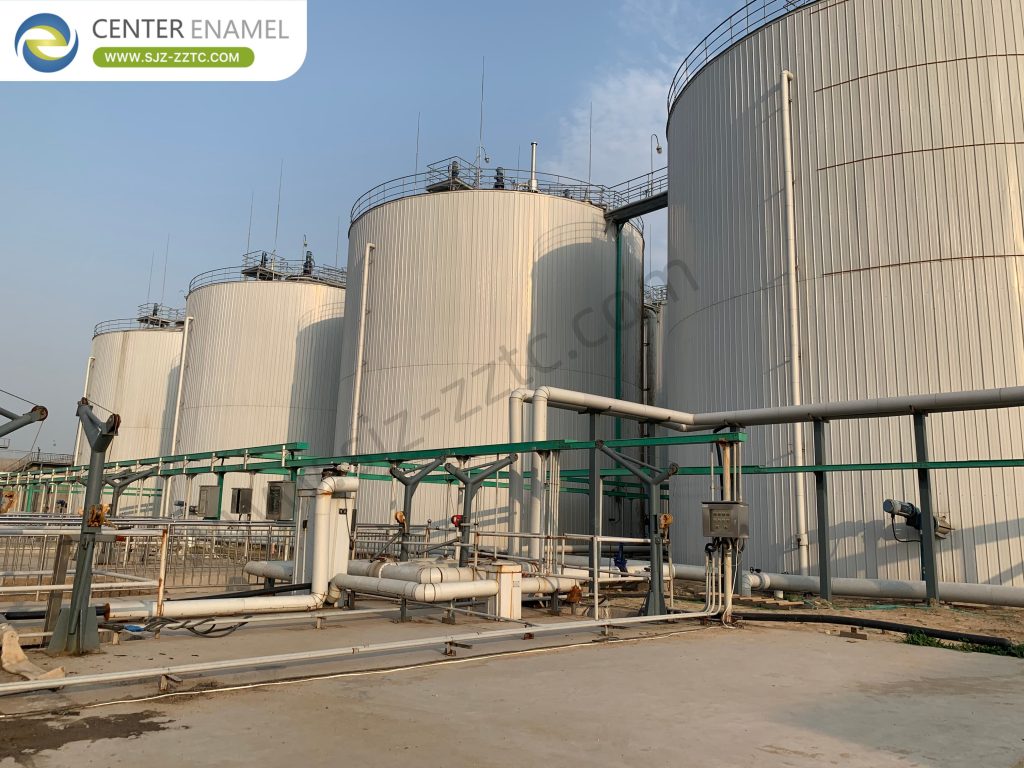
This mature African brewery case demonstrates how Center Enamel integrates Glass-Fused-to-Steel (GFS) tank technology with anaerobic digestion for high-strength industrial streams. The GFS tanks serve as the core anaerobic digestion system, suited to brewery wastewater’s readily degradable organic load. Stainless steel tanks handle wastewater transfer and chemical storage for supporting processes. The complete equipment package provides excellent corrosion resistance and flexible assembly, ensuring long-term stable treatment under continuous operation.
Dairy Wastewater: High Organic Load, No Chemical Toxicity
Dairy wastewater pollutants are entirely natural dairy components-lactose, milk proteins, milk fats-with no synthetic toxic chemicals, heavy metals, bacteriostats, or persistent organics. The chemical toxicity to aquatic organisms and microorganisms is extremely low, and environmental safety is correspondingly high.
The core environmental risk is oxygen demand. High COD/BOD wastewater, if discharged directly, undergoes rapid aerobic decomposition, severely depleting dissolved oxygen and causing fish suffocation. Milk fats form surface oil films that block oxygen exchange. Milk protein decomposition produces ammonia, contributing to eutrophication. Wastewater readily decomposes, producing odors and breeding bacteria and fly larvae.
For dairy processors, these characteristics make anaerobic digestion an ideal fit: the organic load is high and readily biodegradable, meaning strong biogas yield and efficient COD removal, with no chemical toxicity risks to the microbial culture. The pollution is primarily oxygen-demanding organic material, with rapid natural degradation and recovery potential when properly treated.
Installation Quality That Prevents Problems at the Source
Center Enamel’s global project performance demonstrates what standardized installation quality delivers over the long term. The company has established full-chain quality control across four dimensions: factory protection, on-site assembly, completion inspection, and long-term warranty.
At the factory stage, all enameled panels, seals, and structural components receive rust-proof and moisture-proof independent packaging with dedicated protective supports-preventing damage during sea and land transport and avoiding enamel coating damage. On-site construction strictly follows unified assembly process specifications: panel-by-panel tightening and leak testing in layers, with air-tightness and verticality testing after each tank section completion. Dual-membrane covers and anaerobic piping undergo simultaneous pressure testing and acceptance.
Quality acceptance standards are differentiated by region: EU and US projects follow stringent CE/NSF inspection criteria; Southeast Asian hot humid regions receive enhanced corrosion protection and sealing acceptance; remote African sites have additional foundation settlement re-inspection procedures. Upon project completion, complete construction inspection reports, pressure test records, and anti-corrosion appearance acceptance documents are issued, with full photo and video archives retained. Over 10,000 tanks delivered globally have operated long-term without large-scale leakage or structural deformation-preventing future O&M issues at the source.
Choosing the Right Roof for Your Anaerobic System
Not every tank application requires gas collection. Center Enamel offers the FRP Roof as a general-purpose economical cover for atmospheric pressure storage tanks without air-tightness requirements-suitable for drinking water storage, agricultural irrigation, firewater reserve, and general production wastewater temporary storage.
The FRP Roof is available in flat and dome styles. The dome style features excellent drainage performance due to its curved structure, resisting water accumulation, dust buildup, snow load, and strong winds. The flat style facilitates installation of maintenance walkways, level gauges, and vents on top. The roof is integrally molded from resin and fiberglass, lightweight, naturally water-resistant, and mildly resistant to acid and alkali corrosion. It will not rust or rot in long-term humid environments, eliminating the frequent anti-corrosion maintenance required for metal roofs. The product is fully insulated with no risk of galvanic corrosion and will not contaminate drinking water quality.
For anaerobic fermentation gas-producing conditions, Center Enamel supplies specialized gas-tight covers-including dual-membrane gas storage covers-tested for air-tightness and integrated with the biogas collection system.
Frequently Asked Questions
Is anaerobic digestion suitable for all industrial wastewater?
Anaerobic digestion is most cost-effective for high-strength streams with COD above roughly 2,000 mg/L. Lower-strength or ammonia-sensitive discharges typically require aerobic polishing after anaerobic pretreatment.
What maintenance does an IC reactor require?
The IC reactor’s internal circulation design eliminates external recirculation pumps, reducing mechanical maintenance. Routine checks focus on gas collection integrity, feed stability, and temperature control within the mesophilic range.
Can Center Enamel handle installation in remote or challenging sites?
Yes. Installation teams have delivered over 10,000 GFS tank projects globally, including remote African sites, coastal high-corrosion locations, and mountainous terrain. Teams can be deployed as complete units with on-site training for local workers.
Ready to evaluate anaerobic digestion for your industrial wastewater treatment project? Share your flow rate, COD load, and discharge requirements-our engineering team will respond with a preliminary process design and equipment recommendation.
Contact Center Enamel today to discuss how our IC reactor systems and GFS tank solutions can reduce your energy costs, meet discharge limits, and recover resources from your wastewater stream.