
How Does Center Enamel Optimize Anaerobic Wastewater Treatment Using the CSTR Process?
The Asia-Pacific region, particularly China, has become the world's largest industrial wastewater treatment market, with the operation and maintenance service segment's contribution continuing to rise, marking a shift from project construction to long-term operational management. The North American market focuses on upgrading existing facilities, while Europe emphasizes high-value-added resource recovery technologies. Wastewater from the new energy industry chain (lithium batteries, photovoltaics, hydrogen) has become the most notable emerging growth area due to its complex composition and high treatment difficulty, generating significant demand for customized solutions.
The maturity of third-party treatment models in industrial parks continues to improve, driving consolidation in the professional operation market. The Middle East has strong demand for advanced treatment and reuse of industrial wastewater due to water scarcity; manufacturing transfer in Southeast Asia drives local industrial wastewater treatment facility construction demand. To meet these diverse regional demands, Center Enamel provides robust solutions tailored for effective Anaerobic Wastewater Treatment.
Customized Structural Design for Extreme Climates
GFS tanks can undergo customized wind and seismic design based on project site climate and geological conditions, with environmental adaptability far superior to concrete tanks. Concrete tanks are cast-in-place monolithic structures, with seismic and wind resistance entirely dependent on on-site construction quality. In remote areas, typhoon-prone zones, and earthquake belts, construction quality is difficult to control. Under strong earthquakes or typhoons, concrete tanks are prone to cracking and base settlement damage, with subsequent reinforcement costs equivalent to rebuilding.
GFS tanks undergo collection of local seismic intensity, maximum wind pressure, and foundation bearing capacity data before construction, with customized thickened steel panels, stiffening ribs, and anchored base components-all factory-prefabricated to standardized specifications. The bolted panel structure has excellent stress distribution capability, making it less prone to overall fracture under seismic and typhoon impacts, and minor foundation settlement will not cause through-cracking. Structural parameters can be flexibly adjusted for mountainous, coastal typhoon-zone, and high-seismic-zone projects, providing long-term protection against extreme natural climate damage, ensuring structural integrity for any Anaerobic Wastewater Treatment facility.
CSTR Applicable Scenarios
Primarily for high-solids organic pollutant treatment, widely used in food waste leachate, large-scale livestock manure, slaughterhouse wastewater, and food processing high-strength wastewater. Also suitable for municipal sludge and industrial organic sludge anaerobic digestion. In the agricultural and environmental sector, it is used for large-scale farm manure resource recovery, achieving wastewater reduction, harmless treatment, and energy recovery. In the food and brewing industry, it is suitable for high-oil, high-protein, high-suspended-solids wastewater. It is also suitable for small to medium-sized wastewater treatment projects, township decentralized wastewater treatment, and as a pretreatment process for high-strength organic wastewater in large industrial parks to reduce downstream load. It is particularly suitable for difficult-to-treat organic wastewater with complex composition, high solids content, and easy crusting, which forms the core mechanism of the CSTR Process deployed by Center Enamel.
POME Operation and Maintenance Cost Analysis
O&M costs are moderate to low-biogas recovery benefits are exceptionally high-outstanding overall economics-one of the best input-output ratios in industrial wastewater treatment. POME has excellent biodegradability (BOD/COD 0.5-0.6) with very high anaerobic digestion efficiency-no expensive advanced oxidants or detoxification agents needed-only small amounts of lime/NaOH for pH adjustment and flocculants-low chemical costs.
CSTR/USR anaerobic equipment is simple and durable-GFS tanks with 30+ year corrosion resistance, no precision wear parts-extremely low failure rates and minimal repair/replacement-controllable long-term O&M costs. Biogas recovery is the core economic benefit-high-concentration organic wastewater produces exceptional biogas yields of 8-15 m³ per m³ POME-CHP can meet 30-50% of mill electricity demand, with waste heat for digester heating and FFB sterilization preheating-very high energy self-sufficiency, greatly reducing or eliminating external electricity purchases.
Recovered palm oil from pretreatment oil separation can be sold as biodiesel feedstock or oleochemical raw material-substantial economic benefits. Anaerobic effluent rich in nitrogen, phosphorus, and potassium can be used for palm plantation irrigation and fertilization after advanced treatment-dual resource recovery of water and fertilizer, further reducing treatment costs. Palm oil mills in Southeast Asia commonly benefit from renewable energy subsidies and carbon reduction credits (CDM/carbon trading)-biogas power projects can apply for carbon asset development for additional carbon revenue, further improving project economics. Overall, POME treatment system capital payback period is typically 5-8 years-biogas power generation revenues can fully cover O&M costs and generate net profit-one of the highest resource recovery value wastewater categories in industrial wastewater treatment, delivering both environmental management and clean energy recovery.
Malaysia Palm Oil Biogas Project
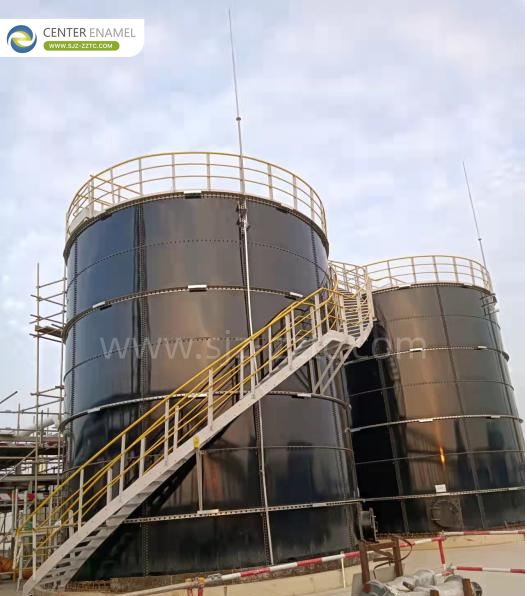
The project uses Center Enamel GFS tanks as the core anaerobic digestion facility with 5 tanks, each with effective volume of 5,400 m³, total effective volume 27,000 m³. Influent COD ≥ 60,000 mg/L, BOD ≤ 25,000 mg/L. After anaerobic digestion, effluent COD drops to below 12,000 mg/L, BOD ≤ 5,000 mg/L-overall organic removal efficiency approximately 80%. Single tank daily biogas production 4,400 m³, total project daily biogas 22,000 m³-stable biogas yield of 0.45 m³ per kg COD removed-efficient biogas energy recovery while solving palm oil processing wastewater pollution. This successful application highlights the capability of Center Enamel in scaling the CSTR Process for regional Anaerobic Wastewater Treatment.
Center Enamel's Global Market Presence
Center Enamel's global business covers over 100 countries and regions, with 30,000+ successful overseas projects. Products are exported to all major regions including Europe, the Americas, the Middle East, Africa, Southeast Asia, and Latin America, with a well-established global localized service network. Domestically, the company is organized into North, South, Central, East, and Southwest marketing regions, covering environmental, water utility, livestock, and petrochemical customers nationwide. Internationally, the company adopts a "standardized products + localized adaptation" model-adjusting tank corrosion protection, sealing, and pressure standards for different national water quality and environmental regulations-with multiple global landmark projects: large-volume GFS tanks in Italy, 20 m tower water supply tanks in Colombia, coastal seawater treatment tanks in Costa Rica, large municipal wastewater aluminum dome projects in Saudi Arabia, etc. The company has established long-term stable strategic partnerships with many Fortune 500 companies, validating its expertise in Anaerobic Wastewater Treatment.
Overseas Installation Coverage and Delivery
Center Enamel is the pioneer of Chinese GFS equipment exports, with installation service coverage across over 100 countries and regions-possessing full delivery capability across climates, regulations, and geographies. Overseas coverage includes Southeast Asia (Vietnam, Thailand, Malaysia, Indonesia, Cambodia, Bangladesh, Nepal, etc.), Africa (Ghana, South Africa, Mali, Guinea, Zambia, Kenya, Pakistan, etc.), Europe/Americas (Sweden, USA, Russia, etc.), the Middle East, and Latin America-adaptable to tropical rainy high-salt spray, high-altitude mountainous, Nordic severe cold, and high-standard European/American facility conditions.
The company uses a dual-service model of "own cross-border construction teams + overseas local agent coordination"-whether clients are in developed countries or remote developing regions-providing one-stop services including on-site survey, on-site installation, process commissioning, and operator training. Complete coverage covers biogas engineering, municipal wastewater, industrial wastewater, livestock manure, drinking water storage, and other global mainstream environmental engineering projects-possessing the full delivery capability to undertake large-scale tank farm projects in any country worldwide, seamlessly completing every CSTR Process deployment.