
How a Leading Biogas Solution Provider Applies Anaerobic Digestion to Complex Chemical Wastewater
Regional demand is reshaping the industrial wastewater market, and the direction of that shift matters for anyone specifying treatment capacity today. The Asia-Pacific region, particularly China, has become the world's largest industrial wastewater treatment market, with the operation and maintenance service segment's contribution continuing to rise-marking a shift from project construction to long-term operational management.
The North American market focuses on upgrading existing facilities, while Europe emphasizes high-value-added resource recovery technologies. Wastewater from the new energy industry chain (lithium batteries, photovoltaics, hydrogen) has become the most notable emerging growth area due to its complex composition and high treatment difficulty, generating significant demand for customized solutions. The maturity of third-party treatment models in industrial parks continues to improve, driving consolidation in the professional operation market. The Middle East has strong demand for advanced treatment and reuse of industrial wastewater due to water scarcity, while manufacturing transfer in Southeast Asia drives local industrial wastewater treatment facility construction demand.
Across every one of these regions, one technology keeps appearing in the process train: Anaerobic Digestion. It is the mechanism that turns high-strength organic loading from a disposal liability into a recoverable energy asset. Delivering it reliably-across climates, regulations, and feed compositions-is the defining work of a capable Biogas Solution Provider. Center Enamel builds that capability from the material level upward, starting with the tank that contains the biology.
Why Anaerobic Digestion Anchors Modern Wastewater Strategy
Anaerobic Digestion converts organic pollutants into biogas without the energy-intensive aeration that aerobic treatment demands. For high-strength streams, that single characteristic reshapes the economics of an entire plant: less electricity consumed, less sludge generated, and a combustible gas produced on site. As treatment markets mature from construction toward long-term operational management, this operating-cost advantage becomes the deciding factor. It also explains why anaerobic reactors now occupy the front line of pretreatment across food processing, pharmaceutical fermentation, alcohol brewing, petrochemical, and chemical industries.
The IC Reactor: Core Engine of an Efficient Biogas Solution Provider
Among anaerobic configurations, the IC-Internal Circulation Anaerobic Reactor-represents the third-generation high-efficiency technology built upon UASB. Its core innovation is a built-in gas-lift internal circulation system, enabling autonomous wastewater recirculation without external return pumps. The reactor features a dual-zone configuration with a lower main reaction zone and an upper polishing zone. Biogas gas-lift creates hydraulic internal circulation, significantly increasing upflow velocity and enhancing sludge-wastewater contact. With extremely high compactness, it is specifically designed for high-concentration, high-flow industrial organic wastewater, combining high efficiency, energy savings, and minimal footprint-the core process for modern industrial high-strength wastewater treatment.
In operation, pretreated high-strength organic wastewater enters the lower main reaction zone from the bottom, mixing with recirculated sludge-water mixture and rising rapidly. Anaerobic microorganisms degrade organic matter efficiently, producing large volumes of biogas. The gas-lift action of that biogas carries the mixed liquor upward to the top gas-liquid separator, where biogas is collected. The degassed sludge-water mixture then returns by gravity through downcomers to the reactor bottom, creating autonomous internal circulation that repeatedly enhances pollutant degradation. After multiple circulation cycles, the wastewater enters the upper polishing zone for further reaction and sludge-water separation. Remaining trace organics are fully degraded, sludge settles back to the lower reaction zone, treated effluent overflows from the top, and aged sludge is periodically discharged. The result is fully autonomous circulation and efficient continuous operation-high-rate treatment that shrinks footprint, energy demand, and operator intervention at the same time.
Supporting Equipment That Makes Circulation Possible
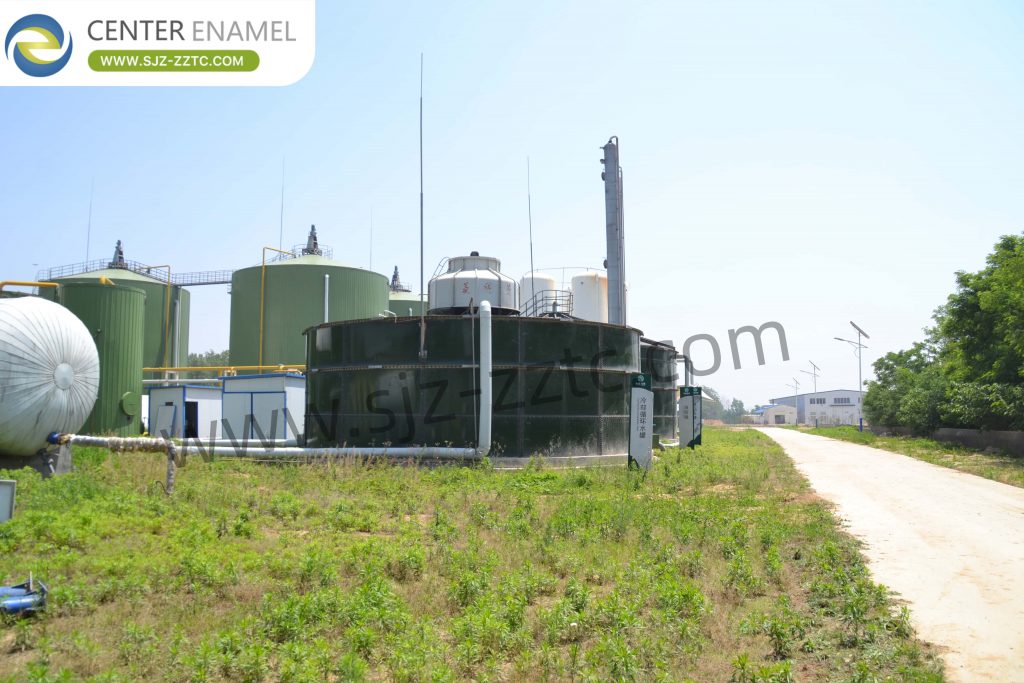
The core equipment is the GFS tank with a built-in gas-lift internal circulation system and upper and lower three-phase separators-the key components for autonomous circulation and gas-liquid-solid separation. Around that core sits a full equipment suite. Fusion Bonded Epoxy Tanks, produced on China's first intelligent standardized production line, primarily serve drinking water, fire water, and neutral medium storage. For sealing, proprietary high-strength aluminum alloy self-supporting Aluminum Dome Covers meet international waterproof and load-bearing standards, suitable for tank sealing and biogas collection. Other tanks include carbon steel tanks, stainless steel tanks, composting tanks, and various non-standard pressure vessels. Engineering services span Environmental EPC general contracting and anaerobic process section subcontracting-one-stop coverage across food waste, leachate, municipal wastewater, livestock biogas, petrochemical and metallurgical, and seawater desalination industries, with customizable tank volume, corrosion protection grade, and complete process solutions integrating equipment manufacturing and engineering construction.
Table 1: Equipment and Service Scope of the Biogas Solution Provider
| Category | Offering | Primary Application |
| Core anaerobic equipment | GFS tank with gas-lift internal circulation and upper/lower three-phase separators | Autonomous circulation; gas-liquid-solid separation |
| Supporting tanks | Fusion Bonded Epoxy Tanks (intelligent standardized line) | Drinking water, fire water, neutral media |
| Sealing | Aluminum Dome Covers (high-strength alloy, self-supporting) | Tank sealing and biogas collection |
| Other vessels | Carbon steel, stainless steel, composting tanks, non-standard pressure vessels | Varied industrial storage duties |
| Engineering services | Environmental EPC contracting; anaerobic process subcontracting | Food waste, leachate, municipal, livestock biogas, petrochemical, desalination |
Chemical Wastewater: Where Anaerobic Digestion Proves Its Value
Chemical wastewater is the hardest test a Biogas Solution Provider faces. It originates from the entire production chain of petrochemicals, coal chemicals, fine chemicals, fertilizers and pesticides, and consumer chemicals-one of the heaviest pollution loads and most complex wastewater categories in industry. Key pollution stages include chemical reaction synthesis, raw material refining and separation, product purification and crystallization, catalyst regeneration, and solvent recovery.
Auxiliary discharges include equipment and pipeline washing, reactor cleaning, floor washing, cooling water, and scrubber drainage. Petrochemical wastewater is primarily oily wastewater and alkaline residue, rich in hydrocarbons, phenols, and sulfides. Coal chemical wastewater is mainly coal gasification scrubber water, rich in ammonia nitrogen, cyanides, phenols, and heterocyclic compounds. Fine chemical wastewater has diverse compositions with various synthesis intermediates, residual raw materials, and byproducts. Pesticide wastewater contains organophosphorus and organochlorine pesticide residues. Wastewater generation is continuous, with significant fluctuations as product lines change. Large petrochemical plants have high continuous discharge volumes, while small and medium-sized chemical plants discharge intermittently with extremely unstable water quality.
Despite that difficulty, the anaerobic route remains viable precisely because these streams are organic-rich. A well-matched Anaerobic Digestion system removes the bulk of COD before energy-intensive downstream stages, cuts chemical and power consumption, and reduces hazardous sludge volume. The determining factor is containment: reactors must survive high salinity, strong oxidation, and aggressive corrosion. Center Enamel has independently developed over 200 specialized enamel frit formulations and supporting patents, allowing anti-corrosion enamel to be customized for the exact media a customer stores. This adaptability is comprehensively superior to concrete tanks, which use a single material suited mainly to neutral clean water. When storing corrosive materials such as chemical wastewater or high-salinity streams, concrete tanks require additional anti-corrosion linings-linings that are prone to failure and cannot adapt to alternating high and low concentration storage conditions.
GFS tanks can be specifically formulated for the full chemical wastewater profile-strong acids, strong alkalis, high organic content, and high salinity-and a single tank can switch between multiple wastewater and fermentation feedstock storage requirements. Because they are universally applicable across biogas anaerobic digestion, municipal wastewater, food processing, and industrial water treatment, factories avoid rebuilding tanks when media change, meeting the needs of diversified, multi-condition environmental protection projects.
GFS Tanks Adaptable to Extreme Climates
Site conditions are the second test. GFS tanks can undergo customized wind and seismic design based on project site climate and geological conditions, with environmental adaptability far superior to concrete tanks. Concrete tanks are cast-in-place monolithic structures whose seismic and wind resistance depend entirely on on-site construction quality; in remote areas, typhoon-prone zones, and earthquake belts, that quality is difficult to control. Under strong earthquakes or typhoons, concrete tanks are prone to cracking and base settlement damage, with subsequent reinforcement costs equivalent to rebuilding. GFS tanks collect local seismic intensity, maximum wind pressure, and foundation bearing capacity data before construction, then apply customized thickened steel panels, stiffening ribs, and anchored base components-all factory-prefabricated to standardized specifications. The bolted panel structure distributes stress excellently, making it less prone to overall fracture under seismic and typhoon impacts, and minor foundation settlement will not cause through-cracking. Structural parameters can be flexibly adjusted for mountainous, coastal typhoon-zone, and high-seismic-zone projects, providing long-term protection against extreme natural climate damage.
Roof Solutions That Complete the Digestion Envelope
Containment is not only the wall-the cover determines whether biogas can be captured safely. For gas production duty, the Aluminum Alloy Trough Deck Roof provides a cost-effective economical tank cover solution for clean water and wastewater storage scenarios, primarily designed for drinking water, production wastewater, and firewater reserve tanks, balancing practicality and cost advantages. The main body is integrally formed from anti-corrosion aluminum alloy plates paired with aluminum support trusses. Its lightweight design imposes less load on the tank foundation, reducing civil construction investment.
A naturally formed dense oxide protective layer on the surface resists rain and mild wastewater corrosion, withstands outdoor sun and rain exposure, and effectively blocks wind, rain, insects, fallen leaves, and odor volatilization, protecting water quality by preventing dust and debris from falling in and causing secondary contamination. The flat roof structure is neat and orderly, allowing installation of maintenance walkways, guardrails, vents, and level monitoring ports on top, facilitating daily inspection and equipment maintenance. The simple sealing structure enables straightforward installation with short construction timelines, and virtually eliminates the need for anti-corrosion painting maintenance, resulting in extremely low operational costs. It is suitable for various small, medium, and large atmospheric pressure water storage tanks, and has been widely implemented in waterworks clear water tanks, industrial circulating water tanks, park firewater tanks, and domestic wastewater temporary storage facilities. It is highly compatible with water storage applications that do not require biogas collection or high-pressure sealing.
Table 2: Roof Cover Selection Guide
| Solution | Material | Best Suited For | Biogas Collection |
| Aluminum Alloy Trough Deck Roof | Anti-corrosion aluminum alloy plates with support trusses | Drinking water, production wastewater, firewater reserve | No |
| Aluminum Dome Covers | High-strength aluminum alloy, self-supporting | Tank sealing and biogas collection | Yes |
Global Market Expertise Behind Every Biogas Solution Provider
Technical delivery must be matched by commercial and regulatory fluency. Center Enamel's marketing team brings together environmental industry multi-skilled professionals and multilingual foreign trade specialists, with deep expertise in global biogas, wastewater treatment, and biomass new energy markets-accumulating extensive practical project experience in Southeast Asia, Africa, Europe, and the Americas. The team is proficient in various countries' wastewater discharge regulations, biogas subsidy policies, and carbon trading rules, providing one-stop preliminary site survey, solution planning, and investment return analysis consulting services. With multilingual capabilities in English, French, Spanish, and Arabic, the team effectively communicates with clients worldwide, precisely matching regional industrial resources, project budgets, and environmental requirements, and customizing high-cost-performance GFS tanks and anaerobic reactor solutions based on client production capacity, treatment targets, and gas production expectations. Leveraging extensive overseas project experience, the team proactively helps clients avoid risks in overseas approvals, equipment import, and construction implementation-building a globally adaptable integrated environmental equipment business service system.
Frequently Asked Questions
Q: What wastewater types suit Anaerobic Digestion?
High-strength organic streams such as food processing, brewery, pharmaceutical, leachate, livestock manure, and chemical wastewater. The IC reactor is ideal for high-concentration, high-flow soluble wastewater but unsuitable for high-solids or high-viscosity feeds.
Q: How does a Biogas Solution Provider handle corrosive chemical effluent?
Through customized GFS tank enamel formulations resisting strong acids, alkalis, salinity, and organics, paired with gas-tight aluminum dome covers for biogas capture-avoiding concrete linings that fail under fluctuating concentrations.
Q: Can these systems be installed in remote or extreme-climate regions?
Yes. Tanks are engineered using local seismic and wind data with factory-prefabricated panels, and multilingual teams manage overseas approvals, import, and construction across Southeast Asia, Africa, Europe, and the Americas.
Looking for a proven Biogas Solution Provider for your high-strength wastewater project? Send Center Enamel your effluent data and gas production targets for a tailored Anaerobic Digestion configuration.
Let our multilingual team map your regulatory, budget, and site constraints into a bankable design. Contact Center Enamel today to discuss how GFS tanks and IC reactor technology can turn your wastewater liability into recoverable energy.