
Beverage Wastewater Treatment Needs One Accountable EPC Contractor
Beverage plants do not struggle because their wastewater is unusual. They struggle because the load arrives in pulses, the sugar content is high, and the discharge permit does not care about either. Add a capital budget under pressure and a site with no spare land, and the case for handing the whole problem to a single Beverage Wastewater Treatment Project EPC Contractor becomes hard to argue against. This article sets out the technical reasoning behind that choice, and what a credible partner must bring.
Where Beverage Effluent Comes From
Every step in a beverage line contributes something different. Syrup preparation and blending produce the heaviest sugar loads, while washing and juicing carry pulp and pectin. Filtration and clarification leave fruit and tea residue. Filling and bottle washing generate large volumes of dilute water. Cleaning-in-place (CIP) returns the concentrated chemical and organic slug that decides how robust the reactor must be, and floor washing adds volume without much strength. Juice lines run highest in organics; carbonated lines add syrup, phosphoric acid and CO2 residue.
| Process Stage | Wastewater Character | Treatment Implication |
| Fruit washing, crushing, juicing | Pulp, pectin, high organic solids | Screening and equalization before digestion |
| Syrup preparation and blending | Very high sugar, high COD | High-rate anaerobic stage essential |
| Filtration and clarification | Fruit and tea residue | Fine screening, residue handling |
| Filling and bottle washing | High volume, low concentration | Volume buffering, reuse potential |
| CIP cleaning | Concentrated chemical and organic slug | Shock tolerance, pH correction, equalization |
Plants of any real size discharge hundreds to thousands of cubic metres a day, and the profile shifts with product changeovers and CIP cycles. A design built on average figures will fail on the worst week of the year, which is why equalization ahead of Anaerobic Digestion matters as much as reactor selection.
Why Conventional Approaches Stall
The sector's difficulties concentrate in three places, and they reinforce each other. Composition is hard to treat, because new energy, chemical and pharmaceutical streams carry characteristic pollutants that conventional trains cannot remove reliably. Cost is high, since energy, chemicals and sludge disposal all scale with load. Energy consumption is high, because aerobic treatment pays for oxygen all day, every day.
Commercial pressure adds to it. Mid- and low-end equipment pricing has compressed, standards tighten annually, and digital reporting and low-carbon targets now sit on top of discharge compliance. A plant sized only for today's limit is a plant scheduled for rebuild.
Anaerobic Digestion as the Load-Bearing Stage
Anaerobic Digestion answers all three at once: microorganisms convert organic matter without oxygen, producing biogas that offsets plant energy and turning most of the load into gas rather than sludge that must be dewatered and hauled. For high-sugar beverage streams, COD removal is high enough that downstream aerobic stages shrink, and with them the aeration bill.
What separates a working plant from a marginal one is how biomass is held, and that is where the IC reactor earns its place.
Inside the IC Reactor: Circulation Without Pumps
The IC, or Internal Circulation reactor, is the third generation of high-rate anaerobic design, built on the UASB principle and improved where UASB struggles. Its core innovation is a built-in gas-lift internal circulation system, so wastewater recirculates without external return pumps.
The vessel is split into a lower main reaction zone and an upper polishing zone. Feed enters the bottom, mixes with recirculated liquor and rises quickly. Biogas generated by the biomass lifts the mixture to a gas-liquid separator at the top, gas is drawn off, and degassed liquor returns by gravity through downcomers. That loop repeats continuously, raising upflow velocity and forcing far better contact between sludge and substrate than a conventional UASB can manage. The result is a compact reactor built for high concentration and high flow.
Tanks That Fit a Compact Plant Footprint
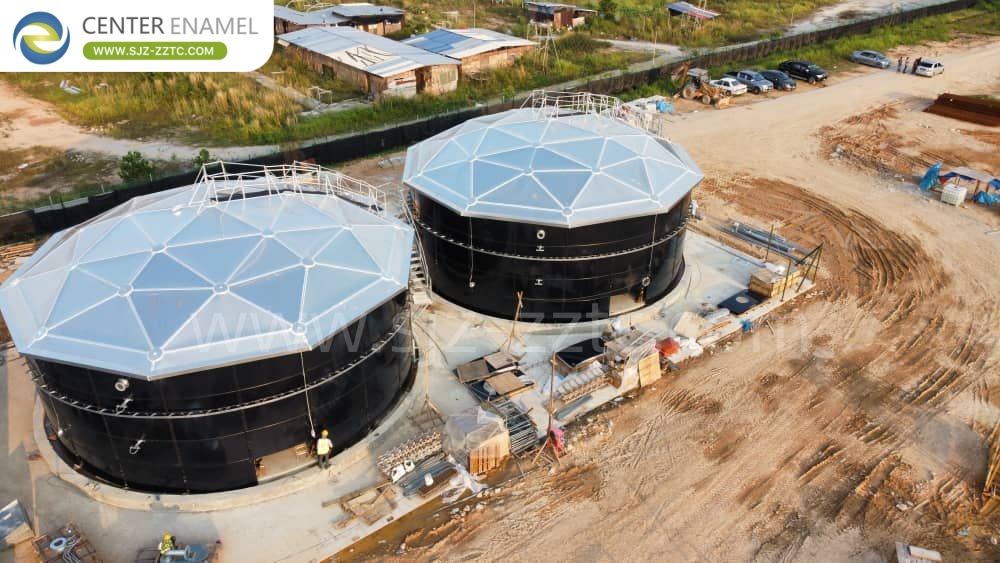
Footprint is often the constraint that decides the project. GFS tanks allow size and appearance to be customised rather than fixed at pour, with volume selectable from tens of cubic metres to 50,000 m³ and height-to-diameter ratios arranged around a narrow or irregular plot. Enamel colour can be matched to plant buildings, and tanks can be added when a line expands.
| Criterion | GFS Tank | Cast Concrete Tank |
| Volume flexibility | Any size up to 50,000 m³, adjustable later | Fixed at pour, cannot be altered |
| Site fit | Height and diameter combined to suit plot | Heavy base, large footprint, awkward on tight sites |
| Expansion | Panels added or layout adjusted | Demolition and rebuild required |
| Appearance | Colour-matched enamel finish | Rough, uniform surface |
| Construction | Modular panels assembled on site | Long cast and cure cycle |
Sealing the Top: Why the Dome Matters
Containment decides whether the biogas is an asset or an odour complaint. Center Enamel's aluminum geodesic dome is stamped from high-strength alloy plates into a triangular-grid, self-supporting spherical structure that spans the tank without internal columns. The alloy resists acid rain, salt spray and UV exposure, and the design follows AWWA D108, with plate thickness, rib sections and joints verified by finite element analysis for local wind and snow loads. It weighs one-third to one-half of an equivalent steel roof, so no wall reinforcement is needed, and double sealant-strip joints deliver the air-tightness gas storage and odour control require. Aluminium also resists microbial growth and needs no repainting.
Three Decades Behind the Delivery
None of this is assembled from a catalogue. Center Enamel has spent more than 30 years in bolted environmental storage, starting from proprietary enamel anti-corrosion material and growing into a full-chain environmental EPC provider. It holds recognition as a National High-Tech Enterprise, National Specialized and Sophisticated Little Giant, Manufacturing Single Champion and Provincial Green Factory, and has delivered over 30,000 environmental projects worldwide.
| Capability | Figure or Status | What It Means for a Buyer |
| Industry experience | 30+ years in bolted storage | Process and coating knowledge, not just fabrication |
| Delivered projects | 30,000+ globally | Reference depth across markets and climates |
| Chain integration | Enamel frit R&D, manufacturing, EPC contracting | One contract from specification to handover |
| Tank capacity | Up to 50,000 m³ per tank | Fits any beverage plant scale |
| Roof standard | AWWA D108, finite element verified | Acceptance in code-driven markets |
Behind that record sits a full-chain team covering R&D, design, installation and after-sales. The R&D group is led by national-level materials experts on enamel frit and tank anti-corrosion, supported by external environmental engineering and mechanical structure engineers. Proprietary laboratories run corrosion simulation tests year-round, with university collaboration, iterating formulations for high-salinity wastewater, strong acid and alkali palm oil effluent and high-organic manure.
What to Expect from the Contractor You Sign
A credible Beverage Wastewater Treatment Project EPC Contractor brings process selection, containment fabrication, installation and commissioning under one signature, and accepts performance risk rather than transferring it to the client. Ask for guarantees tied to effluent quality and biogas yield, a reference list on comparable high-sugar effluent, and evidence that the coating and roof systems have already survived similar chemistry for years. Anaerobic Digestion is proven technology. Delivery discipline is what remains scarce.
Frequently Asked Questions
Why is anaerobic digestion preferred for high-sugar beverage effluent?
Sugar-rich streams degrade readily without oxygen, so digestion removes most of the COD while producing biogas instead of sludge. That cuts aeration energy, reduces disposal cost and creates a revenue offset. That also means less surplus sludge to dewater, which is where disposal budgets usually blow out. Aerobic stages then only polish residuals and handle nutrients.
How does an IC reactor differ from a UASB?
Both retain granular biomass, but the IC adds a gas-lift internal circulation loop and a second polishing zone. Circulation is driven by biogas rather than pumps, upflow velocity is higher, loading capacity rises, and the footprint shrinks. On pulsed CIP loads the IC holds biomass better, which is where UASB designs tend to lose granules. The trade-off is a taller vessel and tighter commissioning.
What tank and roof specification suits a biogas project?
A glass-fused-to-steel tank with double-sided enamel protects against organic acids and sulphides, and a gas-tight aluminum geodesic dome completes the containment. Specify AWWA D108 compliance, verified wind and snow loads, and joint sealing that has been tested, because gas loss is revenue loss. Insist on a documented joint test report.
Send us your product mix, CIP schedule and discharge limits, and we will size the anaerobic stage and containment before you commit to a budget.
Talk to Center Enamel about your Beverage Wastewater Treatment project, and our engineers will map the process, tank and roof specification to your site constraints in one conversation.