
Biogas From Chicken Manure: Harnessing Poultry Waste for Renewable Energy
Intensive poultry farming generates millions of tons of chicken manure and litter annually. Traditionally managed through open storage or land spreading, raw poultry waste presents severe environmental challenges, including intense odor emissions, non-point source water pollution, and unmanaged releases of fugitive greenhouse gases.
Harnessing biogas from chicken manure through advanced anaerobic digestion (AD) transforms this high-strength waste stream into a valuable renewable energy source. However, because poultry manure possesses unique biochemical properties—most notably a very high nitrogen content—successful commercial operation requires precise engineering and careful biological management.
Unique Characteristics and Challenges of Chicken Manure
While chicken manure boasts a high organic content and excellent methane potential, its chemical composition introduces distinct operational hurdles compared to cattle or pig slurry:
- Extremely Low Carbon-to-Nitrogen (C:N) Ratio: While optimal anaerobic digestion requires a C:N ratio between 25:1 and 30:1, raw chicken manure typically features a narrow ratio of 5:1 to 10:1 due to high concentrations of proteins and uric acid.
- High Total Ammonium Nitrogen (TAN): As proteins and uric acid break down inside the digester, nitrogen converts rapidly into free ammonia (FA) and ammonium ions.
- Ammonia Inhibition and Process Failure: When Total Ammonium Nitrogen (TAN) concentrations exceed 3,000 mg/L, methanogenic microbial activity becomes severely impaired. Unchecked ammonia accumulation can trigger volatile fatty acid (VFA) build-up, lower pH buffering efficiency, and lead to complete reactor souring or failure.
Engineering Strategies for Stable Chicken Manure Digestion
To overcome ammonia toxicity and maximize methane yields, industrial biogas plants processing chicken manure implement several proven optimization techniques:
- Co-Digestion with Carbon-Rich Substrates: The most effective method to balance the chemical profile is co-digesting chicken manure with carbon-dense materials—such as agricultural crop straw, maize silage, or green waste. This blends the feedstocks to reach the ideal C:N ratio of 25:1 to 30:1, neutralizing ammonia toxicity.
- Total Solids (TS) and Organic Loading Rate (OLR) Control: Maintaining optimal dilution levels (typically keeping feed TS between 8% and 12%) prevents localized metabolite accumulation and moderates the rate of nitrogen release.
- Advanced Additives and Biochar Amendments: Incorporating specialized materials like biochar into the reactor matrix helps adsorb ammonium ions, buffers system pH, and facilitates direct interspecies electron transfer (DIET) to protect methanogenic communities under high organic loading rates.
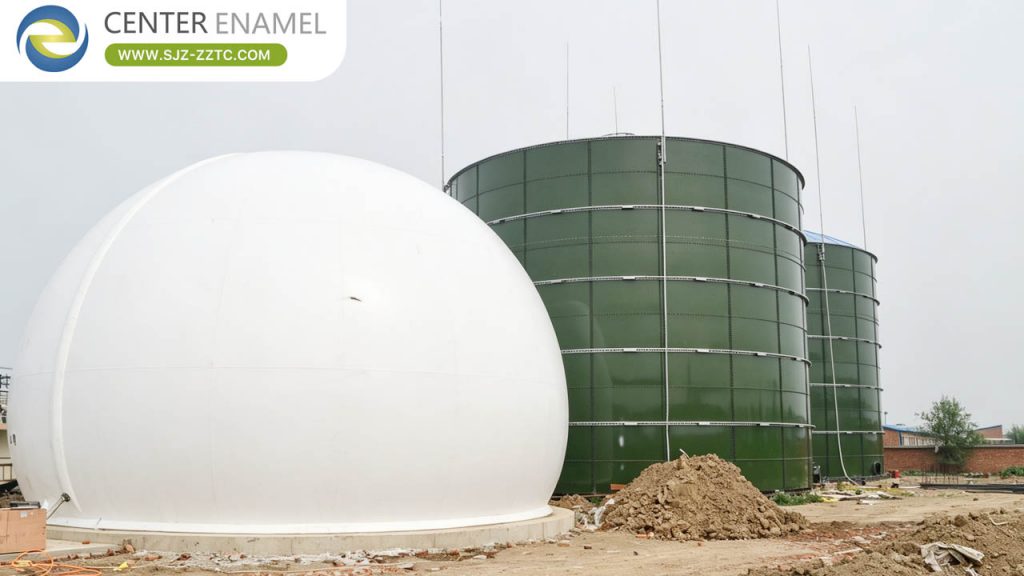
- Robust Industrial Containment Infrastructure: Because poultry manure digestate and high-sulfur biogas are highly corrosive, facilities rely on heavy-duty industrial tanks—such as Glass-Fused-to-Steel (GFS) bolted tanks equipped with double-membrane roofs—to ensure structural longevity and gas-tight containment.
Comparative Data Table: Chicken Manure vs. Other Farm Manures
| Substrate Parameter | Chicken Manure (Poultry) | Cattle Manure (Bovine) | Pig Manure (Swine) |
| C:N Ratio | Very Low (5:1 to 10:1) | Balanced (15:1 to 20:1) | Low to Moderate (10:1 to 15:1) |
| Nitrogen Content | Very High (Rich in proteins/uric acid) | Moderate | High |
| Methane Potential | High (0.35 to 0.45 m3/kg VS) | Moderate (0.20 to 0.35 m3/kg VS) | Moderate to High (0.30 to 0.45 m3/kg VS) |
| Primary Digestion Risk | High risk of ammonia/TAN inhibition | Low risk; strong natural pH buffering | Moderate risk of VFA accumulation |
| Recommended Strategy | Requires strict co-digestion with carbon-rich biomass | Can be digested directly or used as a buffer | Blended with agricultural residues |
Frequently Asked Questions (FAQ)
Q1: Why is anaerobic digestion of pure chicken manure difficult?
A: Pure chicken manure contains high concentrations of proteins and uric acid, resulting in an extremely low C:N ratio (5:1 to 10:1). During digestion, this excess nitrogen converts into high levels of Total Ammonium Nitrogen (TAN), which inhibits methanogenic bacteria and can cause the reactor to fail.
Q2: How can biogas plant operators prevent ammonia toxicity when using chicken manure?
A: Operators primarily prevent ammonia toxicity through co-digestion—mixing nitrogen-rich chicken manure with carbon-rich organic materials like agricultural crop straw or maize silage to achieve a balanced C:N ratio of 25:1 to 30:1. Other methods include controlling total solids (TS) dilution rates and utilizing biochar additives.
Q3: What happens to the residual slurry after chicken manure is digested?
A: The residual material, known as digestate, undergoes solid-liquid separation. The solid portion can be processed into organic fertilizer pellets, while the liquid fraction is safely managed or recycled. Because anaerobic digestion eliminates weed seeds and reduces pathogen loads while retaining essential macro-nutrients, the digestate serves as a high-grade bio-fertilizer.