
Biogas from Fruit and Vegetable Waste: Turn Organic Scraps Into Profitable Clean Energy
Fruit and vegetable waste is one of the most abundant untapped organic resources globally, generated massively from farm harvesting, fresh produce markets, fruit & vegetable processing factories, restaurants and tourism catering sectors every year. Billions of tons of rotten fruits, vegetable peels, pomace, stalks and unsold leftover produce end up in open landfills or open-air incineration sites annually, triggering severe malodor, underground water leachate pollution and uncontrolled methane greenhouse gas emission from natural decomposition.
Thanks to mature anaerobic digestion technology, biogas from fruit and vegetable waste has become a proven circular economy solution, turning worthless organic scraps into clean renewable biogas for power generation, industrial heating and domestic gas supply, while fermented residues are processed into premium organic fertilizer for crop planting. This article breaks down the full biogas production mechanism, core project values, leading anaerobic technologies and superior equipment solutions from global top EPC contractor Center Enamel.
Main Sources & Global Disposal Difficulties of Fruit and Vegetable Waste
Fruit and vegetable waste comes from four mainstream channels across tropical and subtropical regions: on-farm defective produce discarded during seasonal crop harvest, daily expired leftovers from urban wholesale markets and supermarkets, processing residues (peel, seed, pomace) from canned fruit, juice and frozen vegetable manufacturers, plus kitchen trimming waste from countless dining outlets and resort kitchens. Most regions still rely on primitive disposal methods, bringing multiple unavoidable troubles.
Landfill stacking occupies precious land space and releases potent methane; open burning generates toxic fumes that worsen regional air pollution. Mixed garbage collection mixes plastic packaging with organic scraps, sharply raising pre-treatment cost for resource recycling. Besides, fruit and vegetable waste features 80%–90% high moisture and rapid spoilage, making traditional natural compost low-yield and uneconomical, accelerating market demand for stable biogas from fruit and vegetable waste projects.
Four Core Stages of Producing Biogas from Fruit and Vegetable Waste
All biogas conversion happens inside sealed reactors and GFS Tanks under fully oxygen-free environments, completed through four interdependent microbial biochemical reactions, which is the core principle behind biogas from fruit and vegetable waste:
- Hydrolysis: Hydrolytic microbes secrete specialized enzymes to split large-molecule cellulose, pectin, starch and plant protein in fruit & vegetable scraps into soluble small molecules like monosaccharide and amino acid; this is usually the rate-limiting step of whole digestion.
- Acidogenesis: Acid-forming bacteria convert soluble small organics into volatile fatty acids (VFAs) and intermediate alcohols, laying intermediate raw materials for subsequent reactions.
- Acetogenesis: Acetogenic microorganisms further degrade fatty acids and alcohols into acetic acid, hydrogen and carbon dioxide, the primary feedstock for methane creation.
- Methanation: Strictly anaerobic methanogenic archaea synthesize raw biogas with methane accounting for 55%–70% and CO₂ as the remainder.
After desulfurization, dehydration and compression purification, refined high-purity biogas can be used for factory power, boiler heating or Bio-CNG production; post-digestion digestate turns into high-grade organic fertilizer to realize full closed-loop resource recycling.
Key Environmental & Economic Benefits of Fruit Vegetable Waste Biogas Projects
Investing in projects to produce biogas from fruit and vegetable waste brings multi-win gains for enterprises and local governments. Environmentally, it drastically cuts landfill volume and random waste accumulation, curbs soil, water and air pollution while cutting methane emissions to help nations achieve carbon reduction targets.
Economically, food processing factories slash expensive outsourced waste disposal fees and gain extra revenue from biogas electricity sales and organic fertilizer trade. Socially, such projects create new jobs in waste collection, plant operation and equipment maintenance, boosting rural income and promoting circular agriculture development.
Four Advanced Anaerobic Technologies from Center Enamel for Fruit & Vegetable Waste Biogas
As a world-leading biogas EPC provider, Center Enamel develops four customized anaerobic processes perfectly matched with diverse fruit & vegetable waste traits and project scales, all compatible with self-produced GFS Tanks:
1. CSTR (Continuous Stirred-Tank Reactor)
Equipped with internal mechanical stirring inside matched GFS Tanks, CSTR fully mixes high-moisture fruit pomace and microbial sludge to avoid crusting and sediment stratification, with strong anti-shock load capacity. Ideal for large centralized market and agro-factory biogas plants with massive mixed fruit and vegetable waste input.
2. UASB (Upflow Anaerobic Sludge Blanket)
Depends on high-activity granular sludge bed for efficient COD removal, featuring small footprint and low power consumption. Best suited for pre-filtered liquid leachate separated from fruit and vegetable raw waste after solid-liquid pretreatment.
3. USR (Upflow Solid Reactor)
Specially engineered for high-solid fresh fruit & vegetable scraps; simple internal layout and low construction cost, no need for complex pre-crushing and dehydration before feeding. Perfect choice for scattered small rural and market biogas stations.
4. IC (Internal Circulation Reactor)
High-efficiency third-generation reactor with automatic internal gas-liquid-solid circulation; treatment efficiency reaches 3–5 times of conventional anaerobic equipment, designed for super-large urban centralized organic waste disposal hubs.
Core Competitive Advantages of Center Enamel’s GFS Tanks
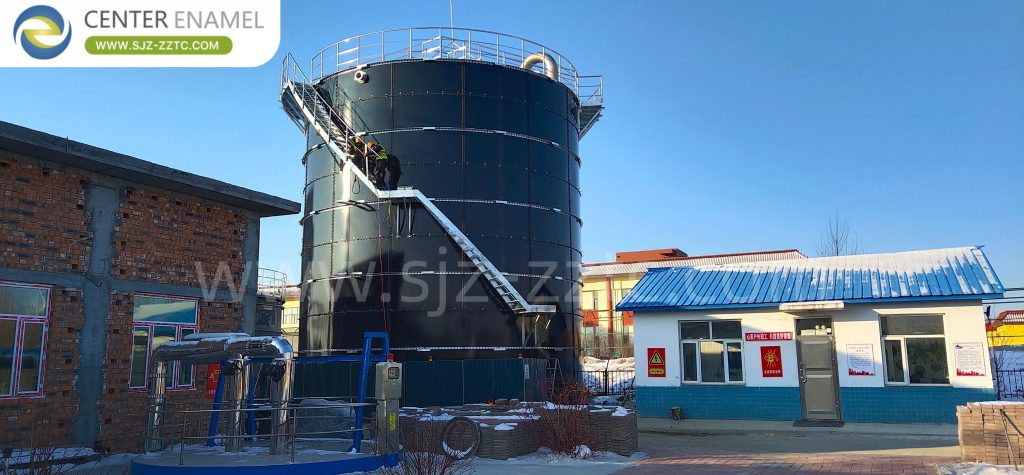
GFS Tanks (Glass-Fused-to-Steel Tanks) act as core containment equipment supporting all four anaerobic processes and dominate biogas plant construction thanks to six outstanding merits:
- Superior Anti-Corrosion: High-temperature sintered enamel coating resists erosion from acidic fruit fermentation liquid and coastal salt fog, adapting to tropical rainy and humid climates with over 30-year service life.
- Excellent Airtightness: Professional customized sealing accessories prevent biogas leakage and energy loss, maximizing methane collection efficiency.
- Modular Bolted Assembly: All tank panels are factory prefabricated and bolt-connected on-site without hot welding, shortening construction cycle and avoiding rainy-season construction defects.
- Smooth Inner Wall: Enamel lining prevents organic pomace scaling, greatly reducing daily tank cleaning and maintenance expenses.
- Flexible Expansion: Tank capacity can be conveniently expanded by adding extra enamel panels to cope with seasonal peak waste output.
- Multi-purpose Application: One tank can serve as fermentation digester, raw waste storage tank or digestate storage tank flexibly.
Comprehensive Full-Cycle EPC Advantages of Center Enamel
Center Enamel stands out in global biogas from fruit and vegetable waste projects with all-round EPC strengths:
- Own more than 200 independent enamel and anaerobic technology patents; all GFS Tanks comply with ISO and AWWA international quality standards for global cross-border project acceptance.
- Provide full turnkey one-stop service covering project design, equipment manufacturing, cross-border logistics, on-site installation, system commissioning, staff training and lifelong after-sales maintenance.
- Deliver localized customized design: adjust anaerobic process matching and tank size based on local waste composition, regional climate and site terrain to maximize biogas output.
- Possess abundant overseas project experience across Southeast Asia, Europe and North America, familiar with local environmental laws and construction specifications.
- Optimize whole system layout to lower equipment failure rate and daily operational cost, securing stable long-term investment returns for project owners.
- Global after-sales network offers timely remote technical guidance and on-site field maintenance anytime.
Developing projects to produce biogas from fruit and vegetable waste is a sustainable circular economy approach to resolve global organic waste pollution and clean energy shortage simultaneously. Supported by Center Enamel’s diversified mature anaerobic technologies and high-performance corrosion-resistant GFS Tanks, fruit processors, market operators and agricultural investors can turn troublesome fruit & vegetable scraps into steady profitable biogas and organic fertilizer.
As a trusted full-chain EPC contractor, Center Enamel’s customized turnkey solutions help worldwide clients realize waste harmless disposal, clean energy production and circular agriculture upgrade, continuously advancing global low-carbon green development goals.