
Biogas from Palm Oil Mill Effluent (POME): Complete Guide to Wastewater-to-Energy Conversion
The palm oil industry faces a persistent environmental challenge: for every tonne of crude palm oil produced, roughly 2.5 to 3 tonnes of thick, brown wastewater-known as palm oil mill effluent (POME)-are generated . This high-strength effluent, if discharged untreated, releases potent methane into the atmosphere and pollutes waterways. Yet within this waste stream lies a valuable resource. Through anaerobic digestion, POME can be converted into biogas rich in methane, transforming a costly pollution problem into a source of renewable electricity, heat, and even vehicle fuel. This article explains where POME comes from, why it is so well-suited for biogas production, and how mills can capture this energy.
What Is Palm Oil Mill Effluent and Where Does It Come From?
Palm oil mill effluent is the liquid waste generated during the extraction of crude palm oil from fresh fruit bunches (FFB). It is not a single stream but a combination of discharges from multiple processing stages. The largest contributor is the clarification and centrifugation step, which accounts for approximately 60% of total POME volume. Sterilization condensates, hydro-cyclone wash water, and boiler blowdown make up the remainder .
Fresh POME is typically hot (60–80°C), acidic (pH 3.3–4.6), and viscous, carrying high concentrations of suspended solids, residual oil, and organic matter. Its brownish colour comes from carotene, pectin, tannin, and lignin compounds . The pollution load is severe: biochemical oxygen demand (BOD) commonly ranges from 15,000 to 40,000 mg/L, and chemical oxygen demand (COD) can reach 100,000 mg/L . Without treatment, discharging a single cubic metre of POME is equivalent to releasing the organic pollution of hundreds of litres of domestic sewage.
Why Can POME Produce Biogas?
The answer lies in its composition. POME is exceptionally rich in biodegradable organic matter-oils, fats, proteins, carbohydrates, and organic acids-that anaerobic microorganisms can consume and convert into methane. The key parameters that make POME a favourable substrate for anaerobic digestion include:
High COD and BOD: The enormous organic load provides ample “food” for microbes. Typical COD ranges from 16,000 to 100,000 mg/L .
Favourable nutrient balance: POME naturally contains nitrogen and phosphorus in proportions suitable for anaerobic microbial growth. Its BOD:N:P ratio of approximately 100:1.5:0.6 exceeds the minimum requirement of 100:0.5:0.1, meaning supplemental nutrients are rarely needed .
High biodegradability: A large fraction of the organic matter in POME is readily hydrolysed and fermented by anaerobic bacteria, making it highly amenable to biological treatment.
Warm temperature: Fresh POME exits the mill at 60–80°C, and even after cooling, it retains sufficient heat to support mesophilic or thermophilic digestion without excessive energy input .
In short, POME is not merely wastewater-it is a dilute energy slurry waiting to be converted.
How Is Biogas Produced from POME? The Anaerobic Digestion Process
Biogas generation from POME relies on anaerobic digestion (AD), a multi-stage biological process in which a consortium of microorganisms breaks down organic matter in the absence of oxygen. The process occurs in four sequential stages:
1. Hydrolysis: Extracellular enzymes-particularly lipases-break down complex polymers such as triglycerides, proteins, and carbohydrates into simpler soluble compounds like fatty acids, amino acids, and sugars. This step is often rate-limiting because the high lipid content of POME requires efficient lipase activity, which operates optimally at pH 6.8–7.5 .
2. Acidogenesis: Fermentative bacteria convert the hydrolysis products into volatile fatty acids (VFAs), alcohols, hydrogen, and carbon dioxide. This stage proceeds rapidly and can cause acid accumulation if the subsequent stages are overwhelmed.
3. Acetogenesis: Acetogenic bacteria further transform VFAs and alcohols into acetic acid, hydrogen, and carbon dioxide-the direct precursors for methane formation. This step requires syntrophic relationships between different bacterial groups to maintain favourable thermodynamics.
4. Methanogenesis: Methanogenic archaea-strictly anaerobic organisms-convert acetate and hydrogen/CO₂ into methane. This final stage is the most sensitive to environmental conditions. Methanogens grow slowly and are inhibited by low pH, oxygen exposure, and excessive VFA accumulation .
The overall result is biogas, typically containing 60–66% methane (CH₄) and 30–40% carbon dioxide (CO₂), with trace amounts of hydrogen sulphide and water vapour . This biogas can be combusted in engines or boilers to generate electricity and heat, or upgraded to biomethane for grid injection or vehicle fuel.
What Technologies Are Used to Capture Biogas from POME?
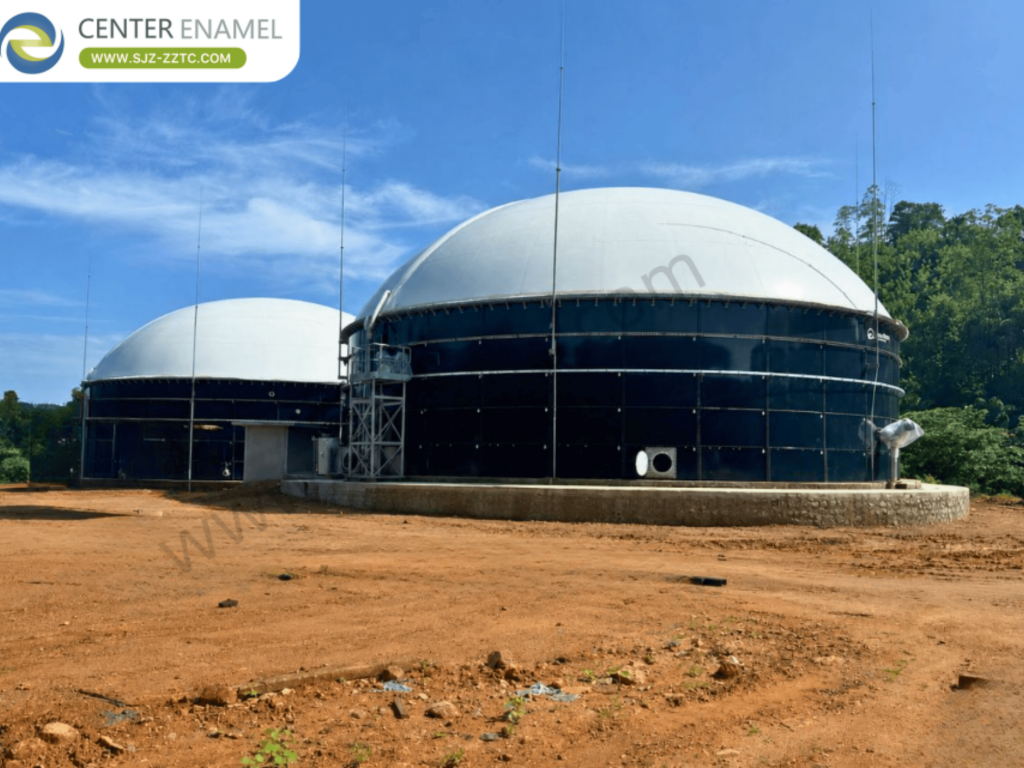
Historically, palm oil mills treated POME in open lagoons or ponds, allowing anaerobic digestion to occur naturally-but releasing methane directly into the atmosphere. Modern biogas capture systems enclose the digestion process to collect this gas for beneficial use. The main commercial configurations include:
Covered Lagoon Digesters: The most widely adopted technology among mills with biogas facilities, particularly in Malaysia. A gas-tight cover is placed over an existing anaerobic lagoon, capturing biogas while maintaining the simple, low-energy operation of a pond system. Covered lagoons tolerate high organic loading rates but require significant land area and long hydraulic retention times .
Continuous Stirred Tank Reactors (CSTR): Enclosed, mechanically mixed tanks that provide better contact between biomass and substrate. CSTR systems offer more consistent performance and smaller footprint than covered lagoons, though they consume more energy for mixing .
Upflow Anaerobic Sludge Blanket (UASB) Reactors: High-rate systems where biomass forms dense granules that settle at the bottom, allowing high organic loading with shorter retention times. UASB reactors can achieve over 90% COD removal at hydraulic retention times of around 5 days .
Anaerobic Membrane Bioreactors (AnMBR): Emerging systems that combine anaerobic digestion with membrane separation, achieving 93% COD removal and methane yields of 0.41 m³ CH₄/kg COD in pilot trials. However, membrane fouling and cost remain barriers to widespread adoption .
How Much Biogas and Energy Can POME Produce?
The energy potential of POME is substantial. Malaysia alone generates an estimated 1,648 million cubic metres of biogas annually from POME, equivalent to 508 MW of electricity generation capacity across all mills, while avoiding 4.96 million tonnes of CO₂-equivalent emissions .
Table 1 summarises typical biogas and methane yields reported for POME treatment under different conditions.
| Parameter | Typical Range / Value | Source Context |
| Biogas yield | 0.28–0.34 Nm³ CH₄/kg COD removed | General AD performance |
| Methane content in biogas | 60–66% | Covered lagoon / CSTR systems |
| Specific methane potential | 45 m³ CH₄ per m³ POME | Estimated for Malaysian POME |
| Methane yield (UASB) | 436–438 mL CH₄/g VS added | Continuous reactor operation |
| COD removal efficiency | 90–94% | Closed tank digester systems |
Table 2 compares the characteristics of raw POME that directly influence biogas production.
| Parameter | Typical Range | Significance for Biogas |
| pH | 3.3–4.6 | Requires buffering for methanogens (optimal pH 6.8–7.5) |
| COD | 16,000–100,000 mg/L | Primary energy source for methane production |
| BOD | 15,000–40,000 mg/L | Indicates readily biodegradable fraction |
| Total suspended solids | 18,000–65,000 mg/L | Can impede mass transfer; pretreatment may help |
| Oil and grease | 0.6–0.7% (6,000–7,000 mg/L) | High methane potential but can cause fouling |
What Are the Environmental and Economic Benefits?
The shift from open pond treatment to closed anaerobic digestion with biogas capture delivers multiple benefits. Environmentally, capturing methane-a greenhouse gas with over 25 times the global warming potential of CO₂-prevents its release into the atmosphere. Life cycle assessment studies show that covered lagoon and CSTR systems both yield net environmental benefits in terms of global warming potential and acidification potential .
Economically, biogas offsets mill energy costs. A mill processing 60 tonnes of FFB per hour can generate sufficient biogas to displace a significant portion of its diesel or grid electricity consumption. Excess electricity can be sold to the grid under feed-in tariff schemes. The digested sludge, rich in nutrients, can be returned to plantations as organic fertiliser, closing the nutrient loop .
What Challenges Remain?
Despite its promise, POME biogas faces practical hurdles. The high initial capital cost of digester construction and gas handling equipment deters many smaller mills. Open lagoon systems remain common because they are cheap to build, even though they waste energy and emit greenhouse gases . Technical challenges include managing the high oil and grease content, which can cause foaming and biomass washout, and controlling hydrogen sulphide, which corrodes engines and requires desulphurisation. Research continues into pretreatment methods-such as mesh filtration, which has been shown to increase methane yield by 32.9–40.5% by removing coarse, poorly degradable solids before digestion .
Frequently Asked Questions
Q1: How long does it take for POME to produce biogas?
Under anaerobic conditions, biogas production begins within days as hydrolytic and acidogenic bacteria initiate breakdown. However, stable methane generation typically requires a startup period of several weeks to allow methanogenic populations to establish. In continuous systems, hydraulic retention times range from 5 days in high-rate reactors to 20 days or more in covered lagoons .
Q2: Can all palm oil mills implement biogas capture?
Technically, yes-any mill producing POME can install anaerobic digestion with gas capture. Practically, feasibility depends on mill scale, land availability, and capital access. Mills with existing lagoon systems can retrofit covers at lower cost, while new facilities can incorporate CSTR or UASB reactors from the outset. Government incentives and carbon credit mechanisms have accelerated adoption in Malaysia and Indonesia .
Q3: What happens to the POME after biogas extraction?
The digested effluent, while reduced in organic load, still contains nutrients and residual solids. It is typically polished in aerobic ponds before discharge to meet environmental standards. Alternatively, the nutrient-rich liquid can be applied to plantation land as fertiliser, and the sludge can be composted with empty fruit bunches to produce organic soil amendments .
Ready to explore biogas recovery for your palm oil operation? Contact our team to discuss a feasibility assessment tailored to your mill’s capacity and effluent profile.
Our engineers can help you evaluate digester options, estimate biogas yield, and design a system that turns your POME liability into an energy asset.