
How We Helped a Biogas Plant Complete Its Wastewater Treatment Project
The global biogas industry competitive landscape shows divergence. Leading companies dominate major project market shares through the "EPC + Operation" integrated model, while small and medium-sized enterprises focus on county-level distributed projects and specialized equipment segments. China's biogas equipment exports continue to expand, with generator sets primarily flowing to emerging markets. Business model innovation is accelerating, with carbon asset development becoming a standard feature of large projects, converting methane emission reductions into tradable carbon credits. Some countries have piloted digestate fertilizer carbon credit trading, encouraging the integration of digestate application to farmland with carbon accounting. The "biogas operation outsourcing" service model is emerging, improving operational efficiency of county-level projects through professional management.
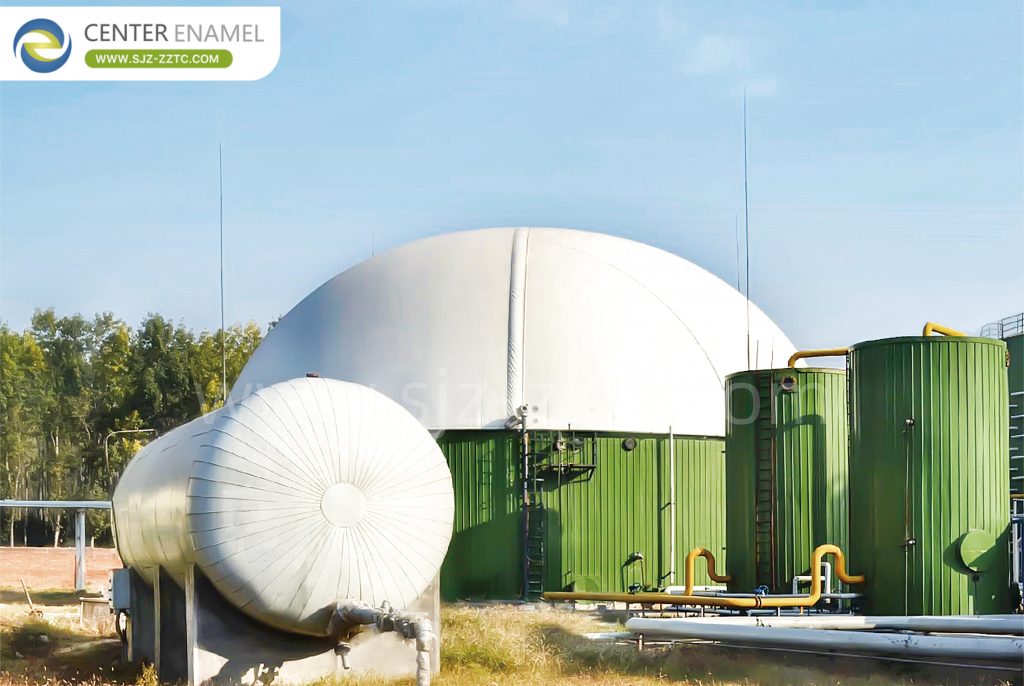
From a technology and equipment perspective, anaerobic digestion is the core process of biogas engineering. GFS Tanks, with their excellent sealing, corrosion resistance, and construction convenience, have become the mainstream choice for large anaerobic digestion tanks. Their modular design can be combined with membrane gas holders to form an integrated "fermentation + gas storage" solution, with penetration rates continuing to rise in new projects in biogas industry clusters. As Anaerobic Technologies continue to mature, the combination of robust tank engineering and optimized biological processes has become the decisive factor in project success.
Why GFS Tanks Outperform Traditional Concrete in Corrosion Resistance
Center Enamel's independently developed double-sided double-layer enameling technology is the industry's leading coating anti-corrosion technology, with corrosion resistance completely surpassing concrete tanks. Concrete tank interiors are riddled with pores, allowing wastewater and acid/alkaline media to easily penetrate and corrode the structural layer. Long-term use leads to irreversible problems such as internal wall spalling, water seepage, and rebar corrosion, which are difficult to repair and cannot be fundamentally resolved.
GFS Tanks feature high-temperature enameling on both the interior and exterior surfaces of steel panels, with a dense, non-porous enamel finish that completely blocks corrosive liquids and biogas permeation. The enamel layer has extremely strong chemical stability, resisting acids, alkalis, salts, and microbial corrosion. Concrete tanks will develop extensive corrosion and leakage after 5–8 years of use, while GFS tank anti-corrosion service life can exceed 30 years, with no need for frequent internal lining repairs throughout the service life, significantly reducing long-term anti-corrosion maintenance investment and fundamentally eliminating environmental risks of medium leakage contaminating sites and groundwater. Compared to traditional concrete and FRP tanks, GFS tank coatings have no risk of peeling or blistering, and are adaptable to highly corrosive conditions such as palm oil mill effluent, livestock manure, and chemical high-salinity wastewater, with outstanding long-term comprehensive cost advantages.
| Comparison Factor | Traditional Concrete Tanks | Center Enamel GFS Tanks |
| Anti-corrosion service life | 5–8 years before major degradation | Exceeding 30 years |
| Surface structure | Highly porous; prone to penetration | Dense, non-porous enamel finish |
| Maintenance requirement | Frequent lining repairs | No internal lining repairs needed |
| Chemical resistance | Limited; degrades with acids/alkalis | Resists acids, alkalis, salts, microbial corrosion |
| Leakage risk | High after 5–8 years | Negligible |
| Adaptability | Poor for high-salinity/high-corrosion media | Excellent for POME, manure, chemical wastewater |
USR Process: A Definition Rooted in High-Solids Anaerobic Technologies
USR, or Upflow Solids Reactor, is an upflow anaerobic process modified for high-suspended-solids, high-solids organic wastewater, specifically designed to solve problems of clogging, sludge washout, and uneven reaction common in traditional anaerobic processes for high-solids wastewater. The process eliminates complex three-phase separators, simplifies internal structure, and relies on upflow hydraulics to promote thorough mixing of solid materials and anaerobic sludge. No strict granular sludge formation conditions are required-flocculent sludge can operate stably. The key feature is high solids tolerance and impurity resistance, with very high influent suspended solids tolerance. It is a dedicated high-efficiency anaerobic process for livestock manure, agricultural organic waste, and high-solids livestock wastewater, specifically developed for agricultural and environmental applications. Within the broader family of Anaerobic Technologies, USR fills a critical gap where conventional reactors struggle with clogging and unstable performance.
Key Water Quality Characteristics in Biogas Plant Wastewater
Stable water quality, simple composition, with high ammonia nitrogen, high total phosphorus, high salinity, and low COD as core characteristics-prominent eutrophication concerns. Through thorough anaerobic digestion, most macromolecular organics have been converted to methane and carbon dioxide, resulting in significantly reduced and stable COD with no easily decomposable pollutants. Nitrogen, phosphorus, and potassium nutrients are concentrated during fermentation, with ammonia nitrogen and total phosphorus far exceeding conventional discharge standards-these are the key control parameters. Moderate to high salinity with strong acid/base buffering, slightly alkaline. Clear, low-turbidity liquor with minimal odor, very low suspended solids. Moderate biodegradability, no major fluctuations, without the high pollution load characteristics of conventional organic wastewater.
| Parameter | Typical Characteristic |
| COD | Low and stable after anaerobic digestion |
| Ammonia nitrogen | High; far exceeds conventional discharge standards |
| Total phosphorus | High; key control parameter |
| Salinity | Moderate to high; strong acid/base buffering |
| pH | Slightly alkaline |
| Turbidity | Low; clear liquor with minimal odor |
| Suspended solids | Very low |
| Biodegradability | Moderate; stable with no major fluctuations |
Bangladesh Large-Scale Poultry Farm Manure Resource Recovery Project
Targeting local poultry farm manure resource recovery with daily treatment of 47 tons, influent COD, BOD, and SS as high as 50,000 mg/L, 25,000 mg/L, and 50,000 mg/L were reduced after CSTR + UASB anaerobic treatment to below 200 mg/L, 100 mg/L, and 100 mg/L respectively-effluent compliant with local environmental discharge standards. The project produces approximately 4,900 m³ biogas daily-each m³ biogas can generate 2 kWh of electricity, with daily power generation of 9,800 kWh-simultaneously achieving pollutant reduction and clean energy recovery. This is a benchmark project for livestock waste recycling in Southeast Asia.
| Parameter | Influent Concentration | Effluent Concentration |
| COD | 50,000 mg/L | Below 200 mg/L |
| BOD | 25,000 mg/L | Below 100 mg/L |
| SS | 50,000 mg/L | Below 100 mg/L |
| Daily treatment capacity | 47 tons | - |
| Daily biogas production | 4,900 m³ | - |
| Daily power generation | 9,800 kWh | - |
Center Enamel R&D Team: Driving Innovation in Anaerobic Technologies
Center Enamel has built a full-chain professional team covering R&D, design, marketing, installation, and after-sales. The R&D team is led by national-level materials technology experts, specializing in enamel frit and tank anti-corrosion core technologies. External senior environmental engineering and mechanical structure engineers are retained to strengthen R&D capabilities, focusing on anti-corrosion coating formulations, specialty corrosion-resistant tanks, and anaerobic supporting integrated equipment-continuously breaking through industry technological barriers.
Center Enamel Innovative Material Technology
Center Enamel has independently developed over 200 anti-corrosion enamel formulations, with proprietary double-sided double-layer enameling technology-GFS tank anti-corrosion service life exceeds 30 years-far surpassing concrete and ordinary equipment-suitable for global high-corrosion wastewater and biogas fermentation conditions. This material innovation underpins the company's leadership in deploying reliable Anaerobic Technologies across diverse and demanding environments.
Frequently Asked Questions
What makes GFS Tanks suitable for anaerobic digestion projects?
GFS Tanks offer dense, non-porous enamel surfaces that resist acids, alkalis, salts, and microbial corrosion. With a service life exceeding 30 years and modular design compatible with membrane gas holders, they provide reliable sealing and structural integrity for biogas fermentation.
When should USR be chosen over other anaerobic technologies?
USR is ideal for high-suspended-solids, high-organic wastewater such as livestock manure, straw leachate, and slaughterhouse effluent. It tolerates high impurity loads and avoids clogging, making it superior to conventional reactors in agricultural applications.
What effluent quality can be expected after anaerobic treatment?
In the Bangladesh project, COD, BOD, and SS dropped from 50,000/25,000/50,000 mg/L to below 200/100/100 mg/L. Effluent met local discharge standards while producing 4,900 m³ biogas and 9,800 kWh electricity daily.
Ready to upgrade your biogas plant with proven GFS Tanks and Anaerobic Technologies? Contact Center Enamel today-our engineers will assess your wastewater profile and recommend the optimal process configuration.