
Biogas Plant Design for Food Waste Treatment: CSTR Process & GFS Tanks Solutions
The competitive landscape shows divergence, with leading companies building integrated service capabilities through technical integration and capital operations, and industry concentration gradually increasing. Chinese companies continue to consolidate their advantages in mid-tier equipment exports. International giants target high-end customers and complex industrial wastewater markets, while local players occupy the mid-to-low-end and industrial park centralized treatment markets with service responsiveness and cost advantages. In the anaerobic process segment, UASB, EGSB, and IC anaerobic reactors, with advantages of high loading rates, small footprints, and stable operation, are widely used in high-concentration organic wastewater pretreatment in food processing, pharmaceutical fermentation, alcohol brewing, chemical, and other industries. These reactors use steel tank shells, and their corrosion resistance and gas-tightness directly determine long-term operational stability. The application value of glass-fused-to-steel tanks in such scenarios is increasingly prominent.
As the global environmental market expands rapidly, modern facilities require meticulous planning and robust engineering standards. Implementing an efficient Biogas Plant Design ensures that complex industrial challenges are addressed with maximum structural and biochemical precision. Consequently, industry leaders are increasingly adopting high-performance containment systems to safeguard long-term project viability.
CSTR Applicable Scenarios
Primarily for high-solids organic pollutant treatment, widely used in food waste leachate, large-scale livestock manure, slaughterhouse wastewater, and food processing high-strength wastewater. Also suitable for municipal sludge and industrial organic sludge anaerobic digestion. In the agricultural and environmental sector, it is used for large-scale farm manure resource recovery, achieving wastewater reduction, harmless treatment, and energy recovery. In the food and brewing industry, it is suitable for high-oil, high-protein, high-suspended-solids wastewater. It is also suitable for small to medium-sized wastewater treatment projects, township decentralized wastewater treatment, and as a pretreatment process for high-strength organic wastewater in large industrial parks to reduce downstream load. It is particularly suitable for difficult-to-treat organic wastewater with complex composition, high solids content, and easy crusting.
Selecting appropriate biochemical reactor models is a critical milestone during the initial stages of Biogas Plant Design. By leveraging a reliable CSTR Process, facility operators can seamlessly handle high-solids and high-viscosity waste streams. This versatile operational adaptability makes it an ideal choice for complex environmental applications worldwide.
Food Waste Operation and Maintenance Cost Analysis
O&M costs are moderate to high, but resource recovery benefits are substantial-good overall economics. Pretreatment oil removal equipment and three-phase separators have high capital investment, but recovered oil can be sold-biodiesel feedstock oil has good market value, providing core revenue for food waste treatment. Stable biogas from anaerobic digestion can be used for power generation or heating, offsetting energy costs. CSTR process has simple equipment with no precision wear parts-low maintenance costs. High-salt, high-oil conditions require premium corrosion protection (GFS tanks), with higher initial investment but long service life and low maintenance. Chemical consumption is mainly flocculants and desulfurizers-moderate expenditure. Oil and salt cause pipe fouling and membrane pollution, requiring periodic cleaning-moderate labor requirements. Overall resource recovery revenues (oil sales + biogas energy + digestate fertilizer) generally cover O&M costs-good overall economics.
Optimizing operational expenditures while maximizing green energy recovery is essential for the economic success of municipal organic recycling. Comprehensive food waste treatment frameworks require careful balancing of capital investment and long-term maintenance savings. Integrating robust GFS Tanks effectively protects infrastructure against severe corrosion, ensuring minimal lifecycle intervention and sustained profitability.
Indonesia Palm Oil Biogas Project
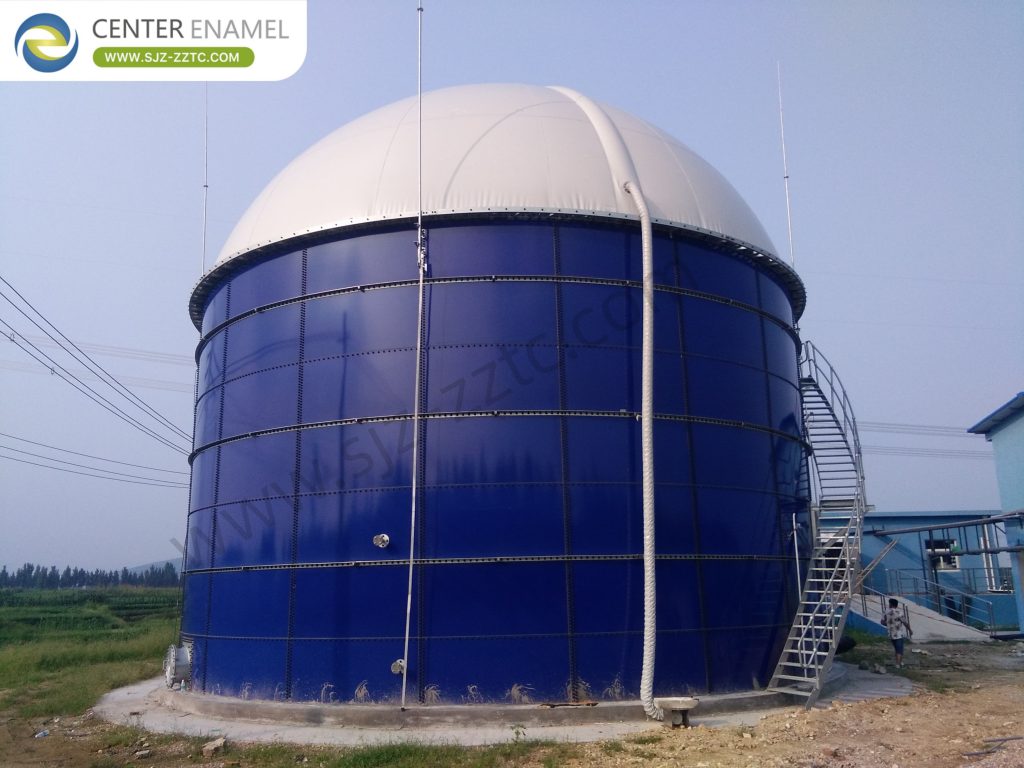
Specifically designed for high-concentration palm oil wastewater treatment with 3 GFS fermentation tanks, each 19.86 m diameter × 8.4 m height. Installation began November 2009 with only 7 construction personnel, completing all tank assembly in 40 days-highly efficient and time-saving. Tanks are fitted with dual-membrane gas storage covers for POME anaerobic digestion-degrading organics and recovering biogas energy while eliminating palm industry pollution. This is an early benchmark POME biogas treatment project in Southeast Asia.
Real-world international implementations consistently demonstrate how modular engineering transforms complex environmental initiatives. Translating a conceptual Biogas Plant Design into an operational masterpiece requires seamless component coordination and rapid assembly. Deploying prefabricated GFS Tanks drastically shortens construction schedules while ensuring top-tier structural integrity in challenging tropical climates.
Center Enamel's Global Market Presence
Center Enamel's global business covers over 100 countries and regions, with 30,000+ successful overseas projects. Products are exported to all major regions including Europe, the Americas, the Middle East, Africa, Southeast Asia, and Latin America, with a well-established global localized service network.
Domestically, the company is organized into North, South, Central, East, and Southwest marketing regions, covering environmental, water utility, livestock, and petrochemical customers nationwide. Internationally, the company adopts a "standardized products + localized adaptation" model-adjusting tank corrosion protection, sealing, and pressure standards for different national water quality and environmental regulations-with multiple global landmark projects: large-volume GFS tanks in Italy, 20 m tower water supply tanks in Colombia, coastal seawater treatment tanks in Costa Rica, large municipal wastewater aluminum dome projects in Saudi Arabia, etc. The company has established long-term stable strategic partnerships with many Fortune 500 companies.
Establishing a robust international footprint requires a delicate balance of standardized manufacturing and precise regional adaptation. A world-class Biogas Plant Design must comply with diverse local environmental regulations and water quality standards. Backed by decades of global expertise, Center Enamel continues to deliver premier solutions across more than 100 countries.
Flexible and Efficient Service Delivery System
Center Enamel's own cross-border construction teams + global localized agent network-modular GFS tank assembly with short construction periods and dismantlable/reusable capability-suitable for overseas short-term projects, phased expansions, and relocation needs-full-lifecycle after-sales O&M support ensuring long-term stable client operations.
Streamlining field deployment through agile service structures eliminates unnecessary project delays and coordination hurdles. Incorporating a flexible service delivery framework into a comprehensive Biogas Plant Design ensures seamless execution from logistics to commissioning. Furthermore, utilizing modular GFS Tanks empowers operators with unmatched scalability and dismantlable adaptability for future facility expansions.
Aluminum Alloy Trough Deck Roof
Aluminum Alloy Trough Deck Roof is a cost-effective economical tank cover solution for clean water and wastewater storage scenarios, primarily designed for drinking water, production wastewater, and firewater reserve tanks, balancing practicality and cost advantages. The main body is integrally formed from anti-corrosion aluminum alloy plates, paired with aluminum support trusses. Its lightweight design imposes less load on the tank foundation, reducing civil construction investment. A naturally formed dense oxide protective layer on the surface resists rain and mild wastewater corrosion, withstands outdoor sun and rain exposure, and effectively blocks wind, rain, insects, fallen leaves, and odor volatilization, protecting water quality by preventing dust and debris from falling in and causing secondary contamination.
The flat roof structure is neat and orderly, allowing installation of maintenance walkways, guardrails, vents, and level monitoring ports on top, facilitating daily inspection and equipment maintenance. The simple sealing structure enables straightforward installation with short construction timelines, and virtually eliminates the need for anti-corrosion painting maintenance, resulting in extremely low operational costs. It is suitable for various small, medium, and large atmospheric pressure water storage tanks, and has been widely implemented in waterworks clear water tanks, industrial circulating water tanks, park firewater tanks, and domestic wastewater temporary storage facilities. It is highly compatible with water storage applications that do not require biogas collection or high-pressure sealing.
Securing the upper structure of containment systems with specialized protective covers ensures complete environmental control and safety. High-quality roofing solutions complement the durability of underlying GFS Tanks by preventing secondary contamination and weather ingress. Ultimately, attention to every structural detail guarantees the long-term reliability of the entire CSTR Process ecosystem.