
Professional Biogas Plant Design Integrating High-Performance GFS Tanks for Anaerobic Digestion
The core challenges of industrial wastewater treatment center on the "three highs"-high difficulty, high cost, and high energy consumption. Wastewater from new energy, chemical, and pharmaceutical industries is complex in composition with numerous characteristic pollutants, and traditional treatment processes are difficult to remove effectively. Chinese companies have significant price advantages in the mid-to-low-end equipment segment. The industry also faces continuous technological upgrade pressure from increasingly stringent emission standards, as well as new requirements for digitalization and low-carbon transformation on operational refinement management capabilities.
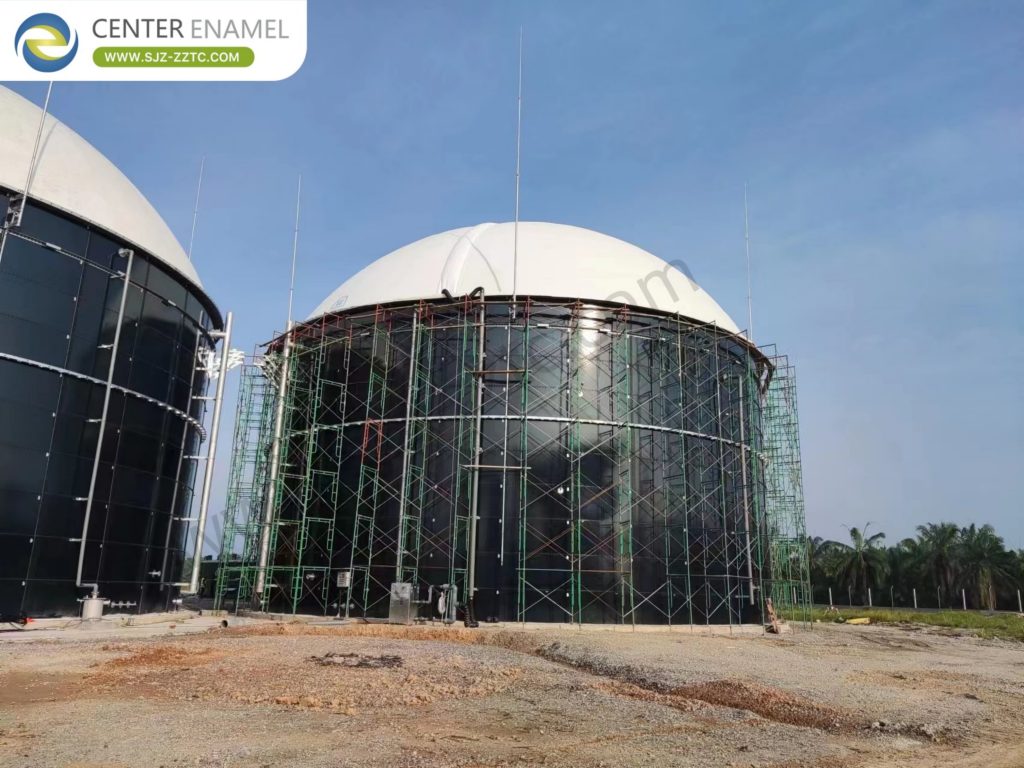
Addressing these multifaceted challenges requires a holistic approach that combines robust infrastructure with intelligent process design. This is where professional Biogas Plant Design becomes essential-integrating durable GFS Tanks with advanced anaerobic treatment technologies to achieve both regulatory compliance and energy recovery. By converting organic pollutants into biogas, facilities can offset operational costs while reducing their environmental footprint.
GFS Tanks Engineered for Modern Intensive Plant Layouts
GFS tanks offer flexible customization of size and appearance, with higher land utilization rates, ideally suited for modern compact plant layouts, with significant advantages over fixed poured concrete tanks. Concrete tanks cannot alter volume or shape after pouring, with heavy bases occupying large areas, making placement difficult on narrow or irregular plots. Their rough, uniform appearance cannot match modern facility aesthetic requirements.
GFS tank volume can be precisely customized as needed, with capacities ranging from dozens of cubic meters to 50,000 cubic meters freely selectable. Tank height and diameter can be flexibly combined to fit narrow or irregularly shaped plots, effectively saving plant land occupation. Enamel color customization is also supported, achieving visual harmony with plant buildings and environmental facilities. During later plant expansion, GFS tanks can be directly adjusted in layout and expanded; concrete tanks, being monolithic structures, must be demolished and rebuilt, offering less flexibility in land resource utilization. This aligns well with the intensive construction and aesthetic operation and maintenance needs of industrial parks .
The modular nature of GFS Tanks also supports phased Biogas Plant Design, allowing facilities to expand treatment capacity incrementally as production grows. This adaptability is particularly valuable for industries with seasonal production patterns, where wastewater volumes fluctuate significantly throughout the year.
Understanding the UASB Process for High-Efficiency Treatment
UASB, or Upflow Anaerobic Sludge Blanket Reactor, is the benchmark mainstream technology for medium-to-high concentration soluble organic wastewater treatment. It requires no mechanical mixing or media carriers, relying on the upward flow of wastewater to suspend and expand granular sludge within the reactor, forming a stable sludge bed layer. Highly active anaerobic granular sludge efficiently degrades pollutants, with excellent settleability and high microbial concentration. UASB innovatively integrates reaction, sedimentation, and gas-liquid-solid separation functions, simplifying the anaerobic treatment process with advantages of high efficiency, energy savings, and compactness. It is widely used in various medium-to-high concentration soluble organic wastewater treatment applications .
The UASB process serves as the biological core of many biogas plant designs, transforming high-COD wastewater into methane-rich biogas while producing minimal sludge. When housed within durable GFS Tanks, UASB reactors benefit from the inert glass surface that prevents bacterial adhesion and corrosion, ensuring stable long-term operation . The integrated design of the UASB also contributes to overall plant efficiency by reducing the need for multiple separate treatment units.
Brewery Wastewater Sources and Treatment Considerations
Brewery wastewater is high-concentration organic wastewater from the entire production process of beer, liquor, and wine-a high-volume wastewater type in the food industry. Key pollution stages include raw material soaking/washing, saccharification/fermentation, distillation/purification, and filling/packaging. Major wastewater streams include still bottoms, fermentation yellow water, spent mash, and raw material soaking wastewater. Auxiliary discharges include equipment/pipeline washing, floor cleaning, production line maintenance, and cooling water. Discharge has significant intermittency and seasonality-high volume during peak production seasons, reduced during off-seasons. Large breweries have unified collection systems; small and medium-sized facilities have more dispersed collection with prominent uncontrolled discharge issues, concentrated in brewing facility areas .
Given these characteristics, brewery wastewater is ideally suited for treatment via the UASB Process within robust GFS Tanks. The high organic content that would otherwise cause environmental damage can be effectively converted into biogas for plant heating and power generation. Professional Biogas Plant Design for breweries must account for the variable flow rates and organic loading, ensuring that the UASB reactor and associated GFS Tanks are sized appropriately for peak production periods .
Center Enamel's Three Decades of Industry Leadership
Center Enamel has been deeply engaged in the environmental bolted storage equipment field for over 30 years. Starting with proprietary enamel anti-corrosion material technology, the company has gradually completed the full-industry-chain upgrade from a single tank manufacturer to a comprehensive environmental EPC service provider. Throughout its 30+ year history, the company has been recognized as a National High-Tech Enterprise, National Specialized and Sophisticated "Little Giant," Manufacturing Single Champion, and Provincial Green Factory. It has successfully delivered over 30,000 environmental projects globally, establishing itself as a leading enterprise in the global GFS tank storage industry. The company has fully integrated the entire chain from enamel frit R&D, intelligent environmental equipment manufacturing, to EPC project contracting-every business breakthrough has been achieved through proprietary core anti-corrosion technology .
This extensive experience directly informs every Biogas Plant Design delivered by Center Enamel. By combining over three decades of material science expertise with practical project execution across more than 100 countries, the company ensures that each GFS Tank installation meets the highest international standards for durability and performance . The proprietary enamel formulations developed through years of research provide the corrosion resistance essential for long-term anaerobic digestion applications.
Research and Development Excellence in Tank Technology
Center Enamel has built a full-chain professional team covering R&D, design, marketing, installation, and after-sales. The R&D team is led by national-level materials technology experts, specializing in enamel frit and tank anti-corrosion core technologies. External senior environmental engineering and mechanical structure engineers are retained to strengthen R&D capabilities, focusing on anti-corrosion coating formulations, specialty corrosion-resistant tanks, and anaerobic supporting integrated equipment-continuously breaking through industry technological barriers.
The team operates through proprietary laboratories with external university research collaboration-conducting year-round new material and new process durability pilot testing and long-term corrosion simulation testing. Specialized enamel formulations are iteratively developed for extreme conditions such as high-salinity wastewater, strong acid/alkali POME, and high-organic livestock manure-providing core technical support for the company's annual new invention and utility patents-building a proprietary material technology barrier .
This ongoing research and development ensures that GFS Tanks used in Biogas Plant Design continuously improve in terms of corrosion resistance, structural integrity, and operational lifespan. The company's nearly 200 enameling patents provide a technological moat, enabling customized tank solutions for the most challenging industrial wastewater applications .
Aluminum Geodesic Dome Roofs for Superior Tank Coverage
Aluminum Geodesic Dome Roof independently developed by Center Enamel is manufactured using high-strength aluminum alloy plates through integral stamping. It features a triangular grid spherical self-supporting structure, enabling large-span full coverage without internal support columns. Made of aluminum alloy, the roof offers excellent weather resistance and corrosion resistance, capable of long-term protection against acid rain, salt spray, and UV radiation, suitable for various extreme outdoor climate conditions. The structural design complies with international AWWA D108 standards, with aluminum plate thickness, rib cross-sections, and joint connections all verified by finite element stress analysis, ensuring wind and snow load resistance that meets building code requirements across different global regions.
The weight of the Aluminum Geodesic Dome Roof is only one-third to one-half of a steel roof with the same span, significantly reducing the load on the tank top and allowing direct installation without tank wall reinforcement. The roof provides superior overall sealing performance, with double sealing between panels using specialized sealant strips and mechanical interlocking, enabling both airtight gas storage and enclosed odor control, suitable for biogas collection and storage, wastewater tank odor control, and drinking water contamination prevention. The support-column-free design does not interfere with the installation and operation of internal equipment such as mixers and water distributors. The aluminum material does not support microbial growth, requiring no anti-corrosion maintenance over long-term use, resulting in low total life-cycle costs .
Integrating Aluminum Geodesic Dome Roofs with GFS Tanks completes a comprehensive Biogas Plant Design that addresses both liquid containment and gas capture. These roofs are particularly valuable for biogas applications where gas-tight sealing is essential for methane collection and odor control . The ability to install these roofs without internal supports maximizes usable tank volume and simplifies maintenance access.
Frequently Asked Questions (FAQ)
Q1: What makes Center Enamel a leading Biogas Plant Design provider with GFS Tanks?
A: Center Enamel combines over 30 years of experience with proprietary GFS tank technology and comprehensive EPC capabilities. The company has delivered more than 30,000 environmental projects globally, holding nearly 200 patents and international certifications including NSF, AWWA D103, CE, and ISO 9001 .
Q2: Which industries benefit most from Biogas Plant Design integrating GFS Tanks and UASB reactors?
A: Industries generating high-strength organic wastewater-including breweries, food processing, sugar refining, papermaking, palm oil mills, and livestock operations-benefit significantly. The combination of GFS Tanks and UASB technology efficiently treats COD while recovering biogas for energy offset .
Q3: How long do Center Enamel's GFS Tanks last in biogas and anaerobic digestion applications?
A: Center Enamel's GFS Tanks are engineered for a minimum service life of 30 years under normal operating conditions. The glass-fused-to-steel coating, fired at 820°C-930°C, provides exceptional resistance to H₂S corrosion, microbial-induced corrosion (MIC), and chemical attack common in anaerobic digesters .