
Global Biogas Plant Design Solutions: GFS Tanks for Industrial Wastewater Treatment
The Asia-Pacific region leads global industrial wastewater treatment, with markets shifting from construction to long-term operational management across North America, Europe, and the Middle East. This dynamic landscape demands robust infrastructure for biogas plant design that integrates corrosion-resistant GFS tanks with proven anaerobic treatment processes. Center Enamel delivers complete solutions for industrial wastewater treatment-from UASB reactors to biogas recovery systems-with 30+ years of durability, rapid installation, and full EPC capabilities across 100+ countries.
Industrial Wastewater Regional Development Status
The Asia-Pacific region, particularly China, has become the world's largest industrial wastewater treatment market, with the operation and maintenance service segment's contribution continuing to rise-marking a shift from project construction to long-term operational management. The North American market focuses on upgrading existing facilities, while Europe emphasizes high-value-added resource recovery technologies. The Middle East has strong demand for advanced treatment and reuse of industrial wastewater due to water scarcity; manufacturing transfer in Southeast Asia drives local industrial wastewater treatment facility construction demand.
Wastewater from the new energy industry chain (lithium batteries, photovoltaics, hydrogen) has become the most notable emerging growth area due to its complex composition and high treatment difficulty, generating significant demand for customized solutions. The maturity of third-party treatment models in industrial parks continues to improve, driving consolidation in the professional operation market. These regional variations underscore the importance of flexible biogas plant design that can adapt to local regulations, climates, and wastewater characteristics.
For breweries and palm oil mills, the need for reliable industrial wastewater treatment is amplified by high organic loads and seasonal discharge patterns. Center Enamel's GFS tanks provide the corrosion resistance and gas-tight integrity essential for anaerobic digestion systems, regardless of location.
UASB Applicable Scenarios: Matching Process to Wastewater
The UASB process is suitable for soluble medium-to-high concentration organic wastewater, covering light industrial wastewater from brewing, sugar refining, starch, papermaking, food processing, printing and dyeing, and similar applications. It is ideal for wastewater where organics are predominantly soluble with low suspended solids content, but not suitable for high-solids, high-viscosity wastewater.
The UASB can be used alone as the primary treatment process or as a pretreatment for high-strength wastewater to reduce downstream aerobic load. It is also suitable for municipal wastewater anaerobic pretreatment and low-solids livestock wastewater treatment. With its low cost and stable operation advantages, the UASB is well-suited for long-term continuous, large-flow industrial wastewater treatment projects.
For any biogas plant design involving food processing or beverage manufacturing, the UASB process offers particular advantages-achieving 90–94% COD removal while producing biogas that can offset energy costs. Center Enamel integrates this proven technology with GFS tank manufacturing to deliver complete, reliable anaerobic digestion systems.
Operation and Maintenance Cost Analysis
O&M costs for anaerobic treatment systems are moderate to low, with stable controllable processes and significant resource recovery benefits offsetting expenses-resulting in good overall economics. The treatment system uses simple durable equipment with no high-end precision wear parts-leading to low failure rates and minimal maintenance costs. Excellent wastewater biodegradability requires no large quantities of oxidants or detoxification agents-only small amounts of flocculants and pH adjusters, keeping chemical costs low.
Stable biogas production from anaerobic digestion can be used directly for plant heating and equipment insulation, significantly reducing energy costs. Only during peak season with high load fluctuations is process parameter adjustment needed-labor requirements remain low. Spent grain, digestate solids, and liquid fertilizer can be sold, further improving economics.
For industrial facilities evaluating biogas plant design options, these operational economics often make anaerobic digestion the most cost-effective approach over the long term. Center Enamel's GFS tanks contribute to these savings through their 30+ year service life and minimal maintenance requirements, delivering superior lifecycle value compared to concrete alternatives.
Indonesia Palm Oil Biogas Upgrade Project: A Proven Benchmark
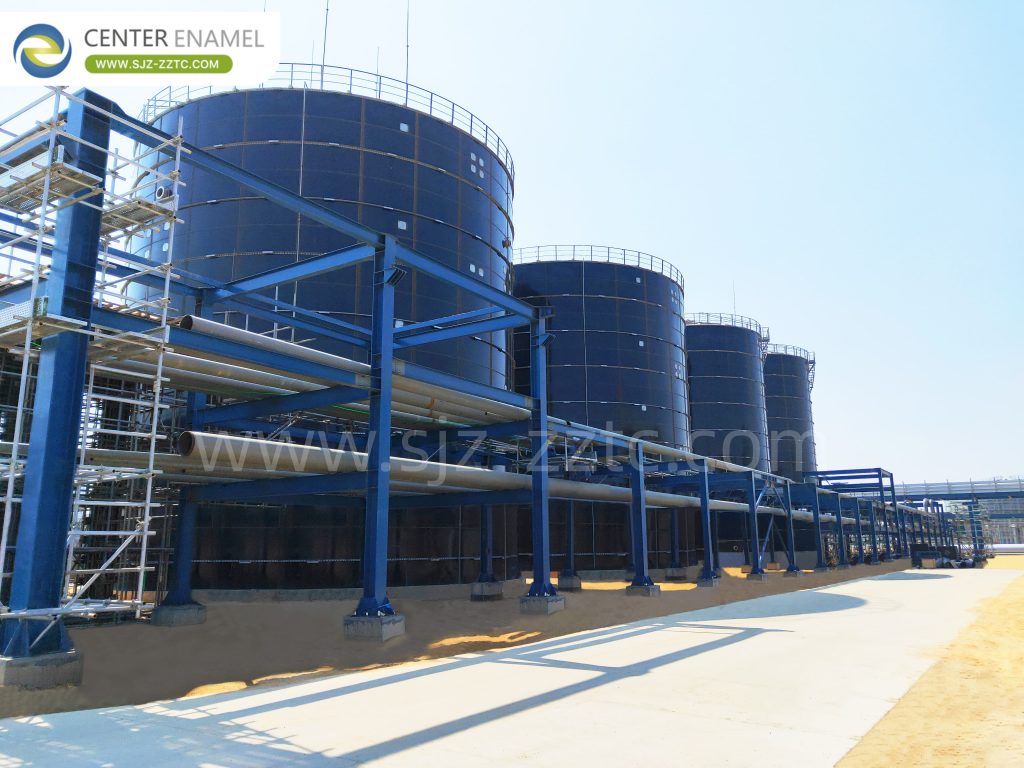
The Indonesia Palm Oil Biogas Upgrade Project, commissioned in 2013, demonstrates the successful application of GFS tank technology for challenging industrial wastewater treatment applications. The project utilized three GFS tanks serving as the core anaerobic digestion reactor for the POME treatment station, with two sizes: 17.58 m diameter × 8.4 m height and 16.82 m diameter × 7.2 m height.
The tanks serve as the core anaerobic reaction equipment specifically designed for high-organic palm oil production wastewater-anaerobic digestion degrades pollutants and recovers biogas. GFS tank assembly proved convenient with corrosion resistance performing exceptionally well in Southeast Asia's hot, humid, high-corrosion environment. This project stands as a mature biomass energy environmental benchmark, demonstrating the viability of GFS-based biogas plant design in challenging tropical conditions.
For breweries and food processors considering similar treatment infrastructure, this project validates the technology's applicability across diverse waste streams. The success in Indonesia confirms that Center Enamel's GFS tanks deliver reliable performance regardless of climate or wastewater aggressiveness.
Center Enamel's Global Market Presence
Center Enamel's global business covers over 100 countries and regions, with 30,000+ successful overseas projects. Products are exported to all major regions including Europe, the Americas, the Middle East, Africa, Southeast Asia, and Latin America, with a well-established global localized service network. Domestically, the company is organized into North, South, Central, East, and Southwest marketing regions, covering environmental, water utility, livestock, and petrochemical customers nationwide.
Internationally, the company adopts a "standardized products + localized adaptation" model-adjusting tank corrosion protection, sealing, and pressure standards for different national water quality and environmental regulations. Multiple global landmark projects demonstrate this capability: large-volume GFS tanks in Italy, 20 m tower water supply tanks in Colombia, coastal seawater treatment tanks in Costa Rica, and large municipal wastewater aluminum dome projects in Saudi Arabia. The company has established long-term stable strategic partnerships with many Fortune 500 companies.
For any industrial wastewater treatment project requiring international standards compliance, Center Enamel's global presence ensures access to proven solutions that meet local regulations while maintaining consistent quality across all project locations.
Flexible and Efficient Service Delivery System
Center Enamel's own cross-border construction teams plus global localized agent network enable rapid project execution. Modular GFS tank assembly with short construction periods and dismantlable/reusable capability makes these systems suitable for overseas short-term projects, phased expansions, and relocation needs. Full-lifecycle after-sales O&M support ensures long-term stable client operations.
This service delivery model is particularly valuable for biogas plant design in remote or logistically challenging locations. The modular nature of GFS tanks reduces on-site construction time and labor costs compared to cast-in-place concrete, while the ability to dismantle and relocate provides flexibility for evolving production requirements.
Aluminum Alloy Trough Deck Roof Solution
The Aluminum Alloy Trough Deck Roof is a cost-effective economical tank cover solution for clean water and wastewater storage scenarios, primarily designed for drinking water, production wastewater, and firewater reserve tanks, balancing practicality and cost advantages. The main body is integrally formed from anti-corrosion aluminum alloy plates, paired with aluminum support trusses. Its lightweight design imposes less load on the tank foundation, reducing civil construction investment.
A naturally formed dense oxide protective layer on the surface resists rain and mild wastewater corrosion, withstands outdoor sun and rain exposure, and effectively blocks wind, rain, insects, fallen leaves, and odor volatilization-protecting water quality by preventing dust and debris contamination. The flat roof structure allows installation of maintenance walkways, guardrails, vents, and level monitoring ports on top, facilitating daily inspection and equipment maintenance.
The simple sealing structure enables straightforward installation with short construction timelines, virtually eliminating anti-corrosion painting maintenance and resulting in extremely low operational costs. It is suitable for various small, medium, and large atmospheric pressure water storage tanks, and has been widely implemented in waterworks clear water tanks, industrial circulating water tanks, park firewater tanks, and domestic wastewater temporary storage facilities. It is highly compatible with water storage applications that do not require biogas collection or high-pressure sealing.
FAQs
Q1: What factors are critical for successful biogas plant design in industrial wastewater treatment?
Critical factors include matching the anaerobic process (UASB, EGSB, or CSTR) to wastewater characteristics, selecting corrosion-resistant GFS tanks for long-term durability, ensuring gas-tight containment for maximum methane recovery, and integrating biogas utilization systems (CHP, boiler, or upgrading) that align with site energy demands.
Q2: How do GFS tanks improve biogas plant economics?
GFS tanks provide 30+ years of corrosion resistance with no internal lining repairs, significantly reducing lifecycle maintenance costs. They install 3x faster than concrete tanks, lowering construction costs, and their gas-tight design maximizes biogas capture-improving energy recovery and accelerating project payback.
Q3: What are the key advantages of UASB-based industrial wastewater treatment compared to aerobic systems?
UASB systems require no mechanical mixing (saving energy), produce 70-80% less sludge (reducing disposal costs), and generate biogas as a revenue stream. They handle organic loads 5-10x higher than aerobic systems with 10-20% of the footprint, making them ideal for high-strength industrial wastewater.