
How an EPC Contractor Handles Biogas Plant Digestate Projects
The global biogas industry is in a phase of large-scale expansion, with China contributing the major share of new capacity and becoming the fastest-growing single market. Europe's mainstream model focuses on combined heat and power (CHP) and biomethane grid injection, with active biomethane certificate trading and application scenarios covering power generation, heating, and transportation fuel. China, in contrast, emphasizes vehicle fuel and industrial heating while actively promoting the fertilizer utilization of digestate, showing significant differentiation in application scenarios. Southeast Asian emerging markets show rapidly growing food waste treatment demand, becoming key areas for global companies, while African and Latin American markets remain in the early stages, primarily relying on low-cost direct application models. Countries show differentiated development paths in biogas resource utilization: Europe focuses on energy output, China emphasizes comprehensive utilization, and emerging markets prioritize pollution control.
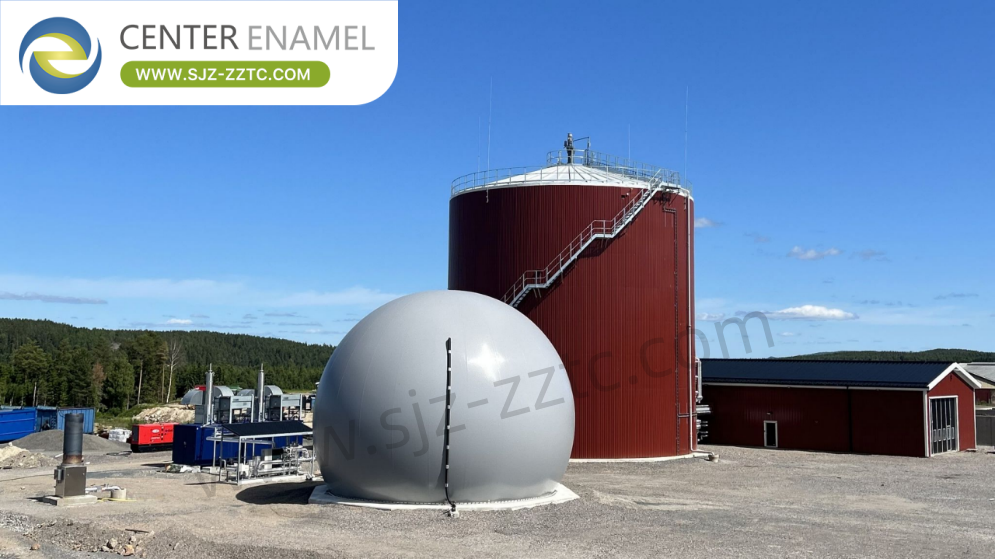
Delivering projects across such divergent markets requires more than equipment supply. It demands an EPC Contractor capable of integrating tank engineering, biological process design, and local compliance into a single accountable scope. The following sections outline how Center Enamel applies this integrated approach-from corrosion-resistant GFS tanks to the USR Process and membrane roof solutions.
Why GFS Tanks Outperform Traditional Concrete in Corrosion Resistance
Center Enamel's independently developed double-sided double-layer enameling technology is the industry's leading coating anti-corrosion technology, with corrosion resistance completely surpassing concrete tanks. Concrete tank interiors are riddled with pores, allowing wastewater and acid/alkaline media to easily penetrate and corrode the structural layer. Long-term use leads to irreversible problems such as internal wall spalling, water seepage, and rebar corrosion, which are difficult to repair and cannot be fundamentally resolved.
GFS tanks feature high-temperature enameling on both the interior and exterior surfaces of steel panels, with a dense, non-porous enamel finish that completely blocks corrosive liquids and biogas permeation. The enamel layer has extremely strong chemical stability, resisting acids, alkalis, salts, and microbial corrosion. Concrete tanks will develop extensive corrosion and leakage after 5–8 years of use, while GFS tank anti-corrosion service life can exceed 30 years, with no need for frequent internal lining repairs throughout the service life, significantly reducing long-term anti-corrosion maintenance investment and fundamentally eliminating environmental risks of medium leakage contaminating sites and groundwater. Compared to traditional concrete and FRP tanks, GFS tank coatings have no risk of peeling or blistering, and are adaptable to highly corrosive conditions such as palm oil mill effluent, livestock manure, and chemical high-salinity wastewater, with outstanding long-term comprehensive cost advantages.
| Comparison Factor | Traditional Concrete Tanks | Center Enamel GFS Tanks |
| Anti-corrosion service life | 5–8 years before major degradation | Exceeding 30 years |
| Surface structure | Highly porous; prone to penetration | Dense, non-porous enamel finish |
| Maintenance requirement | Frequent lining repairs | No internal lining repairs needed |
| Chemical resistance | Limited; degrades with acids/alkalis | Resists acids, alkalis, salts, microbial corrosion |
| Leakage risk | High after 5–8 years | Negligible |
| Adaptability | Poor for high-salinity/high-corrosion media | Excellent for POME, manure, chemical wastewater |
USR Supporting Equipment: Built for High-Solids Reliability
Core equipment for the USR Process is the GFS tank with no complex media or precision three-phase separators, featuring a rugged clog-resistant structure. The bottom large-diameter anti-clogging distribution system is suitable for high-solids wastewater, preventing pipe clogging. Supporting equipment includes influent lift pumps, simple pretreatment screens, and equalization tanks for impurity removal and water quality balancing. Simple top gas collection devices and biogas conveying/desulfurization equipment enable biogas resource recovery. Temperature, level, and pH online monitoring equipment ensures process stability. Bottom large-diameter sludge discharge pipes and pumps allow rapid removal of high-concentration residual sludge, suitable for high-solids conditions. The complete system has extremely low failure rates, outstanding wear and clog resistance, and is far easier to maintain than conventional anaerobic processes.
| USR Supporting Equipment | Function |
| GFS tank (core) | Rugged, clog-resistant reactor body |
| Bottom distribution system | Large-diameter anti-clogging feed distribution |
| Influent lift pumps | Feedwater conveyance |
| Pretreatment screens & equalization tanks | Impurity removal and water quality balancing |
| Top gas collection & desulfurization | Biogas recovery and conditioning |
| Online monitoring | Temperature, level, and pH control |
| Bottom sludge discharge pipes & pumps | Rapid residual sludge removal |
Digestate Pollutant Toxicity: Low Risk, High Environmental Compatibility
Overall high safety, very low toxicity, controllable ecological risks, and no high-risk pollution hazards. All pollutants are natural fermentation residues from organic materials, containing no heavy metals, synthetic toxins, bacteriostats, or persistent organics-no inhibition or toxicity to microorganisms, plants, or animals. The anaerobic environment completely inactivates pathogenic microorganisms-no biological pollution or disease transmission risks. Humic acids and trace elements are beneficial ecological substances, improving soil quality when properly applied to farmland. Only long-term excessive discharge can cause nitrogen/phosphorus enrichment, algal blooms, and nutrient accumulation in soil-no acute toxicity, chronic accumulation, or carcinogenic/teratogenic/mutagenic risks, with excellent environmental compatibility.
| Toxicity Assessment Factor | Finding |
| Heavy metals / synthetic toxins | None present |
| Persistent organics / bacteriostats | None present |
| Pathogenic microorganisms | Inactivated by anaerobic environment |
| Beneficial substances | Humic acids and trace elements improve soil |
| Risk profile | No acute toxicity, chronic accumulation, or carcinogenic/teratogenic/mutagenic risks |
| Only concern | Long-term excessive discharge causing nitrogen/phosphorus enrichment |
Global Integrated Standardized Service System
Leveraging regional sales centers in China and overseas local agent networks, Center Enamel has established a complete after-sales service loop covering all markets. The system provides four core service pillars: 24/7 rapid response mechanism, on-site domestic/overseas installation services, full-project-cycle after-sales support, and long-term warranty protection-forming a complete service chain from preliminary site survey, mid-term construction management, to long-term inspection and maintenance. The entire system is uniformly adapted to both domestic and international project service standards, coordinating personnel scheduling, material support, and on-site coordination for simultaneous projects across multiple regions-significantly reducing customer multi-party coordination costs and ensuring efficient domestic and overseas project delivery as a single EPC Contractor.
Comprehensive International Authoritative Certifications
Center Enamel holds CE, NSF, WRAS, ISO9001, BSCI, ASME, and other global certifications-fully clearing EU, North American, Southeast Asian, and African project tendering barriers-providing critical hard credential advantages for large overseas project bidding.
Single and Double Membrane Roof Cover Solutions
Single and Double Membrane Roofs are proprietary airtight tank cover systems for anaerobic digestion and biogas storage projects, specifically developed for biogas collection and odor containment, representing a benchmark lightweight sealing solution for fermentation tanks. The single-layer membrane roof features a simple structure with economical cost, meeting basic biogas containment needs. The double-layer membrane roof consists of inner and outer corrosion-resistant membrane materials, with pressurized air in the interlayer forming rigid support, providing outstanding thermal insulation that reduces biogas condensate formation inside the tank, with enhanced wind and snow load resistance suitable for high-altitude and windy outdoor sites.
The membrane material is specialized aging-resistant and biogas-slurry-corrosion-resistant PVDF membrane, which will not leak or degrade from long-term contact with biogas or hydrogen sulfide. The flexible structure accommodates tank settlement and slight deformation without cracking or gas leakage. The lightweight design eliminates heavy steel support trusses, significantly reducing the load on the tank and foundation, saving construction costs. The roof integrates biogas outlets, safety pressure relief valves, and access channels, fully enabling closed gas collection for anaerobic fermentation tanks, recovering biogas for power generation and heating while blocking odor diffusion to meet environmental odor control requirements. It is widely used in large-scale livestock biogas projects, municipal sludge anaerobic digestion, and food waste fermentation projects, compatible with large-volume glass-fused-to-steel anaerobic tanks, with fast construction and simple maintenance requiring only periodic membrane seal integrity checks, offering significant overall engineering advantages.
| Membrane Roof Type | Key Features | Best Application |
| Single-layer | Simple structure, economical cost, basic biogas containment | Standard fermentation tanks |
| Double-layer | Inner + outer corrosion-resistant membranes, pressurized interlayer, thermal insulation, wind/snow resistance | High-altitude, windy outdoor sites |
Frequently Asked Questions
What does an EPC Contractor handle in a biogas plant project?
An EPC Contractor manages the full scope: design, equipment manufacturing, installation, commissioning, and handover. Center Enamel integrates GFS tanks, USR Process systems, membrane roofs, and after-sales service under one accountable contract.
How does the USR Process support equipment reduce maintenance?
USR supporting equipment uses large-diameter anti-clogging distribution and sludge discharge systems, eliminating precision three-phase separators. This rugged design delivers extremely low failure rates and far easier maintenance than conventional anaerobic processes.
Are digestate pollutants hazardous to the environment?
Digestate pollutants are natural fermentation residues with no heavy metals, synthetic toxins, or persistent organics. Pathogens are inactivated anaerobically. Only long-term excessive discharge risks nitrogen/phosphorus enrichment-no acute toxicity or carcinogenic risks.
Looking for a reliable EPC Contractor to deliver your next biogas plant? Contact us today-our team will provide a complete USR Process and membrane roof solution tailored to your project.