
Biogas Plant Project Design: Solving Livestock Manure Challenges with GFS Tanks and UASB Process
This article addresses core challenges in livestock manure management-decentralized generation versus centralized treatment, digestate utilization barriers, and economic constraints-and presents integrated technical solutions. It details bolted GFS tanks advantages over concrete, the UASB Process reaction mechanism, livestock wastewater characteristics, and Center Enamel's smart manufacturing and design capabilities. The discussion emphasizes how professional Biogas Plant Project Design combines modular storage, efficient anaerobic digestion, and customized structural engineering to overcome industry obstacles. With over 30,000 projects globally, the content showcases the company's comprehensive capabilities-from proprietary material technology to full-process quality control-ensuring compliant, durable, and cost-effective biogas plants for diverse international markets.
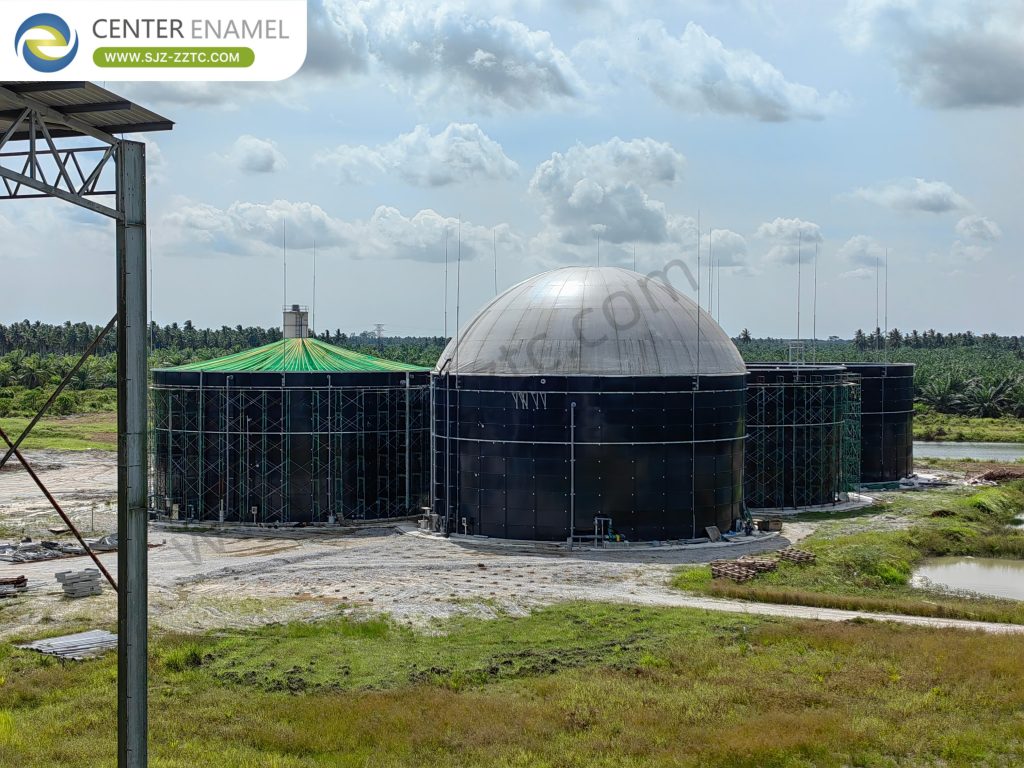
Core Industry Challenges in Livestock Manure Management
The core dilemma of livestock manure treatment lies in the structural contradiction of "decentralized generation vs. centralized treatment." Manure generation surges during intensification, but supporting treatment facilities lag behind. Digestate resource utilization channels are obstructed, with safety risks from heavy metal and antibiotic residues constraining farmland application. At the enforcement level, farmers' environmental awareness varies, with illegal discharges occurring frequently; at the policy level, subsidies and incentives are insufficient to effectively drive voluntary compliance. Biogas grid connection difficulties and limited digestate transport radius further compress the economic viability of resource utilization.
These persistent challenges underscore the need for professionally engineered systems. A well-executed Biogas Plant Project Design addresses these pain points by integrating robust GFS tanks for storage and the UASB Process for efficient digestion-creating a compliant, economically viable treatment train that bridges the gap between waste generation and resource recovery.
GFS Tanks – Bolted Assembly Construction Advantages
GFS tanks are assembled on-site from prefabricated panels, with short construction periods and support for expansion, relocation, and reuse-advantages distinctly different from immovable concrete tanks. Concrete tank pouring requires formwork, rebar tying, pouring, and long curing periods, with a single tank construction taking months. Rain, snow, and low temperatures force work stoppages and delays. Once poured, they are permanent fixed structures that cannot be dismantled, expanded, or relocated-project relocation means complete abandonment.
GFS tank panels are all factory-prefabricated, transported to site, and directly assembled in panels with simple procedures. Construction can proceed even in low-temperature, light-rain conditions, with installation time only one-third that of concrete tanks-construction schedules are controllable. For expansion, additional steel panels can be installed to increase volume; for plant relocation, tanks can be fully disassembled with panels transported to new sites for reassembly and reuse, significantly reducing material and construction costs for new construction and reconstruction. This is ideally suited for short-term environmental projects, phased expansion projects, and relocated construction projects.
For any Biogas Plant Project Design, this modularity translates into schedule certainty and future adaptability. When GFS tanks are specified, clients gain the flexibility to scale operations or relocate facilities without stranded asset risk-a critical advantage in evolving regulatory and market environments.
Reaction Mechanism and Flow of UASB Process
After pretreatment through screens and equalization tanks to remove impurities and balance water quality and flow, wastewater is uniformly fed into the reactor through the bottom distribution system. The wastewater rises at a constant rate through the high-concentration granular sludge bed at the bottom, where anaerobic microorganisms rapidly degrade most organic matter, converting it into biogas, clean water, and a small amount of sludge. Gentle hydraulic mixing maintains sludge suspension, expanding microbial contact area. Remaining pollutants continue to degrade in the mid-section suspended sludge layer, with the mixed liquor finally entering the top three-phase separator for gas, solid, and liquid separation. Biogas is collected upward for utilization, sludge settles back to the reaction zone, treated effluent overflows from the top, and aged sludge is periodically discharged-fully automated continuous operation.
The UASB Process is a cornerstone of modern Biogas Project Design, offering high efficiency with minimal mechanical complexity. When integrated with GFS tanks for feed storage and digestate holding, this combination delivers a compact, energy-positive treatment solution ideal for livestock and agro-industrial applications.
Livestock Wastewater – Key Water Quality Characteristics
Typical high-concentration organic wastewater with "four highs"-high COD, high ammonia nitrogen, high total phosphorus, and high suspended solids-very high pollution load. Livestock wastewater COD can exceed 8,000 mg/L, with high turbidity and suspended solids. Nitrogen and phosphorus levels far exceed discharge standards, being the primary cause of eutrophication. Wastewater is rich in manure, feed residues, and metabolic waste, readily turning black and odorous. Water quality fluctuates significantly with production cycles, seasons, and washing frequency. Aquaculture wastewater has lower pollutant concentrations but significant nitrogen/phosphorus accumulation issues, causing algal blooms and water quality deterioration with long-term discharge.
Understanding these characteristics is fundamental to effective Biogas Project Design. The high organic strength makes it ideally suited for the UASB Process, while the variability demands robust GFS tanks for equalization and storage-ensuring stable feed conditions for optimal biogas production.
Center Enamel's Smart Manufacturing Base Scale
Center Enamel's core intelligent manufacturing base is located in Hebei Province, China, covering a total area of over 150,000 m², with Phase I mature manufacturing facility and Phase II high-end environmental equipment industrial park-dual-base synergy ensures stable production capacity. The base includes dedicated R&D office buildings, proprietary material laboratories, and finished product testing centers, with full-process quality control systems meeting ISO, NSF, CE, and other international standards. The facility operates to green manufacturing standards, certified as a Provincial Green Factory-balancing efficient production with energy conservation and emission reduction. The company has 6 marketing service centers across China, establishing a nationwide production-sales network ensuring stable global order delivery. The base is adjacent to expressway networks and major logistics hubs, with complete container shipping capabilities-supporting simultaneous large-scale tank projects globally. The base employs over 500 staff, with multiple parallel automated production lines-facility scale and production capacity firmly placing it among the global top tier of GFS tank equipment manufacturers.
This manufacturing strength directly supports Biogas Plant Project Design execution worldwide. With high-capacity production of GFS tanks and rigorous quality assurance, Center Enamel ensures that every project-regardless of scale or location-receives reliable, factory-certified equipment on schedule, forming the physical backbone of the UASB Process and overall plant infrastructure.
Center Enamel's Design Team – Custom Engineering Capabilities
The design team includes senior engineers registered in the Hebei Provincial Science and Technology Expert Database, with design standards aligned with strict European/American high-end equipment safety standards. The team can provide complete integrated design for differentiated overseas projects in livestock biogas, POME, municipal wastewater, hazardous waste storage, seawater desalination, etc.-covering tank structure, anti-corrosion/sealing systems, biogas piping, and anaerobic process integration.
Pre-design thoroughly investigates local seismic zone, wind pressure, soil bearing capacity, water quality corrosivity, and local environmental discharge standards-applying thickened panels, reinforced anchored bases, and optimized sealing/corrosion structures as needed. Complete customized equipment solutions can be tailored to customer plant area, wastewater load, treatment targets, and budget-balancing safety, economics, and local adaptation-providing compliant, stable, and highly adaptable equipment structural design support for global environmental projects.
Such comprehensive engineering expertise is what distinguishes a premium Biogas Project Design provider. By customizing GFS tanks and UASB Process configurations to site-specific conditions, the design team ensures that each plant operates safely, economically, and in full compliance with local regulations-from Southeast Asian palm oil mills to European livestock farms.
Aluminum Alloy Trough Deck Roof – A Complementary Solution
Aluminum Alloy Trough Deck Roof is a cost-effective economical tank cover solution for clean water and wastewater storage scenarios, primarily designed for drinking water, production wastewater, and firewater reserve tanks, balancing practicality and cost advantages. The main body is integrally formed from anti-corrosion aluminum alloy plates, paired with aluminum support trusses. Its lightweight design imposes less load on the tank foundation, reducing civil construction investment.
A naturally formed dense oxide protective layer on the surface resists rain and mild wastewater corrosion, withstands outdoor sun and rain exposure, and effectively blocks wind, rain, insects, fallen leaves, and odor volatilization, protecting water quality by preventing dust and debris from falling in and causing secondary contamination. The flat roof structure is neat and orderly, allowing installation of maintenance walkways, guardrails, vents, and level monitoring ports on top, facilitating daily inspection and equipment maintenance.
The simple sealing structure enables straightforward installation with short construction timelines, and virtually eliminates the need for anti-corrosion painting maintenance, resulting in extremely low operational costs. It is suitable for various small, medium, and large atmospheric pressure water storage tanks, and has been widely implemented in waterworks clear water tanks, industrial circulating water tanks, park firewater tanks, and domestic wastewater temporary storage facilities. It is highly compatible with water storage applications that do not require biogas collection or high-pressure sealing.
While Biogas Project Design typically emphasizes gas-tight covers for digester tanks, the Aluminum Alloy Trough Deck Roof offers an ideal complement for non-digester storage applications within the same plant-such as influent equalization, treated effluent holding, or firewater reserves. When paired with GFS tanks and the UASB Process, this roofing solution enhances overall plant functionality at minimal additional cost, demonstrating Center Enamel's holistic approach to complete wastewater and biogas infrastructure.
FAQ
Q1: Why is professional Biogas Plant Project Design critical for livestock manure treatment?
Professional design addresses the "decentralized generation vs. centralized treatment" challenge by integrating GFS tanks for flexible storage, the UASB Process for high-efficiency digestion, and site-specific engineering. This ensures regulatory compliance, maximizes biogas recovery, and overcomes barriers like digestate utilization and grid connection-transforming waste into a profitable resource.
Q2: How do GFS tanks outperform concrete tanks in biogas plant applications?
GFS tanks are factory-prefabricated, bolted on-site in one-third the time, and support expansion or full relocation-eliminating the permanent-structure drawback. Their 30+ year corrosion resistance, achieved through proprietary double enameling, ensures durability in aggressive environments like livestock manure and POME, reducing lifecycle costs significantly compared to concrete.
Q3: What wastewater types are suitable for the UASB Process in a biogas plant?
The UASB Process excels with soluble medium-to-high concentration organic wastewater-typical of livestock washwater, palm oil mill effluent (POME), and food processing streams. Its high-rate anaerobic digestion, combined with GFS tanks for feed equalization and digestate storage, delivers stable biogas production and low operational costs for continuous, large-flow applications.