
Biogas Plant Project Design and GFS Tanks: Comprehensive Solutions for Livestock Manure Treatment
The livestock manure treatment market is undergoing a significant transformation, shifting from environmental compliance-driven approaches to dual-value models that emphasize energy and fertilizer valorization. The European digestate concentration fertilizer market has reached maturity, while large-scale biogas projects in North America increasingly incorporate digestate processing centers as standard infrastructure. In terms of business model innovation, asset-light approaches-where farmers pay per volume treated-have been successfully piloted in several countries, and China's "biogas operation outsourcing" model is beginning to penetrate county-level projects. Digital technology-driven precision nutrient management platforms are emerging as new industry links, effectively connecting farms, treatment centers, and agricultural end-users. These trends collectively underscore the growing importance of professional biogas plant project design that can integrate multiple value streams while maintaining operational reliability.
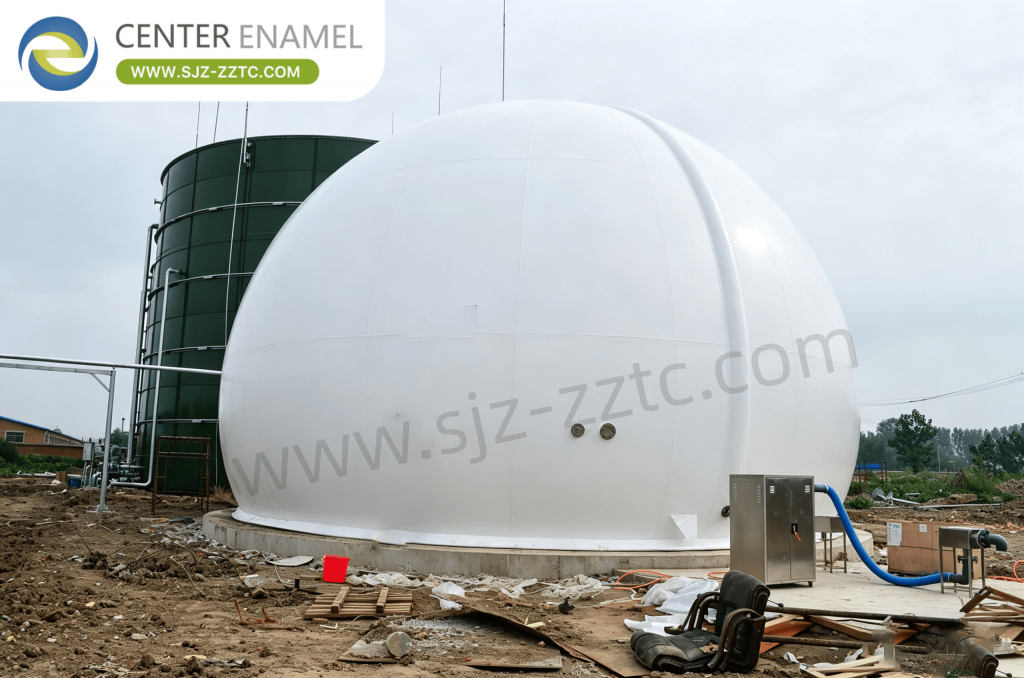
Within the process equipment landscape, CSTR (Continuously Stirred Tank Reactor) remains the mainstream anaerobic digestion process for treating livestock manure. After anaerobic digestion, manure produces biogas suitable for power generation or grid-injection purification, while digestate is processed into organic fertilizer for farmland application. Given the corrosive nature of manure treatment environments-characterized by high ammonia-nitrogen and high hydrogen sulfide levels-equipment selection becomes critical. This is where GFS tanks demonstrate their distinct advantage: with strong corrosion resistance and low maintenance costs, these tanks are widely used in manure treatment projects on large-scale farms across North America, Europe, and China, proving particularly suited to the demanding corrosive environments encountered in livestock waste processing.
Full-Process Factory Standardization for GFS Tanks
Building upon this industry landscape, the technical superiority of GFS tanks becomes clear. GFS tanks are fully factory-prefabricated to standardized specifications, ensuring finished product quality stability that far exceeds cast-in-place concrete tanks. In contrast, all concrete tank processes are completed in the open air, with rebar tying, concrete pouring, and curing heavily influenced by worker skill, temperature, and rainfall. Wall thickness, density, and strength vary significantly between batches, with hidden defects like honeycombing, voids, and insufficient wall thickness being common-quality simply cannot be uniformly controlled.
Center Enamel's GFS tank steel panels, seals, and reinforcement components are all mass-produced in automated factories. Steel stamping, high-temperature enameling, and dimensional cutting are all controlled by CNC equipment, with each panel's parameters and enamel thickness strictly following unified national standards. All components are uniformly packaged and transported to site, with assembly strictly following standardized construction drawings. Full-process quality inspection from raw materials to finished components ensures highly consistent product performance parameters, completely eliminating the uncontrollable quality risks of on-site concrete construction, with every tank delivering stable, consistent performance. This level of quality assurance is essential for any professional biogas plant project design seeking long-term reliability.
UASB Process Advantages in Biogas Plant Project Design
Complementing the structural integrity of GFS tanks, the UASB (Upflow Anaerobic Sludge Blanket) process offers exceptional biological treatment efficiency. No mechanical mixing equipment is required, with sludge suspension achieved through hydraulic action, resulting in very low overall energy consumption. High-concentration anaerobic granular sludge can be cultivated, providing high sludge concentration, strong activity, excellent settleability, low sludge washout, and low sludge yield-significantly reducing sludge disposal costs. The integrated design combines reaction, sedimentation, and separation simultaneously, with small footprint and moderate capital investment. The simple structure ensures low failure rates and convenient maintenance. High volumetric loading rates deliver excellent organic pollutant degradation efficiency and good shock load resistance. Stable biogas production with high resource recovery value makes this process particularly attractive. The process is mature and widely adopted, with well-established construction, commissioning, and O&M systems, making it suitable for large-scale industrial wastewater treatment. When combined with durable GFS tanks as reactor vessels, the UASB process achieves optimal performance in demanding industrial environments.
Livestock Wastewater Environmental Toxicity of Pollutants
Understanding the nature of livestock wastewater is essential for effective treatment system design. Fortunately, livestock wastewater contains no synthetic chemical toxicity and no hazardous substances, presenting very low risk of acute or chronic toxicity. Pollution impacts are primarily biological and nutrient-based. All pollutants are natural organics from livestock metabolites and feed residues, with no inhibition of microbial activity and no toxicity to soil, water, or aquatic organisms. However, these wastewaters are rich in nitrogen, phosphorus, and suspended impurities, carrying E. coli, parasite eggs, and pathogens. Direct discharge without treatment rapidly causes eutrophication, black-odor conditions, mosquito breeding, and disease transmission. Long-term discharge causes soil compaction and elevated nutrient levels in groundwater-persistent ecological pollution, but with no hazardous substance accumulation or carcinogenic/mutagenic risks. These characteristics make livestock wastewater an ideal candidate for anaerobic digestion, aligning perfectly with the objectives of modern biogas plant project design that transforms environmental liabilities into renewable energy assets.
Indonesia Palm Oil Biogas Project: A Benchmark Application
The practical value of combining professional design with high-quality GFS tanks is best demonstrated through real-world project examples. A landmark project in Indonesia was specifically designed for high-concentration palm oil wastewater treatment, featuring 3 GFS fermentation tanks, each 19.86 m diameter × 8.4 m height. Installation began in November 2009 with only 7 construction personnel, completing all tank assembly in 40 days-demonstrating remarkable efficiency and time savings. Tanks were fitted with dual-membrane gas storage covers for POME (Palm Oil Mill Effluent) anaerobic digestion, degrading organics and recovering biogas energy while eliminating palm industry pollution. This project stands as an early benchmark POME biogas treatment project in Southeast Asia, proving the viability of GFS tanks in challenging tropical environments and establishing a model for similar projects across the region.
Center Enamel's Core R&D Capabilities and Global Certifications
The success of global projects is underpinned by Center Enamel's robust R&D foundation. Technology R&D is Center Enamel's core competitive advantage. The company independently masters over 200 differentiated anti-corrosion enamel formulations, with full self-control over the enamel raw material chain, holding nearly 100 invention and utility patents. Products have passed NSF, WRAS, ASME, BSCI, CE, ISO9001, and other global certifications. Company certifications and honors include National High-Tech Enterprise, National Specialized and Sophisticated "Little Giant," Hebei Manufacturing Single Champion, Provincial Smart Factory, and Provincial Green Factory, along with complete environmental engineering and special equipment manufacturing compliance qualifications. The company maintains long-term collaborative research with multiple universities through joint materials laboratories-continuously iterating anti-corrosion coatings and large bolted tank structural design technologies. This proprietary material technology barrier creates an irreplaceable competitive advantage, with product performance comparable to high-end imported European and American storage equipment. This R&D excellence directly enhances every biogas plant project design undertaken by Center Enamel.
Full-Process Standardized Installation Quality Control
Beyond manufacturing excellence, Center Enamel demonstrates high-standard installation quality through long-term stable global project performance. The company has established full-chain quality control standards across four dimensions: factory protection, on-site assembly construction, completion inspection, and long-term warranty-ensuring quality control for every GFS tank. At the factory stage, all enameled panels, seals, and structural components receive rust-proof and moisture-proof independent packaging with dedicated protective supports-preventing damage during sea and land transport and avoiding enamel coating damage. On-site construction strictly follows unified assembly process specifications-panel by panel tightening and leak testing in layers, with air-tightness and verticality testing after each tank section completion. Dual-membrane covers and anaerobic piping undergo simultaneous pressure testing and acceptance. Differentiated quality acceptance standards are customized for different regions: EU/US projects follow stringent CE/NSF inspection criteria; Southeast Asian hot humid regions receive enhanced corrosion protection and sealing acceptance; remote African sites have additional foundation settlement re-inspection procedures. Upon project completion, complete construction inspection reports, pressure test records, and anti-corrosion appearance acceptance documents are issued, with full photo and video archives retained. Over 10,000 tanks delivered globally have operated long-term without large-scale leakage or structural deformation-preventing future O&M issues at source. These quality standards are integral to every professional biogas plant project design delivered by Center Enamel.
Frequently Asked Questions
Q1: What makes GFS tanks superior to concrete tanks for biogas plant applications?
GFS tanks offer superior corrosion resistance, consistent factory-controlled quality, and faster installation compared to concrete tanks. Unlike concrete structures that suffer from variable on-site quality and susceptibility to cracking in extreme environments, GFS tanks feature durable glass-fused coatings that withstand acidic biogas conditions for 30+ years with minimal maintenance.
Q2: What anaerobic processes does Center Enamel support in biogas plant project design?
Center Enamel provides design support for both CSTR (Continuously Stirred Tank Reactor) and UASB (Upflow Anaerobic Sludge Blanket) processes. CSTR is ideal for high-solids feedstocks like livestock manure, while UASB excels in high-concentration industrial wastewater treatment with low energy consumption.
Q3: How does Center Enamel ensure quality control for international biogas projects?
Center Enamel implements full-chain quality control from factory production to installation, including rust-proof packaging, standardized on-site assembly, region-specific acceptance criteria, and comprehensive documentation. Projects comply with international standards including ISO 9001, NSF/ANSI 61, and AWWA D103-09.