
High-Efficiency Biogas Power Plant Powered by Advanced GFS Tanks Solutions
The Asia-Pacific region, particularly China, has become the world's largest industrial wastewater treatment market, with the operation and maintenance service segment's contribution continuing to rise, marking a shift from project construction to long-term operational management. The North American market focuses on upgrading existing facilities, while Europe emphasizes high-value-added resource recovery technologies. Wastewater from the new energy industry chain (lithium batteries, photovoltaics, hydrogen) has become the most notable emerging growth area due to its complex composition and high treatment difficulty, generating significant demand for customized solutions. The maturity of third-party treatment models in industrial parks continues to improve, driving consolidation in the professional operation market. The Middle East has strong demand for advanced treatment and reuse of industrial wastewater due to water scarcity; manufacturing transfer in Southeast Asia drives local industrial wastewater treatment facility construction demand.
As regional industrial standards evolve rapidly across global markets, adopting reliable infrastructure has become a decisive factor for sustainable industrial growth. Establishing an advanced Biogas Power Plant allows facility operators to address tightening environmental compliance while simultaneously generating clean energy. By transforming organic waste streams into profitable power assets, modern industries successfully bridge regional regulatory demands with long-term ecological responsibility.
Supporting Equipment in CSTR Process
The core equipment is a vertical sealed anaerobic reactor tank, with Center Enamel GFS tanks as the mainstream choice for high-corrosion, high-viscosity wastewater conditions. The key operating equipment is a low-speed mechanical stirrer, comprising motor, gearbox, and impeller blades, achieving uniform mixing throughout the reactor and preventing sedimentation and crusting. Supporting equipment includes corrosion-resistant feed pumps, flow control valves, and inlet piping for precise feed flow control; biogas collection systems (piping, water seals, dual-membrane gas holders, desulfurization units) for biogas collection, purification, and storage. Online monitoring equipment for temperature, pH, and liquid level is integrated for real-time reaction parameter monitoring. Sludge discharge pumps, return piping, and emergency drain systems complete the equipment package, with convenient operation and maintenance, low failure rates, and support for long-term continuous stable operation.
Ensuring optimal biological reaction performance relies heavily on seamless equipment integration within the anaerobic reactor system. Incorporating high-durability GFS Tanks into the process line guarantees exceptional corrosion resistance and structural longevity under aggressive operating conditions. Every component—from low-speed mechanical stirrers to gas holders—works in perfect harmony to maximize operational reliability and energy yield.
Palm Oil Mill Effluent Standardized Treatment Solutions
Core treatment uses a mature train of "oil separation/cooling pretreatment + CSTR/USR anaerobic digestion + aerobic treatment + advanced treatment"—perfectly suited for POME's high-concentration, high-oil, high-temperature, low-pH characteristics.
Pretreatment: Raw POME first enters oil separation tanks/oil separators to remove free and dispersed oil—recovered palm oil can be sold as a resource, significantly reducing organic load. Cooling towers/heat exchangers reduce temperature from 60-80°C to 35-38°C for mesophilic anaerobic digestion. Lime/NaOH addition adjusts pH from 4.0-5.0 to 6.8-7.2 for optimal anaerobic conditions. Screens and sedimentation tanks remove fruit shell fibers, fruit pulp residues, and other large suspended solids to prevent distribution system and pipe clogging.
Main anaerobic treatment: Center Enamel CSTR or USR anaerobic reactors with GFS tanks as core reaction equipment, suited to POME's high-concentration, high-oil, high-suspended-solids conditions. CSTR mechanical mixing addresses oil floating layers, suspended solids sedimentation, and surface crusting—the three major challenges—ensuring thorough material-microbe contact. USR simplifies internal structure with anti-clogging, high-solids tolerance—suited for high-suspended-solids POME. Single GFS anaerobic tank effective volume 3,000-10,000 m³, with multiple tanks configurable for different mill capacities. Anaerobic digestion HRT 20-30 days, COD removal 80-90%, BOD removal 85-92%, with simultaneous large-volume biogas production.
Aerobic treatment: Anaerobic effluent still has COD 3,000-10,000 mg/L—requiring aerobic polishing. A/O, A²O, or SBR processes further degrade residual organics and remove nitrogen/phosphorus, reducing COD to 200-500 mg/L and BOD to 50-100 mg/L. Advanced treatment: Depending on discharge standards or reuse requirements, BAF, coagulation/sedimentation, sand filtration, or constructed wetlands reduce COD to below 100 mg/L and ammonia to below 10 mg/L for irrigation reuse or surface discharge compliance.
Biogas utilization: POME anaerobic digestion produces exceptionally high biogas yields—8-15 m³ biogas per m³ wastewater—after desulfurization and dehydration, biogas can be used for CHP, meeting 30-50% of mill electricity demand, with waste heat used for digester heating and FFB sterilization preheating—achieving energy self-sufficiency.
Addressing challenging industrial effluents like palm oil mill wastewater demands proven, large-scale engineering methodologies and specialized multi-stage treatment trains. Utilizing robust GFS Tanks within these systems effectively neutralizes high organic loads while powering a high-efficiency Biogas Power Plant. Consequently, agro-industrial processors achieve substantial energy self-sufficiency and superior environmental compliance.
Malaysia Palm Oil Biogas Project
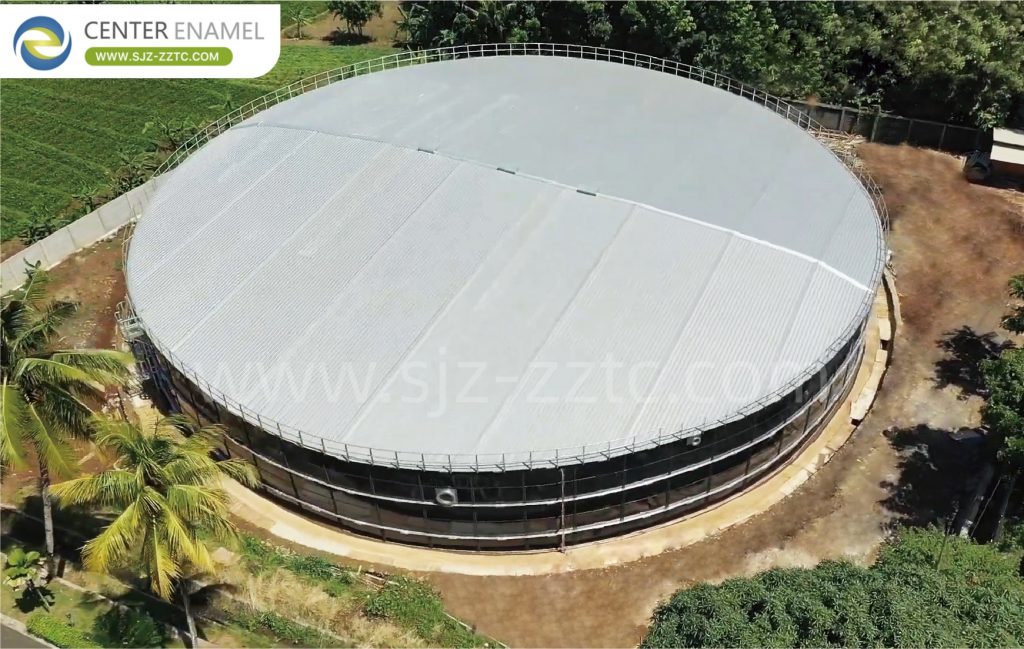
The project uses Center Enamel GFS tanks as the core anaerobic digestion facility with 5 tanks, each with effective volume of 5,400 m³, total effective volume 27,000 m². Influent COD ≥ 60,000 mg/L, BOD ≤ 25,000 mg/L. After anaerobic digestion, effluent COD drops to below 12,000 mg/L, BOD ≤ 5,000 mg/L—overall organic removal efficiency approximately 80%. Single tank daily biogas production 4,400 m³, total project daily biogas 22,000 m³—stable biogas yield of 0.45 m³ per kg COD removed—efficient biogas energy recovery while solving palm oil processing wastewater pollution.
Real-world benchmark implementations validate the remarkable performance of industrial anaerobic systems under demanding operational environments. Each successful project highlights how premium-quality GFS Tanks serve as the dependable backbone of a high-capacity Biogas Power Plant. These large-scale facilities successfully turn severe agro-industrial pollution into consistent, profitable renewable power ventures.
Global Integrated Standardized Service System
Leveraging regional sales centers in China and overseas local agent networks, Center Enamel has established a complete after-sales service loop covering all markets. The system provides four core service pillars: 24/7 rapid response mechanism, on-site domestic/overseas installation services, full-project-cycle after-sales support, and long-term warranty protection—forming a complete service chain from preliminary site survey, mid-term construction management, to long-term inspection and maintenance. The entire system is uniformly adapted to both domestic and international project service standards, coordinating personnel scheduling, material support, and on-site coordination for simultaneous projects across multiple regions—significantly reducing customer multi-party coordination costs and ensuring efficient domestic and overseas project delivery.
Delivering flawless project execution across international borders requires a comprehensive, standardized service network and meticulous lifecycle management. From initial site surveys to long-term maintenance, establishing a robust Biogas Power Plant demands expert coordination and uncompromised technical support. Trusted after-sales frameworks ensure that every installation maintains peak performance throughout its operational lifecycle.
Center Enamel Marketing Team
The marketing team brings together environmental industry multi-skilled professionals and multilingual foreign trade specialists, with deep expertise in global biogas, wastewater treatment, and biomass new energy markets—accumulating extensive practical project experience in Southeast Asia, Africa, Europe, and the Americas. The team is proficient in various countries' wastewater discharge regulations, biogas subsidy policies, and carbon trading rules—providing one-stop preliminary site survey, solution planning, and investment return analysis consulting services. With multilingual capabilities (English, French, Spanish, Arabic), the team effectively communicates with clients worldwide—precisely matching regional industrial resources, project budgets, and environmental requirements—customizing high-cost-performance GFS tanks and anaerobic reactor solutions based on client production capacity, treatment targets, and gas production expectations. Leveraging extensive overseas project experience, the team proactively helps clients avoid risks in overseas approvals, equipment import, and construction implementation—building a globally adaptable integrated environmental equipment business service system.
Navigating complex international regulatory frameworks and securing optimal financial returns require deep industry knowledge and professional consultation. When planning a new Biogas Power Plant, expert guidance ensures that every engineering parameter aligns with local environmental policies and subsidy structures. Professional technical consulting minimizes regulatory risks and accelerates project commercialization worldwide.
Aluminum Geodesic Dome Roof
Aluminum Geodesic Dome Roof independently developed by Center Enamel is manufactured using high-strength aluminum alloy plates through integral stamping. It features a triangular grid spherical self-supporting structure, enabling large-span full coverage without internal support columns. Made of aluminum alloy, the roof offers excellent weather resistance and corrosion resistance, capable of long-term protection against acid rain, salt spray, and UV radiation, suitable for various extreme outdoor climate conditions. The structural design complies with international AWWA D108 standards, with aluminum plate thickness, rib cross-sections, and joint connections all verified by finite element stress analysis, ensuring wind and snow load resistance that meets building code requirements across different global regions.
The weight of the Aluminum Geodesic Dome Roof is only one-third to one-half of a steel roof with the same span, significantly reducing the load on the tank top and allowing direct installation without tank wall reinforcement. The roof provides superior overall sealing performance, with double sealing between panels using specialized sealant strips and mechanical interlocking, enabling both airtight gas storage and enclosed odor control, suitable for biogas collection and storage, wastewater tank odor control, and drinking water contamination prevention. The support-column-free design does not interfere with the installation and operation of internal equipment such as mixers and water distributors. The aluminum material does not support microbial growth, requiring no anti-corrosion maintenance over long-term use, resulting in low total life-cycle costs.